
Muslims Projected To Outnumber Christians Worldwide By 2035
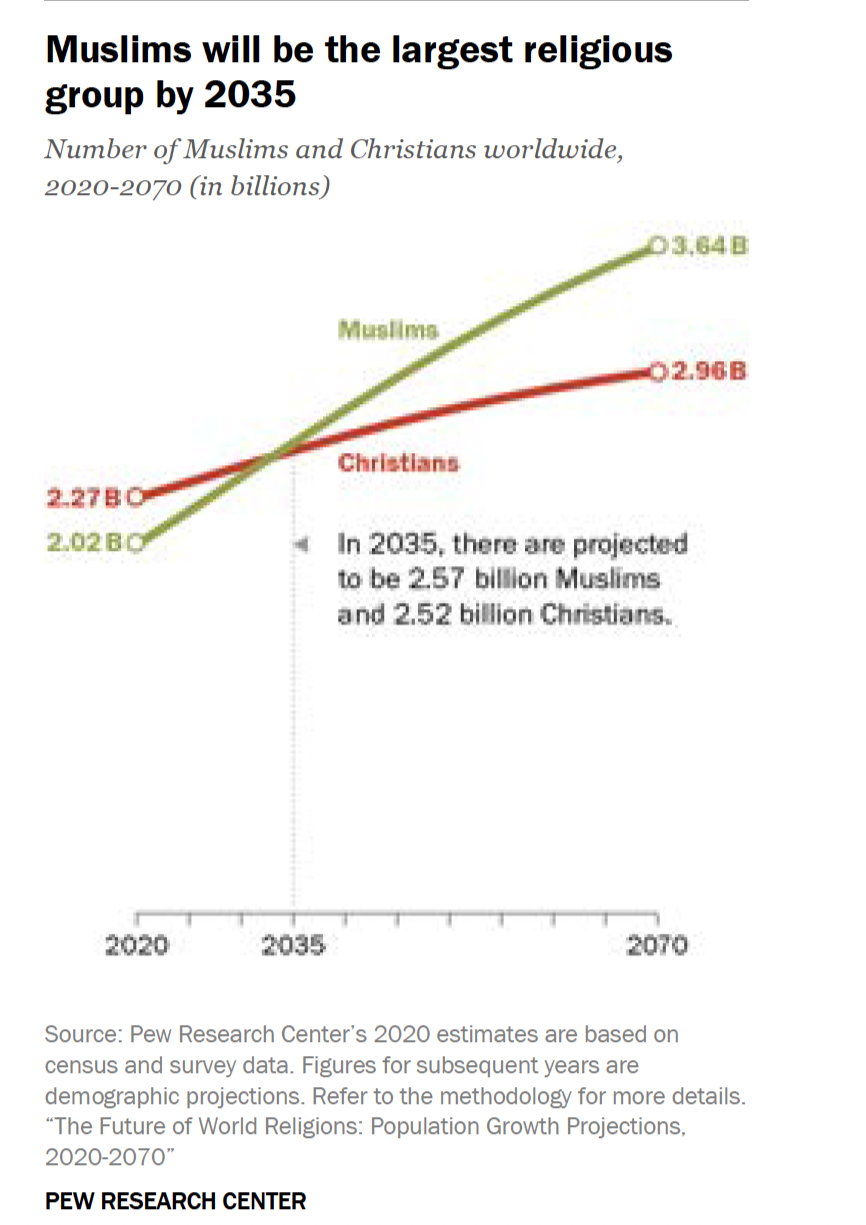
NEW YORK — Muslims are projected to become the world’s largest religious group by 2035 — surpassing Christians for the first time as shifting birth rates, population growth and religious affiliation reshape the global religious landscape, according to new projections from Pew Research Center.
The data indicates that both Christianity and Islam will continue to grow in absolute numbers over the coming decades. However, the Muslim population is expected to expand considerably faster. By 2070, the world could have more than 3.6 billion Muslims, compared with just under 3 billion Christians, if current demographic trends continue.
The findings are part of a comprehensive Pew Research Center study examining how the populations of seven major religious groups could change between 2020 and 2070. Researchers considered fertility rates, age distributions, mortality, religious conversion and migration patterns to estimate the future size and composition of religious populations.

The projections reveal that the changes will be driven largely by demographic differences between regions, particularly the rapid population growth expected in sub-Saharan Africa.
The world’s total population is expected to increase by 29% between 2020 and 2070. Muslims, the report said, are expected to grow by approximately 80% during that period, while Christians will increase by 30%. These are the only two major religious groups examined in the study projected to grow at or above the rate of overall global population growth.
“Both Christians and Muslims are going to continue to grow in number. It’s also true that there's very little net conversion in either direction. There’s no appreciable move of Christians into Islam or Muslims into Christianity,” said Alan Cooperman, Director of Religion Research at Pew Research Center. “And it’s furthermore the case that most of the growth of Christians that is projected will take place in countries that are already majority Christian. And similarly, the vast majority of the growth of Muslims in number that we project from 2020 to 2070 will take place in countries where Muslims are already in the majority.”
As a result, Muslims are expected to account for 36% of the world’s population by 2070, up from 26% in 2020. Christians, meanwhile, are projected to maintain a relatively stable share of the global population at approximately 29%.
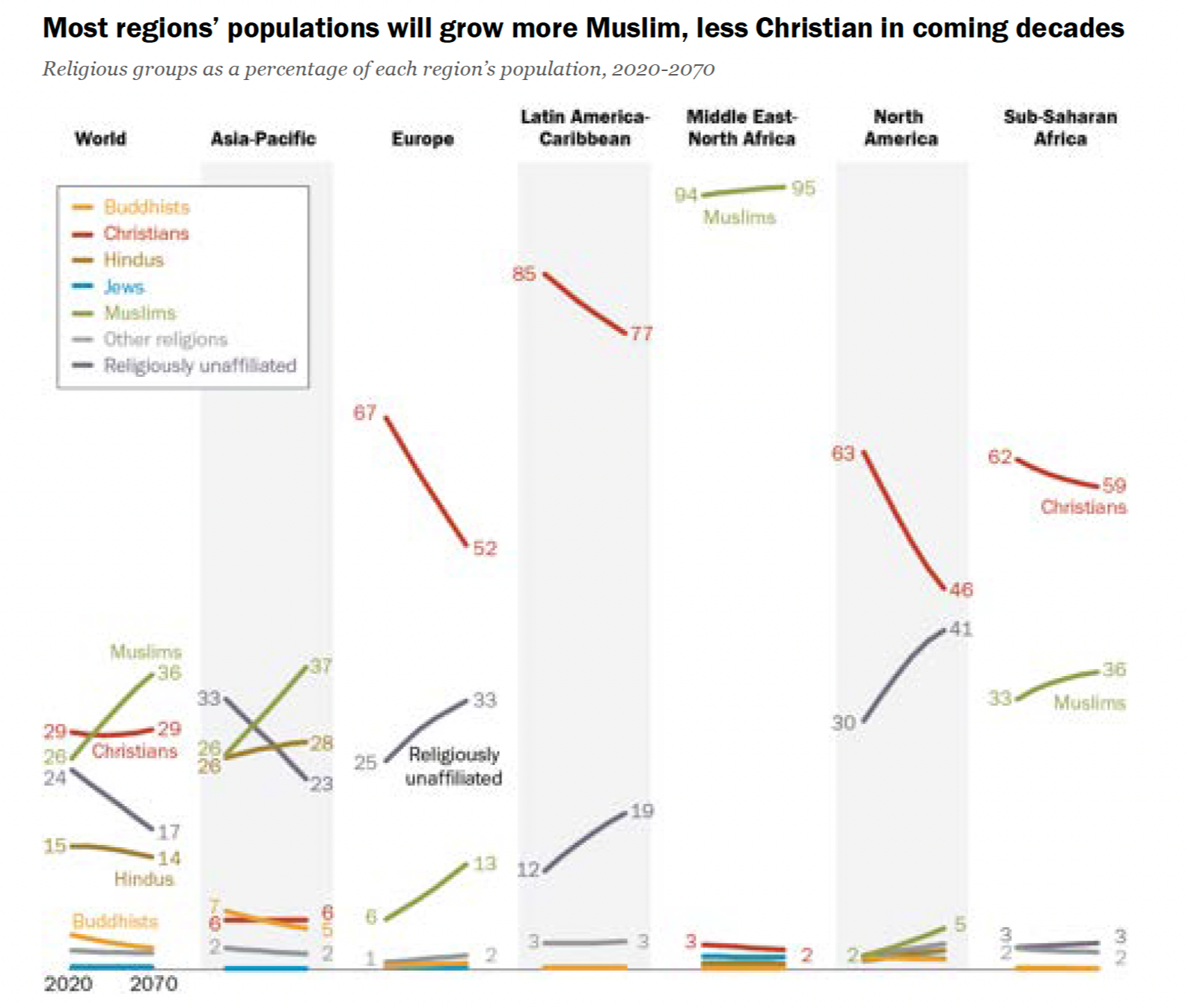
Overall, The study anticipates that Muslims will increase their share of the population in all six major world regions examined, while Christians will lose population share in every region except Asia and the Pacific.
“For all those reasons, I don’t think this is a situation in which the growth of Muslims is coming at the expense of Christians,” Cooperman said.
In Europe, for example, religiously unaffiliated people are projected to increase from approximately one-quarter of the population in 2020 to one-third by 2070. The Muslim share of Europe's population is expected to roughly double, rising from 6% to 13%.
In Asia, Muslims are projected to surpass religiously unaffiliated people as the largest religious group, while Hindus will become the second-largest.
Across Latin America and the Caribbean will continue to have the highest proportion of Christians of any world region. However, the Christian share is expected to decline from 85% in 2020 to 77% in 2070.
In the Middle East and North Africa, religious demographics are projected to remain relatively stable. Muslims are expected to account for approximately 95% of the population in 2070, compared with 94% in 2020.
Other religious groups are expected to experience different patterns of growth and decline. Although the number of Hindus and Jews will increase, both groups are projected to represent smaller percentages of the global population by 2070. Buddhists are expected to decline in both absolute numbers and as a share of the world's population.
Smaller religious communities, including Baha’is, Daoists, Jains, Sikhs and adherents of traditional folk religions, are projected to experience modest numerical growth. As a whole, these groups will account for less than 2% of the world’s population. The number of people who identify with no religious affiliation — commonly described as religiously unaffiliated or “nones” — is also expected to decline as a proportion of the globe’s population. Their share is projected to fall from 24% in 2020 to 17% by 2070.
Africa to drive population growth
One of the most significant factors behind the projected changes is the geographic distribution of population growth. Sub-Saharan Africa is expected to experience the greatest population expansion during the 21st century. By 2070, more than one-quarter of the world's population is projected to live in the region.
Since most people in sub-Saharan Africa identify as either Christian or Muslim, the region’s growing population will substantially increase the global numbers of both religious groups. The report considered Christianity as a monolith, not distinguishing between Catholics, Protestants and Orthodox.
The Pew study projects that more than half of all Christians worldwide will live in sub-Saharan Africa by 2070. An African nation, the Democratic Republic of the Congo, is also expected to surpass the United States as the country with the world's largest Christian population.
“I could see that that is something that Christian mission organizations will certainly wrestle with, and one can imagine a scenario where Christians in Africa might consider the mission field to be North America and Europe, places which were once known as bastions of Christianity,” said Conrad Hackett, senior demographer and associate director of research at Pew Research Center.
Muslims are projected to grow even faster than Christians in the region, increasing their share of the sub-Saharan African population from 33% in 2020 to 36% in 2070.
By comparison, Europe’s population is expected to decline. The continent's share of the global population will fall from 10% in 2020 to approximately 6% in 2070. These regional differences help explain why religious populations can grow globally even as their share of the population declines in individual countries.
Fertility rates shape projections
Differences in fertility rates are another major factor influencing the projections. According to Pew, Muslims have higher fertility rates than other major religious groups. Between 2020 and 2025, Muslim women had an average of 3.1 children, compared with 2.0 children per woman among non-Muslims.
Age distribution also plays an important role. Younger populations generally have more people entering or remaining within their reproductive years, creating greater potential for future population growth.
In 2020, the median age of Muslims worldwide was 24, nearly a decade younger than the median age of non-Muslims, which stood at 33. The combination of higher fertility rates and a younger population gives Muslims a demographic advantage that is expected to continue influencing global religious growth over the coming decades.
The projections suggest that several countries will experience substantial changes in their religious composition by 2070.
Pakistan is expected to become the country with the largest Muslim population, overtaking Indonesia, which currently holds that distinction. India and Nigeria are projected to follow Pakistan in the ranking.
India will continue to account for the largest Hindu population in absolute numbers, although Hindu populations are expected to grow more rapidly in some countries outside India, including the United States.
The Jewish population, meanwhile, is also expected to become increasingly concentrated in Israel. By 2070, approximately 62% of the world’s Jewish population is projected to live there, compared with 46% in 2020.
At the same time, the populations of China, Japan and South Korea are expected to shrink. Their Buddhist populations are projected to decline by more than half during the period covered by the study.
Christianity to lose majority status in the US
The United States is expected to experience significant religious changes in the coming decades — particularly a decline in the proportion of people identifying as Christian.
Christians accounted for approximately 63% of North America's population in 2020. By 2070, that figure is projected to fall to 46%, meaning the region will no longer have a Christian majority.
The United States is expected to follow a similar pattern. Christians will remain the country's largest religious group, but they are projected to make up less than half of the population by 2070.
Religiously unaffiliated Americans, meanwhile, are expected to increase to approximately 41% of the population.
Pew researchers attribute much of this anticipated change to religious switching, particularly the movement of Americans away from Christianity and toward no religious affiliation.
Christians in the United States have experienced greater losses than gains through religious switching. The unaffiliated population is also younger, on average, than the Christian population, giving it additional potential for growth over time. The projections further indicate that Jews, who were the country's third-largest religious group in 2020, could be surpassed by both Muslims and Hindus by 2070.
Population changes create unexpected global trends
Pew’s findings also highlight an apparent contradiction: Christians are projected to lose population share in many individual countries, yet their percentage of the global population is expected to remain relatively stable.
Similarly, religiously unaffiliated people are expected to increase as a share of the population in numerous countries, even as their overall global share declines.
Researchers explained that these trends are largely the result of population changes in a small number of countries and regions.
For Christians, rapid population growth in sub-Saharan Africa is expected to offset declines elsewhere, particularly in Europe. European Christians are projected to experience more deaths than births, alongside continued losses through religious switching.
For the unaffiliated population, China, a communist nation, plays an especially significant role. The country was home to approximately two-thirds of the world’s “nones” in 2020. Although 9-in-10 people in China are expected to remain religiously unaffiliated through 2070, the country’s overall population is projected to decline dramatically.
As a result, the number of religiously unaffiliated people in China is expected to decrease by approximately 361 million. That decline will outweigh projected growth of 180 million unaffiliated people elsewhere in the world, resulting in an overall reduction in the global population of “nones.”
Pew emphasized in its report that the findings are projections rather than certainties. They assume that current demographic patterns — including fertility, religious switching and migration — will continue at their current levels.
“I emphasize that we’re carefully working to extend recent patterns and talk about what the consequences of that would be,” Hackett said. “We’re not making predictions. We don't have a crystal ball.”
Clemente Lisi serves as executive editor at Religion Unplugged.