
Religious Freedom Faces Growing Pressures Worldwide
A sharp increase in religiously motivated harassment and violence pushed the number of countries dealing with high levels of social hostilities involving faith to its highest point in more than a decade, according to a Pew Research Center study released on Monday.
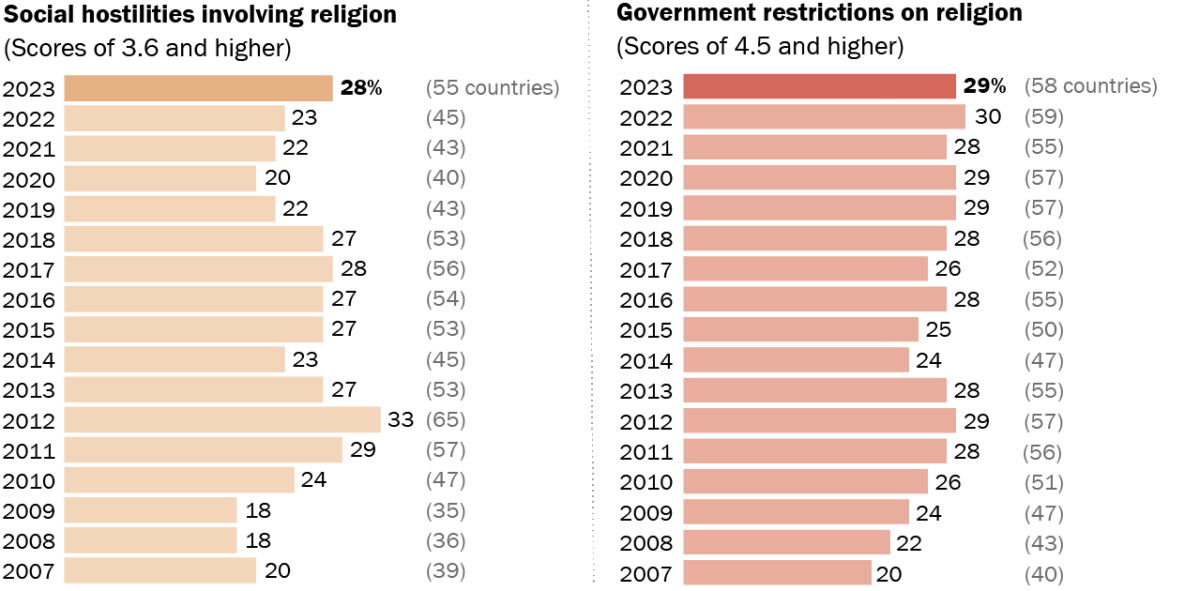
The report found that 55 countries recorded high or very high levels of social hostilities tied to religion in 2023 — an increase from 45 the previous year. Researchers cited growing harassment of religious minorities and the global fallout from Hamas’ Oct. 7 attack on Israel and the subsequent military campaign in Gaza as key drivers of this increase.
While the figure remains below the record high of 65 countries reached in 2012 in the aftermath of the Arab Spring, it marks a significant jump in a single year. Since many of the countries with the highest levels of restrictions or hostilities are among the world’s most populous — including China and India — approximately 78% of the global population now lives in places with “high” or “very high” levels of religious restrictions.
The Pew study examined conditions in 198 countries and territories, drawing on reports from the U.S. State Department, the United Nations and other international organizations.
Pew measures religious freedom using two indexes: The Government Restrictions Index, which tracks laws, policies and actions by governments that limit religious freedom, and the Social Hostilities Index, which measures religiously motivated harassment and violence carried out by private individuals and groups.
Government restrictions remained near historic highs, the report noted. Fifty-eight countries recorded high or very high levels of government restrictions on religion — down only slightly from the record 59 countries reported in 2022.
Countries with very high government restrictions included China, Iran, Afghanistan, Indonesia, Syria and Uzbekistan. Meanwhile, countries with very high levels of social hostilities included Nigeria, India, Israel, Syria, Bangladesh and Pakistan.
Although more countries entered the high-hostility category, the median SHI score remained unchanged at 1.6 out of 10 for the third straight year. Most countries continued to report low or moderate levels of social hostilities.
By contrast, the median score for government restrictions remained at a record-high 3.0, which adds to the long-term trend of increased government involvement in religious affairs since Pew first started tracking the issue in 2007.
12 nations go from ‘moderate’ to ‘high’
Twelve countries, meanwhile, moved from moderate to high levels of social hostilities in 2023, including Belgium, Norway, Russia, Spain, Sweden, the Democratic Republic of the Congo, Sierra Leone, Tanzania, Thailand, Turkey, Guatemala and Sudan. Two countries — Ethiopia and the Philippines — moved from high to moderate levels.
All continents were impacted by increases. In Spain, attacks on Jehovah’s Witnesses, anti-Muslim discrimination and a rise in antisemitic incidents following the Israel-Hamas war were factors in the country’s increase.
In Norway, where the SHI score jumped from 3.2 to 4.2 in 2023, there were cases of harassment of Jehovah’s Witnesses, Jews and Muslims. Jehovah’s Witnesses, for example, were the targets of repeated attacks in the Scandinavian nation. At the same time, Jewish and Muslim groups in Norway reported an increase in incidents after the 10/7 terror attacks and Israel’s response.
Russia’s score also rose after incidents — including an antisemitic mob protest at an airport in Dagestan — following the start of Israel’s war in Gaza.
Tanzania recorded increased attacks on individuals accused of witchcraft, while Thailand experienced growing violence linked to a long-running insurgency in its Muslim-majority southern region. Sudan’s worsening civil war led to damage to religious sites and houses of worship, contributing to one of the largest increases in social hostilities.
Government-led attacks
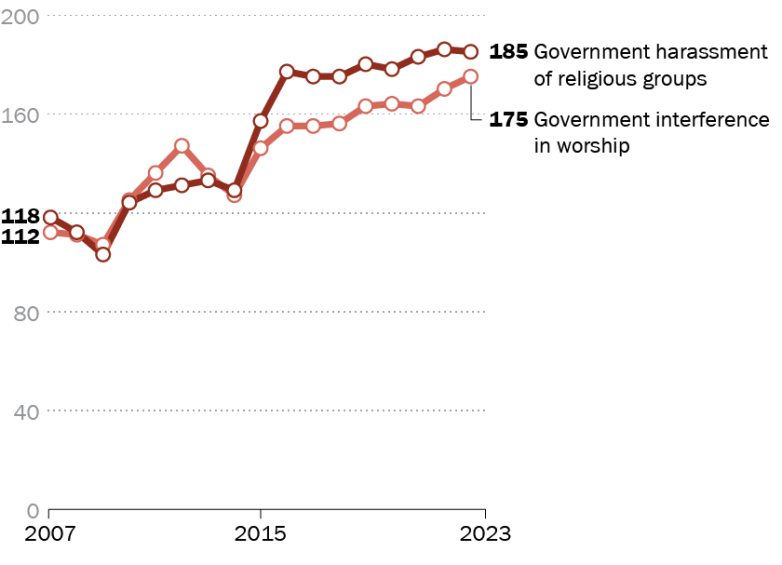
Government harassment of religious groups remained one of the most widespread forms of religious restriction, occurring in 185 countries (93% of those studied. Interference in religious worship reached a new high, occurring in 175 countries and territories. Such interference includes denying permits for places of worship, disrupting religious activities and restricting religious practices such as burial rites or conscientious objections to military service.
Detentions, including arrests and kidnappings, tied to religion occurred in 89 out of 198 countries — including by governments in 85 countries and by private individuals or groups in 24 countries.
People were detained due to their faith in 85% of the 20 countries in the Middle East-North Africa region, 60% of the 50 countries in the Asia-Pacific region, 50% of the 48 countries in sub-Saharan Africa, 23% of the 35 countries in the Americas and 22% of the 45 countries in Europe.
In Iran, which is grouped in Asia by Pew for this study, there were continued protests in 2023 after the September 2022 death in police custody of Mahsa Amini, a Kurdish woman who had been detained by the government’s morality police for how she wore her religious head covering. The U.S. State Department said at least 10 Kurdish Sunni clerics were sentenced to “imprisonment, exile, flogging and revocation of clerical status” because they spoke in support of widespread protests.
In Saudi Arabia, where the government has instituted some legal reforms such as lifting a ban on women driving, women still faced “restrictions on their religious freedom,” according to the U.S. Commission on International Religious Freedom. In addition, activists who had called for some of the changes were still in prison or faced harassment from authorities.
Clemente Lisi serves as executive editor at Religion Unplugged.