
Religious Freedom And The ICE Reckoning In Minnesota
(ANALYSIS) The recent events in Minnesota, and the responses they have generated across religious, political and civic communities, invite a deeper reckoning than much of the public commentary has so far allowed.
What is unfolding is not only a dispute about protest tactics or the boundaries of worship. It is a moment that presses us to ask what religious freedom is meant to sustain in public life, what religious responsibility requires of people and communities formed by faith, and whether our institutions still possess the spiritual imagination to hold sacred differences without defaulting to criminalization or retreat.
In this moment, the American public is increasingly formed to draw ever tighter boundaries and enforce ever stricter purity tests — tests aligned less with shared moral responsibility than with preexisting political, religious or cultural affinities. Public life is approached not as a shared moral ecology but as a series of discrete incidents to be adjudicated, condemned, or defended in isolation.
This narrowing of vision reflects a deeper spiritual brokenness: a loss of formation in practices that cultivate patience, moral imagination and responsibility for institutions that endure beyond any single controversy.
When public life is reduced to tactics, alignment and boundary maintenance, we fail to reckon with the long erosion of the spiritual and institutional conditions that made such fragmentation feel not only inevitable, but righteous.
“ At stake is a more fundamental question of religious freedom: Who has the authority to define the boundaries of worship?”
The First Amendment offers a useful starting point — not as a list of legal permissions, but as a framework of public justice grounded in a sacred understanding of the human person. It assumes that human beings are created with conscience and moral agency, accountable to an authority that precedes and exceeds the state.
It recognizes that we gather not merely for efficiency or shared interest, but for formation, through religious and civic institutions that shape responsibility and orient our common life toward what we hold to be sacred.
It protects public speech because ultimate commitments cannot be confined to private belief, and because a just public order depends on moral witness not authorized by government. And it safeguards the right to petition because political authority is penultimate — real and necessary, but limited — and must remain open to challenge when it seeks to constrain the rights and responsibilities that flow from humanity’s ultimate source of meaning.
In this way, the First Amendment does not merely protect religious practice; it assumes it, recognizing that these freedoms are inseparable from the spiritual formation of a people.
Freedom of religion belongs within this constitutional constellation not as a private exemption from public life, but as a public good essential to it. It cannot be disentangled from the freedoms of speech, assembly, and petition, because conscience and faith are formed and expressed in relationship — through communities, practices, and institutions that carry responsibility beyond the self. The public expression of spiritual commitments is not a distortion of democratic life; it is one of the conditions that sustains it.
For Christians, religious freedom is not an abstract principle but a condition for faithful communal life. In the book of Exodus, the Hebrew midwives — Shiphrah and Puah — refuse Pharaoh’s command to turn birth into an instrument of state control. Their resistance takes place at the moment life is formed, revealing a fundamental limit on political authority: The state does not govern the sources of moral life itself. The midwives act as individuals, but they do so within a shared moral and spiritual practice that sustains a people over time.
In this way, they foreshadow the Gospel, in which God enters history not through decree or force, but through birth, vulnerability and embodied care — and in which communities formed around that truth inevitably come into tension with powers that claim ultimacy.
This pattern continues today. When government seeks to narrow the space in which religious communities can live out their callings — particularly in works of formation, care and moral witness — it is not merely regulating behavior, but constraining the communal conditions through which conscience is born and sustained. Institutional religious freedom exists to protect that work, ensuring that faith is not reduced to private belief but allowed to take institutional shape in public life.
Colin Lloyd/Unsplash photo
Minnesota and the question before us
The questions raised by religious freedom today are not theoretical. They are unfolding in real congregations, under real political pressure, with concrete consequences for how religious communities are permitted to inhabit public life.
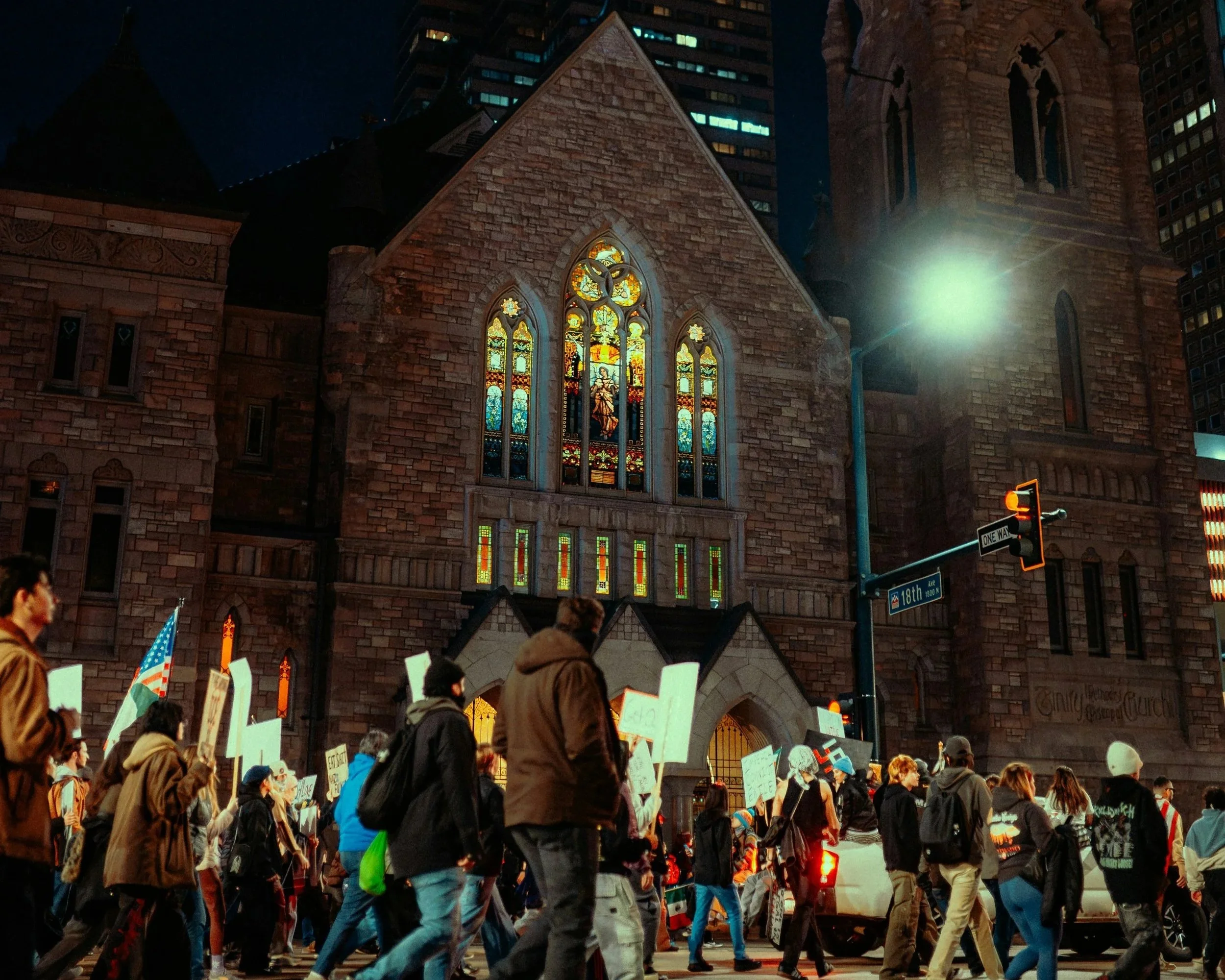
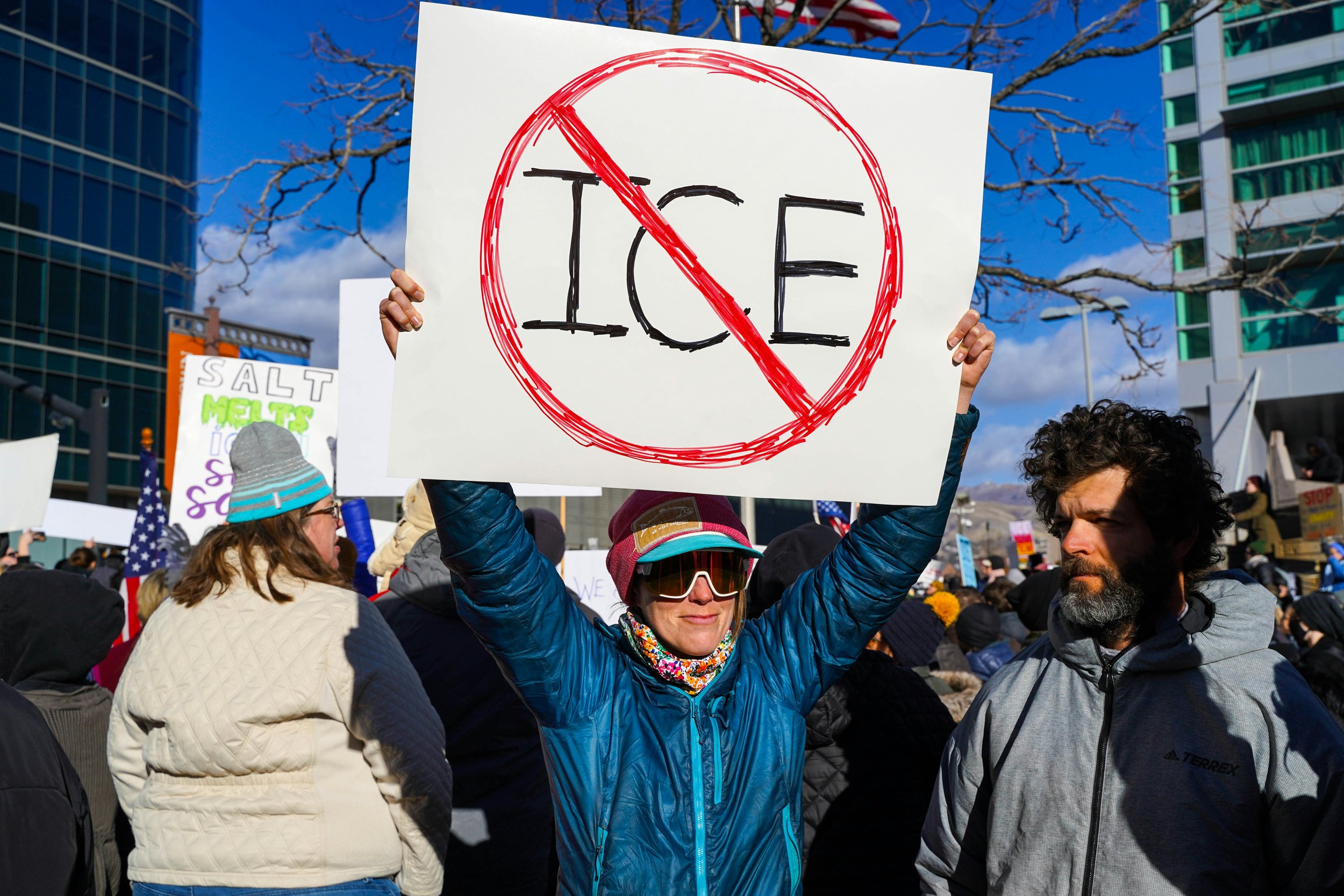
On Jan. 18, protesters disrupted a worship service at Cities Church in St. Paul, Minnesota, not as a generalized protest against immigration policy, but in response to what they understood as an institutional entanglement between the church and federal immigration enforcement.
Activists targeted the congregation because a pastor affiliated with the church was allegedly a senior official with U.S. Immigration and Customs Enforcement. They connected that dual role to the killing of Renee Good during an ICE operation earlier that month. Federal authorities later charged several individuals under laws protecting access to places of worship, including the federal Freedom of Access to Clinic Entrances Act.
What followed is equally telling. As Stateline has documented, lawmakers in multiple states — including Oklahoma, Alabama, Idaho, Ohio, and South Dakota — moved swiftly to introduce or pass legislation increasing penalties for disrupting worship services, expanding buffer zones around houses of worship and elevating certain offenses from misdemeanors to felonies.
These measures were presented as direct responses to the Minnesota incident, framed as necessary safeguards for the integrity of worship against political disruption. Yet the speed and near-uniformity with which they emerged signal something deeper than concern over protest tactics alone.
At stake is a more fundamental question of religious freedom: Who has the authority to define the boundaries of worship, and whether religious communities retain protected space for their most elemental expressions of faith — devotional prayer, sacramental life, and communal worship — without those practices being subsumed or policed by an increasingly polarized civic order.
Yet these tensions cannot be resolved through legislation alone. For Christian communities in particular, the question is not simply how to shield worship from disruption, nor how to justify protest, but how to discern what religious freedom is for. Religious freedom exists to sustain the spiritual-ethical life of faith as it is borne by institutions and communities over time — the practices of worship, formation and discernment through which people are rooted in the sacred and oriented toward how life is to be lived.
It is not simply a protection for individual belief, but the condition that allows a diverse tapestry of religious and spiritual nonprofits and institutions to inhabit public life with depth, integrity, and distinctiveness, each shaped by its own devotional and ethical grammar. When government action tightens legal boundaries without attending to this formative institutional life, worship risks being treated as a contained space to be managed rather than as a living sacred ecology that forms perception, restraint and moral imagination across traditions.
What this moment requires, then, is spiritual-ethical discernment and institutional imagination together: Discernment about how communities remain deeply rooted in the sacred while refusing both the politicization of the sanctuary and the hollowing out of faith into something ethically inert or publicly mute.
Responsibility is not risk avoidance
If religious freedom is to mean more than the protection of private belief or uninterrupted worship, then it must be capacious enough to hold difference not only across traditions, but within them. Public life shaped by religious and moral formation depends on communities and institutions that can sustain varied forms of presence — speech, assembly, petition, protest, hospitality and quiet endurance — without demanding that they all look the same or occur in the same way.
The challenge before us is not to decide which single mode of engagement is correct, but to recover a thicker account of responsibility: one that recognizes that shared life is carried forward through differentiated roles, shaped by circumstance, relationship and the particular forms of bearing that each person or community is able to sustain.
Yet much of the response to Minnesota has moved in the opposite direction. Responsibility has been framed as restraint — choosing not to escalate, not to disrupt, not to enter contested space. The underlying assumption is that public life is healthiest when disturbance is minimized and when shared commitments are expressed only through the least costly means. This framing treats responsibility as a matter of individual risk management, rather than as a shared, formative practice that unfolds over time.
The scriptural witness offers a different orientation. Responsibility is not uniform, and it is not assigned in the same way to everyone who belongs to a people. It emerges instead through attentiveness to time, place, role, and capacity — through a recognition that shared life is sustained not by identical actions, but by differentiated forms of bearing.
Rizpah’s story in 2 Samuel 21 makes this visible with particular clarity. After her sons are executed and their bodies left exposed “on the mountain before the Lord” by royal decree (2 Sam. 21:9), Rizpah does not respond by appealing directly to authority or organizing collective action. She does not speak in public assemblies or issue demands.
Instead, she takes sackcloth and remains beside the bodies “from the beginning of the harvest until rain fell on them from the heavens” (2 Sam. 21:10). Day and night, she guards them — driving away birds and wild animals — refusing to allow their deaths to be absorbed into silence or erasure.
“In a pluralistic public life shaped by religious and spiritual formation, responsibility is not about identifying the one correct response and measuring everyone against it. ”
Rizpah’s action is public, but it is not interchangeable. It arises from her position, her loss, her capacity to remain, and the particular form of presence that only she can sustain. What she bears is not something that can be delegated or replicated.
Others in Israel will act differently; the king will respond differently; the institutional repair that follows will take another shape altogether (2 Sam. 21:11–14). Responsibility here is not a single act that everyone must perform. It is a shared unfolding, made possible by distinct roles held together across time.
This matters for how we think about protest, advocacy, petition, and assembly in our own moment. A decision by one person or community to engage in a particular form of public action does not establish that same action as necessary or even appropriate for another, even when they share a spiritual or ethical tradition. Responsibility is not transferable in that way. It depends on external circumstances, relational location, capacity and the forms of presence a given person or institution is actually able to sustain.
In a pluralistic public life shaped by religious and spiritual formation, responsibility is not about identifying the one correct response and measuring everyone against it. It is about discerning what forms of engagement strengthen or thin the communal and institutional spaces that allow shared life to endure. Some will assemble. Some will petition. Some will protest. Some will remain, quietly and visibly, refusing disappearance. None of these exhaust the field of responsibility, and none can be absolutized without doing harm.
Christian tradition has long lived within this differentiated understanding. Public witness has not depended on uniform action, but on communities capable of holding diverse forms of participation without collapse — churches that sustained prayer while others marched, households that sheltered while others spoke, institutions that bore strain so that others could act more freely. The work was not identical, but it was held together.
This is why responsibility cannot be equated with retreat, but neither can it be reduced to a single mode of public engagement. It is shaped by formation, by relationship, and by the willingness of institutions to make room for varied expressions of faithfulness without demanding sameness.
In a pluralistic society, this understanding of responsibility is inseparable from religious freedom. It depends on the freedom of communities to discern, to differ, and to remain publicly present in ways responsive to circumstance rather than governed by fear or enforced conformity. Responsibility, in this sense, is not about choosing the least risky path. It is about bearing what one has been given to bear, for as long as shared life requires it.
Yasmin Peyman | Unsplash
Religious freedom as communal and institutional
Religious freedom is often described as freedom from interference. But it is equally freedom for formation and witness. It protects the ability of individuals and communities to cultivate moral imagination together and to act publicly in ways that reflect their deepest commitments.
This is why protest — while not the only or always the most effective form of engagement — has a legitimate place within a Christian account of religious freedom and responsibility. Protest can function as lament when institutions fail, as intercession when suffering is ignored, and as embodied truth-telling when ordinary channels of redress prove insufficient. Historically, protest has emerged not from political theater, but from communities formed by shared moral vision and sustained spiritual practice.
To defend religious freedom, then, is not merely to defend one’s own preferred expressions. It is to defend the freedom of others to engage public life according to conscience — even when we disagree with their conclusions or methods. In a pluralistic civil society, religious freedom requires moral humility, forbearance, and a willingness to live with tension rather than resolve it prematurely through force.
These tensions come sharply into focus when protest intersects with houses of worship.
There is broad agreement that people should be able to worship without fear, coercion or harassment. Sacred space matters. Liturgical life matters. Communities must be able to gather for prayer and sacrament without intimidation. Existing laws against trespass and disorderly conduct already recognize this and provide mechanisms for addressing genuine disruption.
But sacred space has never meant insulation from moral urgency. In Jewish and Christian traditions, sanctuary has often meant refuge for the vulnerable and resistance to unjust power. Churches have sheltered immigrants, protected those fleeing violence, and served as sites of moral formation and public witness precisely because they understand themselves to be accountable to a higher authority than the state.
“The question Minnesota leaves us with is whether religious freedom will be treated as a narrow tool of control or reclaimed as a constitutional commitment to sustaining plural religious institutions ... ”
This dual vocation complicates efforts to resolve current conflicts through blunt legal instruments alone. As Stateline reports, critics across ideological lines have raised concerns that new laws expanding buffer zones and criminal penalties around houses of worship may be overly broad, vaguely defined and unnecessary given existing legal protections. Such laws risk chilling lawful expression — especially on public sidewalks and in other traditional public forums long protected by the First Amendment.
From a Christian perspective, this is not merely a legal concern but a moral one. A church that claims sanctuary only as a shield from public moral claim risks forgetting its own history and vocation. At the same time, a protest that disregards the formative and pastoral dimensions of worship risks instrumentalizing sacred space rather than honoring it.
Holding these truths together requires more than law. It requires moral formation within the complexities and nuances inherent to the Christian tradition itself.
Minnesota has revealed how thin our working account of religious freedom has become. It is often invoked only at moments of disruption, as a mechanism for containment or defense, rather than understood as the condition that allows religious institutions to exist as formative presences in public life at all.
Religious freedom was never meant to resolve conflict by sealing worship off from the world, nor to legitimate every public claim made in its name. It exists to preserve space for institutions of faith to carry out practices of worship and formation over time, and to inhabit public life without being absorbed by the state or reduced to private belief.
When that institutional purpose is lost, law is left to manage tensions it cannot meaningfully address, and public life is reduced to boundary enforcement rather than shared moral life. The question Minnesota leaves us with is whether religious freedom will be treated as a narrow tool of control or reclaimed as a constitutional commitment to sustaining plural religious institutions capable of shaping public life without domination or retreat.
Chelsea Langston Bombino is a believer in sacred communities, a wife and a mother. She serves as a program officer with the Fetzer Institute and a fellow with the Center for Public Justice.