
Who Is Telling The Truth About American Religion?
(ANALYSIS) OK, I guess it’s time to write the post that I’ve been dreading for a long time because I don’t know how it’s going to be received.
Be warned — this one is super nerdy and goes very deep into the weeds of survey methodology. I want this newsletter to be really accessible to the average American, but I think it’s helpful every once in a while to pull back the curtain on stuff that I see in the data that just doesn’t sit right with me.
Let me start by showing a simple data point: the share of the public who says that they have no religious affiliation.
But I’m going to give you that figure across six different surveys that I can find strewn all over the internet. They include the Cooperative Election Study, the Pew Research Center, the Nationscape Survey, the Public Religion Research Institute survey, the General Social Survey and the Gallup Survey.
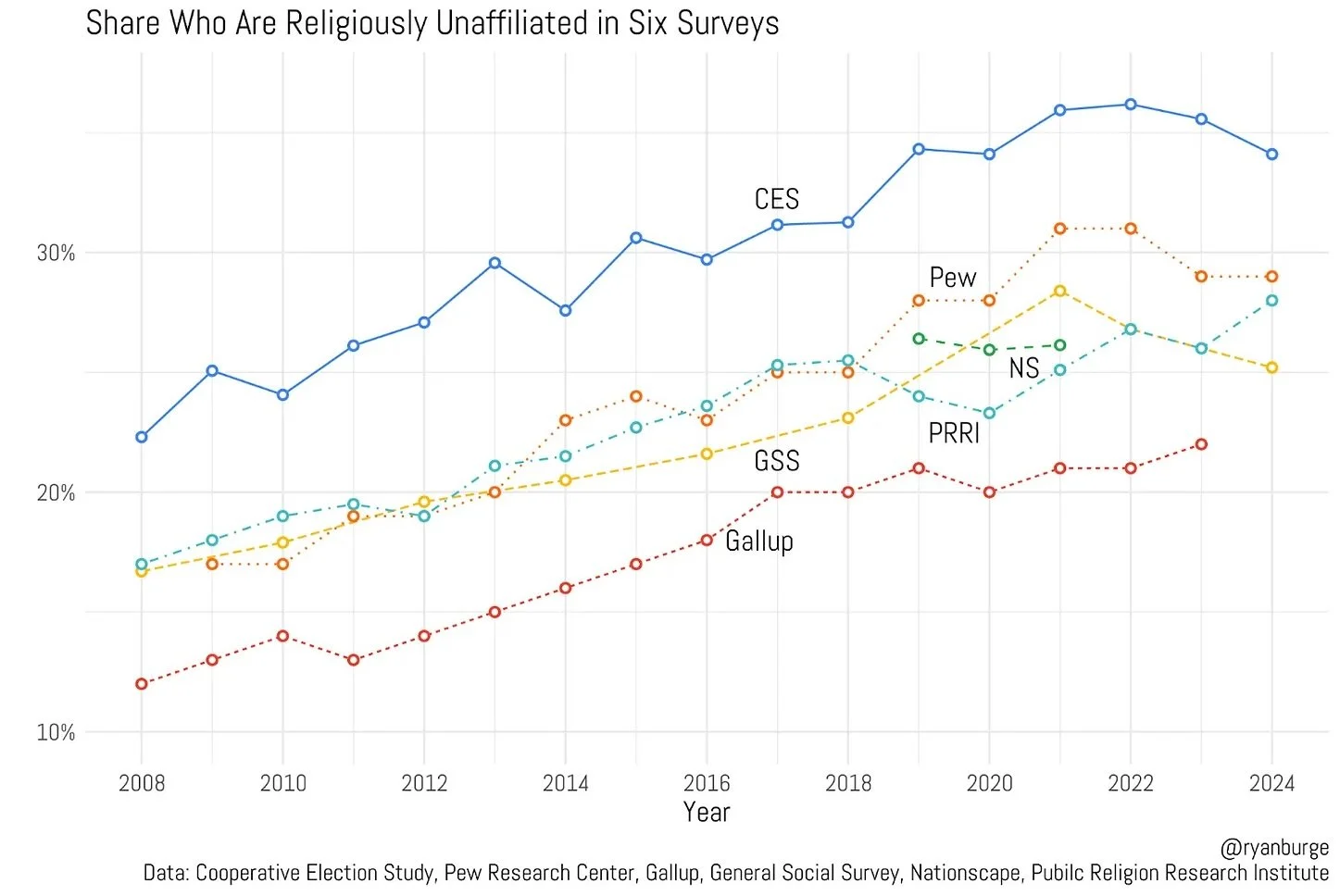
Here’s what they all basically agree on — the share of Americans who are non-religious has been increasing over the last fifteen years.
That’s just undeniable, no matter what instrument you look at. But here’s where they disagree: the actual percentage of nones in the United States. And these differences aren’t small, either.
Here are five estimates of the share of nones in 2024:
CES: 34%
Pew: 29%
PRRI: 28%
GSS: 25%
Gallup: 22%
If you use the CES estimate, the number of nones in the United States is about 115 million. If you use the Gallup statistic, it’s about 75 million. That’s a difference of 40 million people — basically the population of the state of California.
These surveys, which all use different methodologies, different questions, and different response options, lead to widely different conclusions about the actual share of non-religious Americans.
I actually wrote a paper about this a few years ago, making the case that the GSS figure is too low: How Many “Nones” Are There? Explaining the Discrepancies in Survey Estimates.
You can read the rest of his post on Substack.
Ryan Burge is an assistant professor of political science at Eastern Illinois University, a pastor in the American Baptist Church and the co-founder and frequent contributor to Religion in Public, a forum for scholars of religion and politics to make their work accessible to a more general audience. His research focuses on the intersection of religiosity and political behavior, especially in the U.S. Follow him on X at @ryanburge.