
America’s Freedom Born From Faith: The Liberty Bell And Its Moral Foundations
PHILADELPHIA — The Liberty Bell occupies a singular place in the story of the United States. It is an object that has transcended its physical form to become a symbol of freedom and national identity.
As the country approaches the 250th anniversary of its founding, the cracked bell invites renewed reflection not only on the political events of the American Revolution but also on the religious ideas that shaped those events. Its inscription, its origins in Pennsylvania’s Quaker culture and resonance with Judaism together reveal how faith traditions and religious freedom contributed to the ideals that brought about the American experiment.
Cast in 1752 for the Pennsylvania State House (now known as Independence Hall), the Liberty Bell bears an inscription from the Hebrew Bible: “Proclaim LIBERTY throughout all the Land unto all the Inhabitants thereof.” This line, from Leviticus 25:10, is a verse describing a time when debts were forgiven, land was returned, and enslaved people were set free.
READ: How Georgia’s Legacy Was Built On Religious Diversity
In its original context, it represented a radical reset of social and economic relationships, rooted in the belief that ultimate ownership belongs to God and that human societies must periodically restore justice and balance.
The decision to place this verse on the bell was not a coincidence. In the mid-1700s, Pennsylvania had been deeply shaped by Quaker beliefs, and the colony’s founders were steeped in biblical language. For Jewish readers then and now, the verse carries profound significance: It is part of a broader ethical framework emphasizing justice, compassion and communal responsibility. The presence of this Hebrew verse on a civic object in colonial America reflected the extent to which the Bible — filtered through Protestant interpretation — helped to inform public life.
Rabbi Lance J. Sussman, rabbi emeritus of Reform Congregation Keneseth Israel in Elkins Park, Penn., noted that the Liberty Bell “holds special fascination for American Jews, especially those of us who live in Philadelphia.”
“I have long maintained that the fact that the verse is from the Torah, and not the New Testament or Greco-Roman literature, adds spiritual accessibility to the bell’s symbolic value for many American Jews,” he added.
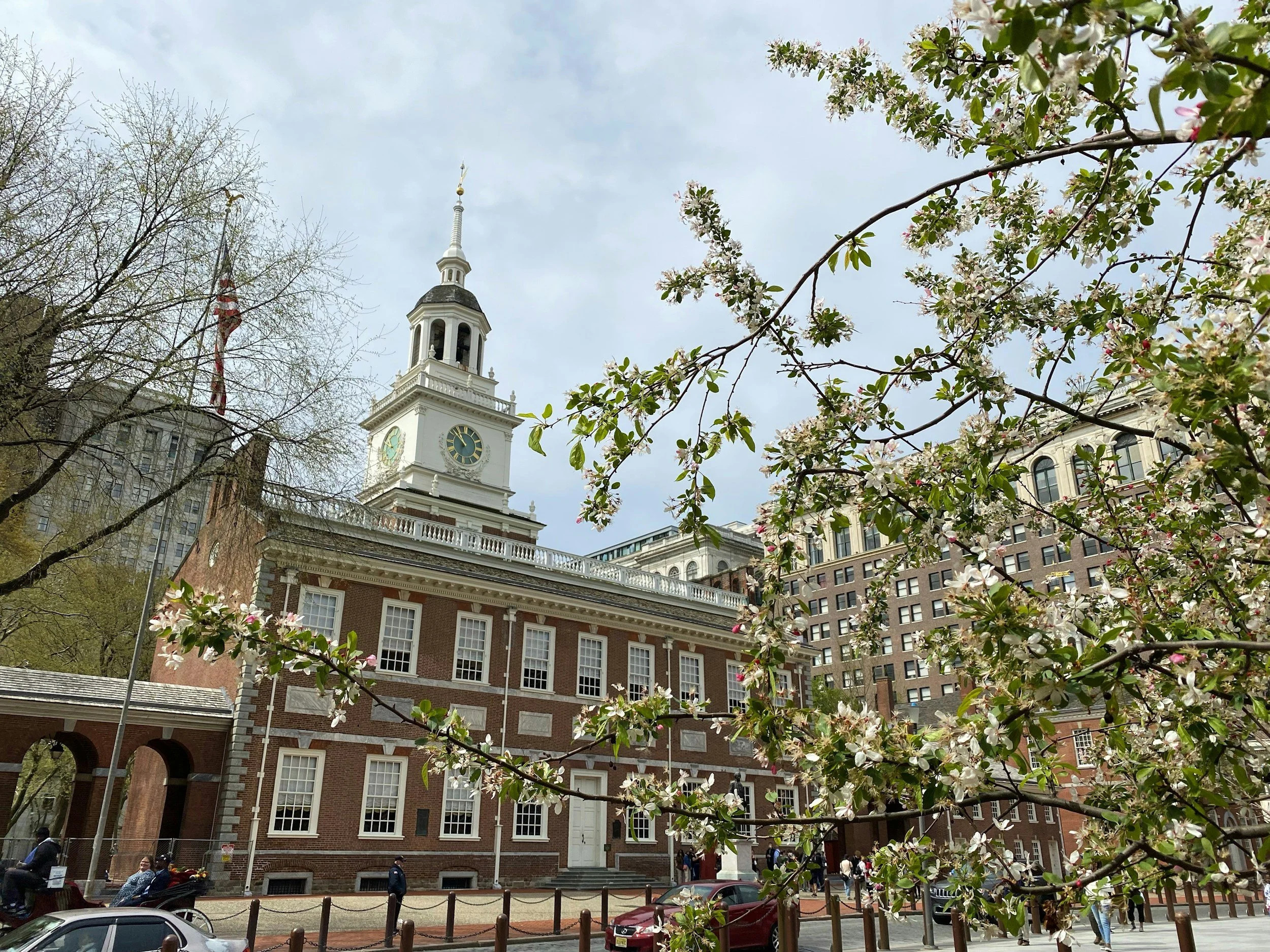
Independence Hall in Philadelphia (Unsplash photo)
Quakers, formally known as the Religious Society of Friends, played a central role in Pennsylvania’s founding and governance. Established in 1671 by William Penn as a “holy experiment,” the colony was intended to demonstrate that a society grounded in religious tolerance and moral equality could thrive.
Quaker theology emphasized the “inner light,” a belief that every person carries a divine spark. This conviction led Quakers to advocate for equality in ways that were unusual for the time, including fair dealings with Native Americans, opposition to slavery and a commitment to peaceful conflict resolution.
These principles had tangible political consequences. Pennsylvania also became a haven for religious minorities, including Jews, who found in the colony a degree of acceptance rare in the 18th-century.
While Jewish communities in colonial America were relatively small, their presence in cities like Philadelphia contributed to a broader culture of pluralism. The Liberty Bell’s inscription, drawn directly from a Jewish sacred text, can be seen as a symbolic bridge between traditions and an acknowledgment of a shared morality.
As tensions with Great Britain escalated starting in the 1760s, the language of liberty increasingly took on both political and spiritual dimensions. Colonists framed their grievances not only in terms of taxation and representation, but also as violations of natural rights endowed by God. Sermons, pamphlets and public speeches of the era often invoked the Bible, casting the struggle against British rule in terms reminiscent of the Exodus story.
In fact, the Liberty Bell was commissioned by the Pennsylvania Assembly to celebrate the 50th anniversary of a remarkable document, Penn’s “Charter of Rights and Privileges,” issued for the citizens of the state in 1701.
It provides for “Liberty of Conscience,” declaring: “No People can be truly happy, though under the greatest Enjoyment of Civil Liberties, if abridged of the Freedom of their Consciences, as to their Religious Profession and Worship.” It is therefore wrong to “prejudice” Pennsylvania citizens due to religious belief.
“This document was one of the factors that made Philadelphia, the ‘City of Brotherly Love,’ a true melting pot from early on,” according to a 2013 blog post in The Times of Israel written by Joella Klinghoffer, a freelance writer and certified Philadelphia tour guide. “It was once the only city in the English-speaking world where Catholic Mass could be openly conducted. And of course, the Jews had their congregation, Mikveh Israel, where prayers went according to Sephardic liturgy, but Yiddish was often spoken.”
Within this broader religious context and the fight against Britain, the bell’s message acquired new meaning. Though there is no historical evidence that it rang on July 4, 1776, to announce the adoption of the Declaration of Independence, it nonetheless became retrospectively associated with that moment.
Even the very notion of “proclaiming liberty” resonated powerfully with a population seeking to define itself as free and self-governing. At the same time, the bell’s inscription provided a moral framework that extended beyond immediate political concerns, suggesting that liberty was not merely a right to be claimed but a responsibility to be enacted.
Later, during the 19th century, the Liberty Bell was adopted by abolitionists, who saw in its inscription a clear mandate to end slavery. Jewish and Quaker activists alike drew upon the same verse to argue for emancipation, demonstrating the enduring power of this shared religious heritage.
Starting in the late 1800s, the Liberty Bell traveled across the country, stopping in various places. For a nation recovering from the wounds of the Civil War, the bell served to remind Americans of a time when they fought together for independence.
As the United States marks 250 years since its founding, the Liberty Bell stands as an enduring symbol that the nation’s ideals were forged not only in political debate but also in religious reflection. The influence of Judaism, mediated through Quaker belief and colonial culture, helped articulate a vision of liberty that was both aspirational and deeply rooted in moral tradition.
Clemente Lisi serves as executive editor at Religion Unplugged.