
How Georgia’s Legacy Was Built On Religious Diversity
ATLANTA – Known as The Big Peach, Atlanta is often described as a city of reinvention — rising from the ashes of the American Civil War to become a modern hub of culture and commerce. But the city’s deeper story is tied to currents that began long before its skyline took shape.
To fully understand Atlanta, you have to look beyond its highways and glass towers, back to the broader history of Georgia and its unusual role during colonial America. In that earlier era, a quiet but consequential force — religious diversity — helped shape a mindset that would eventually contribute to the movement for independence in 1776.
Atlanta, it should be noted, did not exist at the time of the American Revolution. The city was founded in 1837 as the terminus of the Western & Atlantic Railroad. Originally known as “Terminus,” it was renamed Marthasville in 1843, and finally Atlanta in 1845. Today’s Atlanta is a gateway to the American South.
READ: Jamestown Marks Where America Began In Hardship And Faith
The neighborhoods are as varied as the people who live in them: The historic charm of Inman Park, the artistic pulse of Little Five Points and the energy of Midtown. Visitors might start at the Martin Luther King Jr. National Historical Park, where the legacy of slavery and later the Civil Rights Movement is preserved in powerful detail. Yet even as Atlanta feels unmistakably modern, its spirit is rooted in a long tradition of pluralism and resilience.
That tradition dates back to the founding of Georgia in 1733, when James Oglethorpe established the colony as a sort of social experiment. Unlike most of the other British colonies, Georgia was conceived not only as a buffer against Spanish Florida, but also as a place where debtors and the “worthy poor” could start anew. From the beginning, it was shaped by a mix of idealism and pragmatism — and crucially, by a relatively open attitude toward religious practice.
While not entirely free of restrictions (Catholics, for example, initially faced limitations due to political tensions with Spain), Georgia became home to a range of religious communities. Lutheran Salzburgers, Jews, Anglicans and later Methodists and Baptists all found a home. Today, 67% identify as Christians – 33% of whom are evangelicals and 14% members of historically Black congregations.
“From its founding in 1732 throughout the 18th century, Georgia was a place of both religious tolerance and religious pluralism,” noted Joel Nichols, a law professor and vice dean at the University of Alabama Law School. “Georgia’s Royal Charter provided for liberty of conscience for all, and for the free exercise of religion by all except Roman Catholics. The charter did not establish the Church of England or any other church.”
The Church of England would later be established by law in 1758, but it was, in practice, a “weak establishment with little real ecclesiastical presence,” Nichols added.
Establishing a church at at time, specifically as a result of the Church Act of 1758, mandated the public tax funding for Anglican churches, while creating a parish system that blurred the lines between church and local government.
Between the American Revolution and 1800, the new State of Georgia had three constitutions (1777, 1789 and 1798), “each of which explicitly addressed religion and provided for varying levels of free exercise (including liberty of conscience) and disestablishment,” Nichols said.
As a result, congregations formed side by side, each bringing distinct traditions and worldviews. In Savannah, one of the oldest Jewish congregations in North America, Congregation Mickve Israel, took root as early as the 1730s. This diversity was unusual in a colonial world where many settlements were dominated by a single denomination.
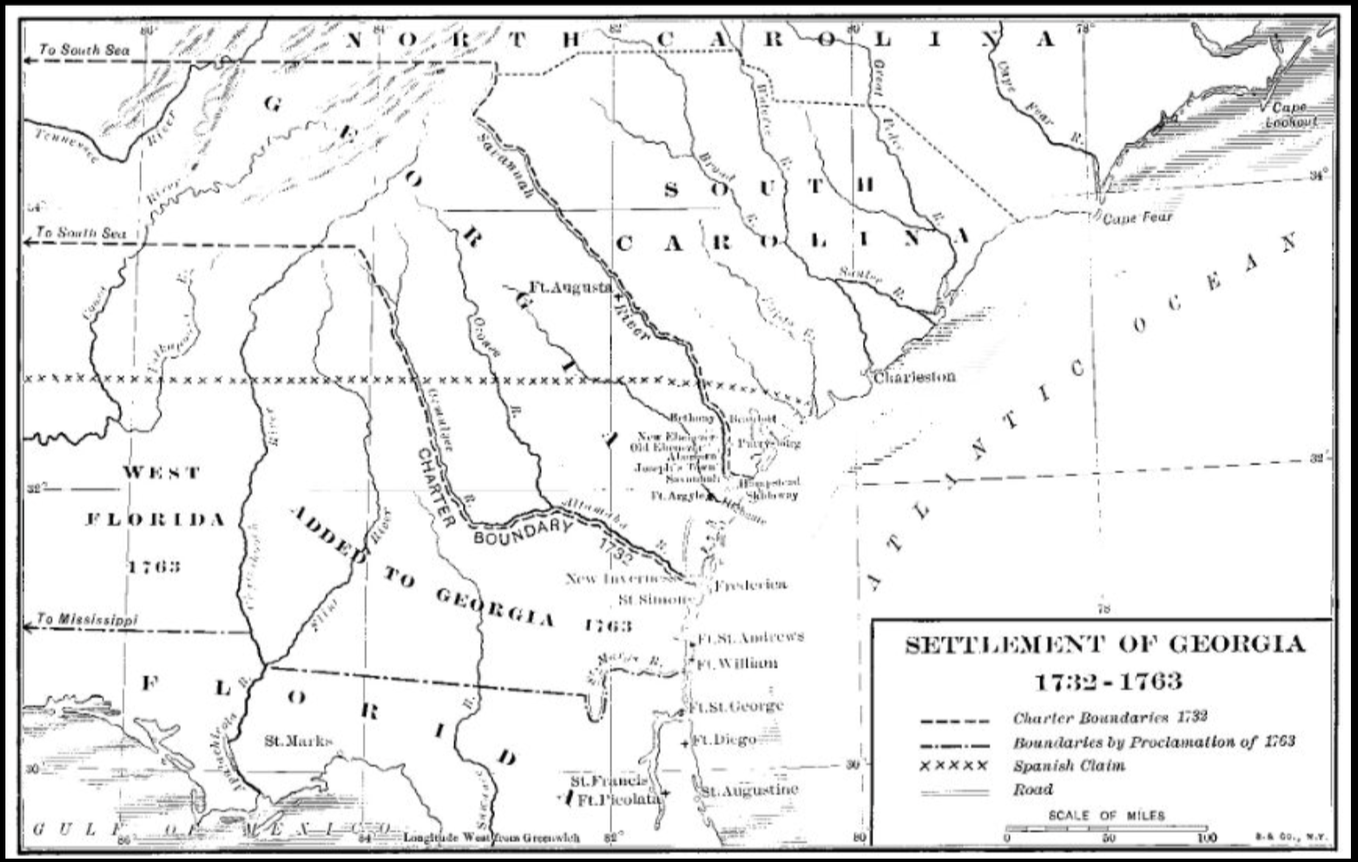
A map from 1905 showing Colonia Georgia. (Wikipedia Commons photo)
The result was not perfect harmony, but it did encourage a kind of practical tolerance. No single religious group could easily dominate public life, and, like in the other colonies, cooperation became a reality. Over time, this fostered habits of negotiation and coexistence — skills that would prove invaluable as tensions with Britain escalated in the mid-18th century.
“This admixture of religious adherents was welcomed — indeed, invited — to the new territory,” Nichols said. “And the various worshipers were not asked to conform to, nor required to support, the Church of England, but instead received governmental funding and support for their own endeavors.”
By the 1760s and ‘70s, the American colonies were grappling with questions of British rule, representation and broader rights. In Georgia, those debates unfolded in a society already accustomed to balancing differences. Religious pluralism had subtly reinforced the idea that authority should not be absolute and that individuals as well as communities should have a voice in their governance. These were not purely theological concerns, but political ones as well.
When resistance to British policies began to grow — sparked by measures like the Stamp Act — Georgia was initially more cautious than some of its northern counterparts. Its economy and security were closely tied to Britain, and loyalty remained strong among the colonists. But the same diversity that had once required compromise also made it difficult for any single loyalist perspective to prevail. Gradually, support for resistance expanded.
By the time of the American Revolution, Georgia had joined the other colonies in challenging British rule. Representatives from the colony participated in the Continental Congress, and three Georgians ultimately signed the Declaration of Independence. The path there was not straightforward, but it was shaped in part by the colony’s earlier experience with diversity — religious and otherwise — which had encouraged a broader conception of rights and self-determination.
For travelers to Atlanta today, this history is not always immediately visible, but it lingers in subtle ways. The city’s identity as a crossroads of cultures, ideas and beliefs echoes those early colonial dynamics. You can see it in the variety of places of worship scattered across the city and its metro area, from historic churches to mosques and synagogues, each contributing to the city’s evolving story.
A visit to the Atlanta History Center offers a deeper dive into these layers of the city’s past, connecting the colonial era to the Civil War and beyond. Meanwhile, a four-hour trip to Savannah reveals the physical spaces where Georgia’s early racial and religious diversity took shape, like old congregations that have witnessed two centuries of change.
What makes Atlanta compelling is not just its attractions, but its continuity. The same openness that characterized colonial Georgia continues to define the region. It is a place where differences meet, where negotiation is part of daily life and a place whose colonial past informs the present.
Clemente Lisi serves as executive editor at Religion Unplugged.