
Crossroads Podcast: Is Faith In Space OK Now?
In 1968, the three Apollo 8 astronauts, while the world focused on their Christmas Eve effort to orbit the moon, read the opening verses of Genesis, beginning with: “In the beginning God created the heaven and the earth. And the earth was without form, and void; and darkness was upon the face of the deep. And the Spirit of God moved upon the face of the waters. And God said, Let there be light: and there was light.”
What happened next, upon their return to Earth, played a crucial role in this week’s “Crossroads” podcast, which focused on mainstream media coverage of NASA’s recent flyby of the moon. The Religion News Service headline noted: “Faith has always gone to space. Artemis II shows how much it has changed.”
What changed, and why? Here is a crucial part of that story:
That broadcast prompted a lawsuit from atheist activist Madalyn Murray O’Hair, who argued it violated the First Amendment’s establishment clause. Although the U.S. Supreme Court eventually threw out the case due to “want of jurisdiction” — presumably referring to space — historians have long argued the lawsuit had a lasting impact on NASA, as astronauts were effectively discouraged from openly engaging in worship or religious activity during a mission.
Many point to Buzz Aldrin, who celebrated Communion on the moon shortly before walking out onto the lunar surface, but waited more than a year before commenting on the moment publicly.
However, a “Crossroads” listener emailed me with an interesting question: There was quite a bit of talk about faith, including Christianity, during the Artemis II news coverage — before, after and even during that mission. Why didn’t the God-talk cause as much controversy this time?
During the podcast, I noted that the legal context of the 1968 controversy was crucial. The Apollo 8 mission took place only a few years after Engel v. Vitale, the historic U.S. Supreme Court decision that said official, scheduled prayers in public schools were a violation of the separation of church and state. That controversy lingered for years, with many states or local school districts challenging the ruling.
Prayer wasn’t the only hot-button issue. For a decade or more, church-state activists — on both sides — challenged what schools could or could not say about whatever role that God played, or did not play, in creating this planet and the universe.
In other words, fights about what many called “Creationism” were common in American life. Whatever their intentions, three Christian astronauts reading the most famous creation verses from Genesis offended some of the key warriors in the era’s church-state warfare.
What was different about the Artemis II mission? Early on, the RNS story noted:
… [M]oments before the crew would enter into roughly 40 minutes of radio silence as they passed behind the moon, the voice of astronaut Victor Glover — who has been open about his Christian faith and worships at Churches of Christ congregations in Texas — crackled over the broadcast channel to offer a message of love.
“As we continue to unlock the mysteries of the cosmos, I would like to remind you of one of the most important mysteries there on Earth — and that’s love,” said Glover. “Christ said, in response to what was the greatest command, that it was to love God with all that you are. And he also, being a great teacher, said this: ‘I give you equal to it, and that is to love your neighbor as yourself.’”
To be blunt about it, Glover reminding listeners to “love your neighbor as yourself” was a message that threatened fewer listeners than three astronauts — looking down on Planet Earth from space — reading a biblical account of the creation of all things.
In his Religion Unplugged summary of news coverage of Artemis II, my former GetReligion.org colleague Bobby Ross, Jr., discussed his own Zoom interview with Victor and Dionna Glover for The Christian Chronicle. The veteran astronaut and his family are active at Southeast Church of Christ in Friendswood, Texas, near the NASA Space Center.
After returning home, Glover appeared on The Christian Chronicle’s podcast and offered this memorable soundbite: “In the military, there’s a saying that there are no atheists in foxholes. There aren’t any on top of rockets, either, I would think.”
In terms of timing, it’s important to remember that the 10-day Artemis II mission overlapped with both the Western Christian celebration of Easter and the Jewish Passover. In terms of Islam, the season of Ramadan had just ended — which was mentioned during Artemis II press coverage.
Also, Canadian astronaut Jeremy Hansen wore a patch on his uniform with symbolic references to faiths in Indigenous communities. RNS noted that the Canadian government verified that it was designed by Anishinaabe artist Henry Guimond with nods to “Seven Sacred Laws, a traditional First Nations teaching” and the Artemis II making a journey around “Grandmother Moon.”
However, the RNS report — with good cause — noted that:
Much of the God-talk on the Artemis mission has centered on Glover, who is also the most publicly religious astronaut on the mission. He reportedly brought a Bible along with him for the 10-day journey in space, which is something he’s done before: He told The Christian Chronicle in 2020 that he had a Bible and Communion cups sent to the International Space Station in preparation for his arrival aboard a Space X capsule in November of that year. …
NASA officials did not offer a direct response when asked by Religion News Service if Glover or other Artemis II astronauts have made special arrangements to worship while aboard the Orion capsule. But Glover did offer some public religious reflection while hurtling toward the moon over the weekend, when CBS reporter Mark Strassmann asked him to comment on the journey’s overlap with Easter.
“When I read the Bible and I look at all of the amazing things that were done for us who were created, it’s you have this amazing place, this spaceship. You guys are talking to us because we’re in a spaceship really far from Earth, but you’re on a spaceship called Earth that was created to give us a place to live in the universe and the cosmos,” Glover said.
He added that whether listeners “believe in God or not, this is an opportunity for us to remember where we are, who we are, and that … we got to get through this together.”
At another pre-launch event a journalist asked the Artemis II team about the Easter timing for their mission.
Reid Wiseman, Artemis II’s commander, and the two other astronauts — Christina Koch and Jeremy Hansen — all glanced over to Glover, who said something inaudible that sparked a chuckle among the group.
Wiseman then stepped forward and acknowledged the legacy of Apollo 8, gearing his answer to a multireligious audience.
“We have our own different opinions, our own individual opinions and our own individual beliefs,” he said, gesturing to his fellow astronauts. “I think that’s one of the best parts about this mission right now: As we have said from the beginning, we really are for all, by all, and we want to take the whole world along with us.”
If there was any controversy after the mission, it centered on speculation — in social media — that the mission led to a radical change in Wiseman’s beliefs. Basically, one emotional moment on splashdown day was interpreted as a conversion experience.
Here is one typical Instagram post on that topic.
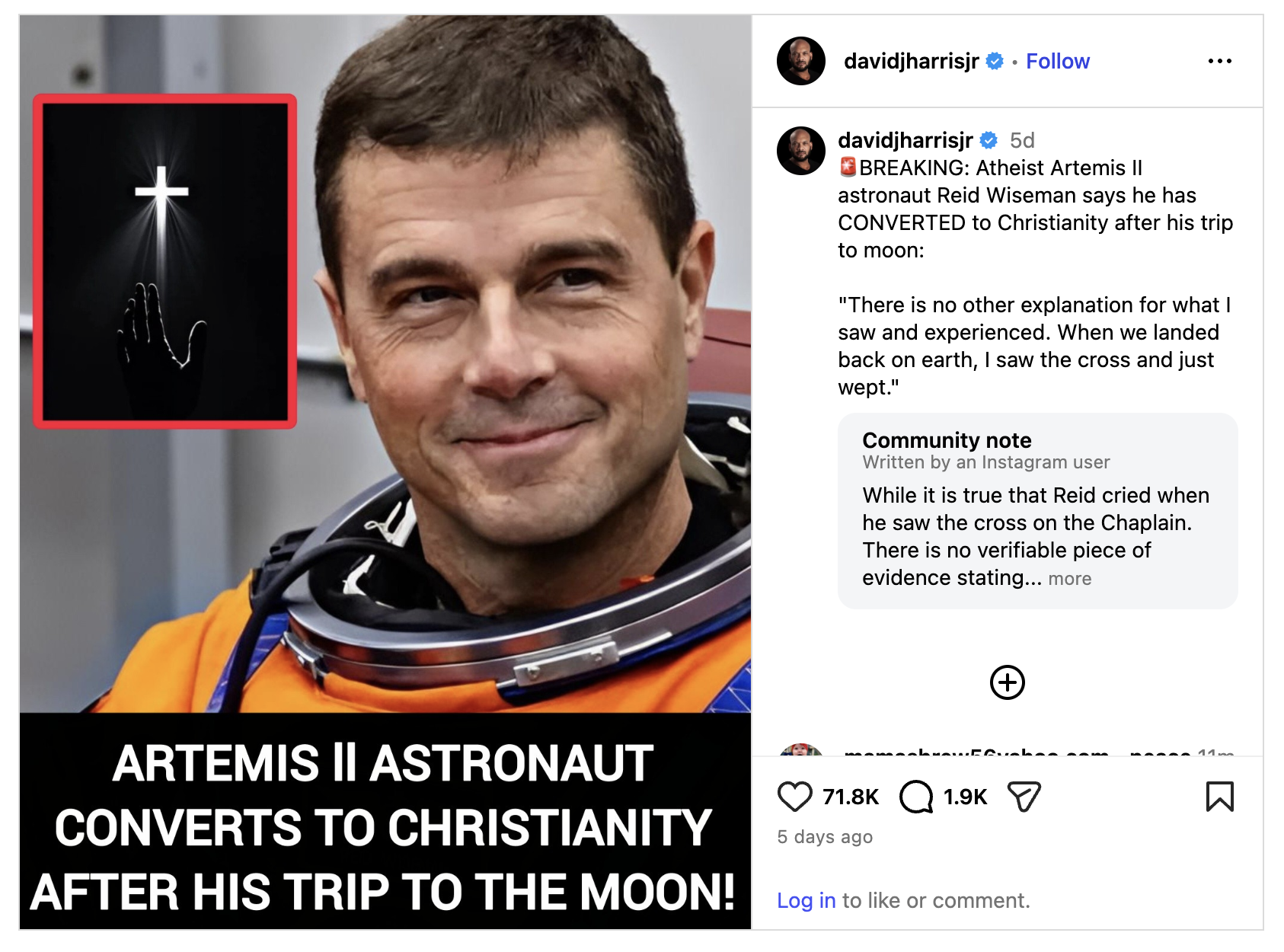
Image via Instagram
The liberal fact-check website Snopes published the following information in its takedown of commentary on what was clearly an emotional moment, one that Wiseman has not discussed at length.
The Snopes post noted that the conversion rumor was linked to:
… a real exchange beginning at around the 8:47 mark of the Artemis II crew’s first news conference after returning to Earth. In that exchange, Wiseman was asked whether the mission had given the astronauts a profound shift in consciousness similar to what Apollo 14 astronaut Edgar Mitchell once described.
In response, Wiseman said: “I’m not really a religious person,” and then explained that after returning to the ship he asked for the chaplain to come visit. When the chaplain arrived, Wiseman said, he saw the cross on the chaplain’s collar and “broke down in tears.” He added that it was still hard to fully grasp what the crew had just experienced and that they had not yet had much time to reflect because the week after return had been filled with testing, doctors and scientific evaluations.
Glover was quoted as saying that what the crew experienced was a sense of awe. He added that, “I am a religious person, but everything else is the same.”
Snopes interpreted that as evidence that Wiseman’s tears were not evidence that he “had just embraced Christianity.”
Enjoy the podcast and, please, pass it along to others.