
The Afterlife Isn’t Going Away: ‘Do You Believe People Have A Soul’
(ANALYSIS) One thing I am always probing the edges of is how deeply religion is embedded in each one of us. There’s a saying that bounces around the sociology of religion: “you may be done with religion but religion is not done with you.”
I really like how Daryl van Tongeren describes this phenomenon: Religious residue. You may not have gone to church in a decade and have no plans of raising your kids in a religious household, but there are probably parts of your psyche that are still impacted by religious concepts and frameworks.
I think that the idea of the afterlife is one of those things. It seems pretty common to reject the idea of Moses parting the Red Sea or to question whether Jesus died and actually resurrected. Lots of folks cast serious doubts on those types of miraculous events.
But then when surveys include questions about concepts like having a soul and what happens to your existence after you die, that religious residue reemerges, and you can see that lots of Americans do tend to have some type of supernatural belief.
Pew added this little battery of questions to their Religious Landscape Survey that probed these general concepts, and I thought I would poke around those ideas in today’s post.
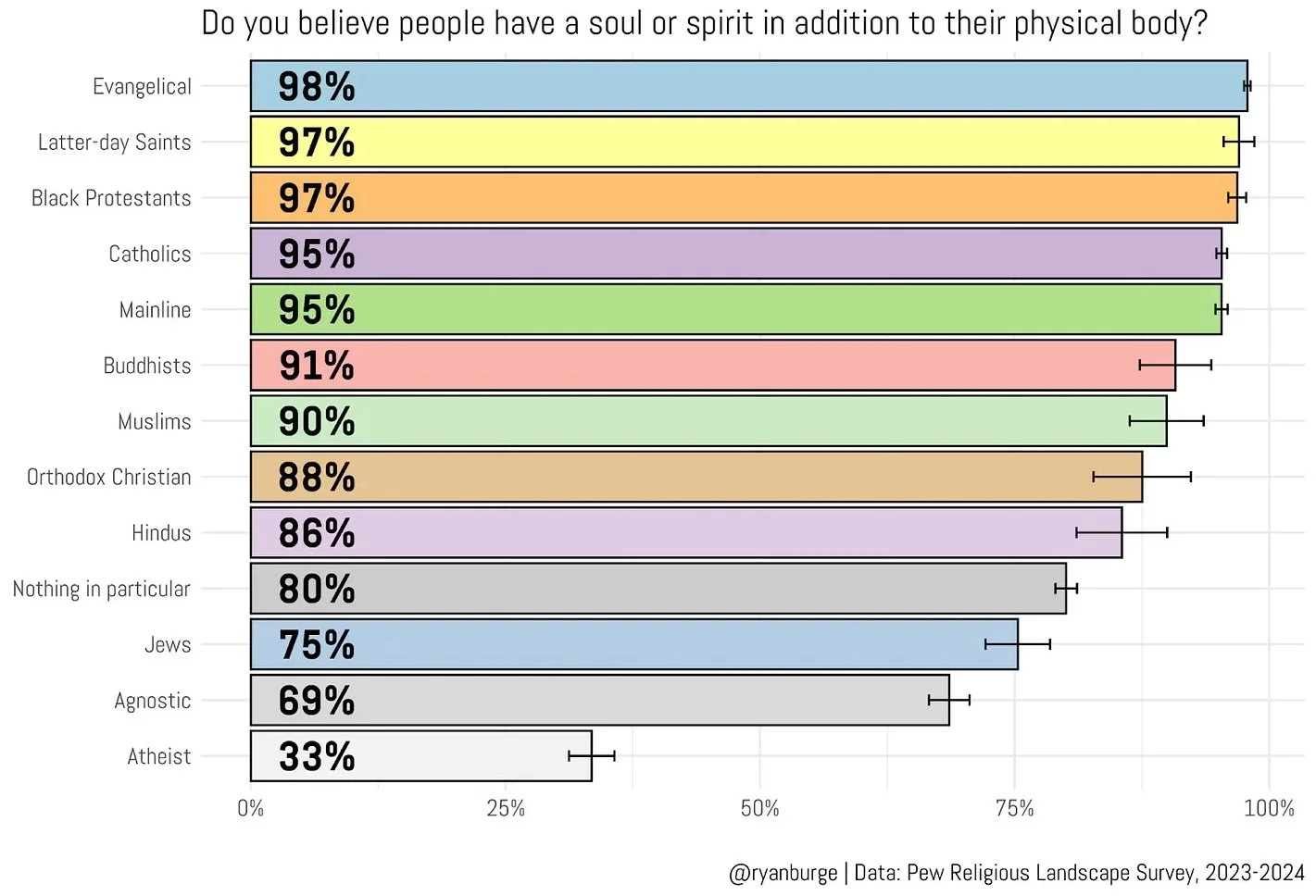
For instance, they asked, “Do you believe people have a soul or spirit in addition to their physical body?” It’s certainly not definitively predictive of whether someone has a deep well of spirituality, but it seems telltale that holding to the concept of a soul is pretty widespread in the data.
In the full sample, 88% of folks said that they did believe that each being possesses both a soul and a physical body. I look at survey data all day, and here’s what I know: It’s hard to get 88% of Americans to agree on anything, really.
If you tried to pull together a battery of ten public policy proposals, it’s very unlikely that any of them would get 88% support. But the data tells this story clearly: Almost all Americans believe that there’s something happening beyond our physical bodies.
And that belief is absolutely widespread among nearly every religious group in the survey. It’s at least 95% of every single Christian group. And even among non-Christian faiths like Islam and Buddhism, it’s at 90% agreement. The religious tradition that is the least likely to believe in a soul is Jews, at just 75%. I think this may be due, in no small measure, to the fact that lots of Jews are essentially secular in their religious beliefs. They embrace Judaism from a cultural/ethnic perspective.
You can read the rest of this post on Substack.
Ryan Burge is an assistant professor of political science at Eastern Illinois University, a pastor in the American Baptist Church and the co-founder and frequent contributor to Religion in Public, a forum for scholars of religion and politics to make their work accessible to a more general audience. His research focuses on the intersection of religiosity and political behavior, especially in the U.S. Follow him on X at @ryanburge.