
Lessons Learned After the Bomb Thrown Outside Mamdani’s Home
Surely it is a commentary on the age in which we live that many Americans laughed when they read the early New York Times headline about the terrorist attack that fizzled near the New York home of Mayor Zohran Mamdani.
In case you missed it, the first double-decker Times headline read:
"Smoking Jars of Metal and Fuses Thrown at Protest Near Mayor's
House Six people were arrested after anti-Islamic protesters led by the right-wing activist Jake Lang clashed with counterprotesters near Gracie Mansion.
Wait a minute! Who threw what — and at whom did they throw it — during this mysterious event?
Oh, and why did they throw whatever it was that they threw, in whatever direction they threw it?
That was one series of questions, out of many, that host Todd Wilken and I discussed during this week’s “Crossroads” podcast. The key was that our discussion focused on what news consumers could learn from both the firestorm ignited by the slanted early coverage of this event and the alternative-news sources — the new realities in the digital-news marketplace — that shaped the coverage that followed. Hold that thought.
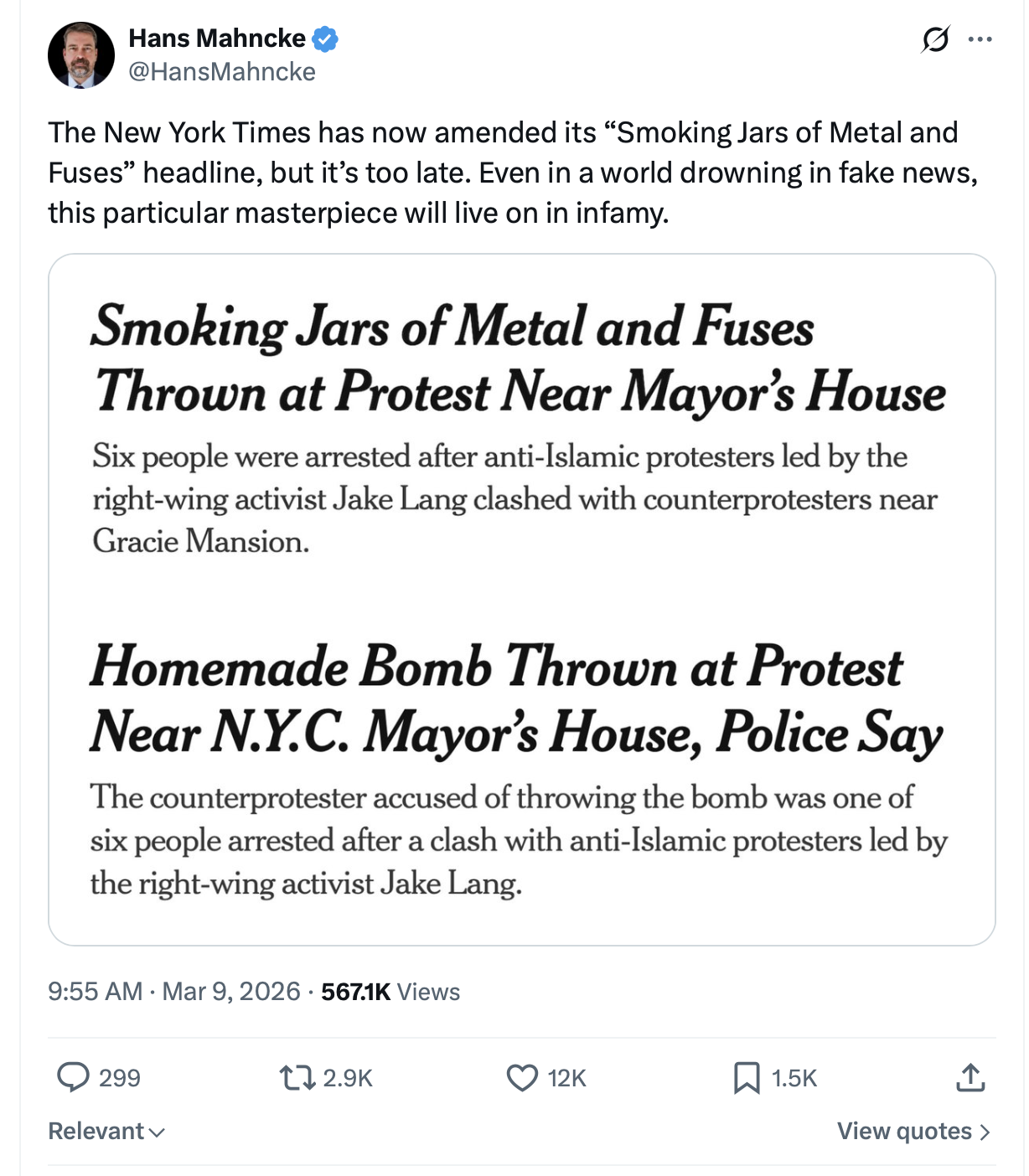
First, back to that laugh-to-keep-from-crying headline by the journalism gatekeepers at the New York Times.
As often happens, memes erupted in social media.
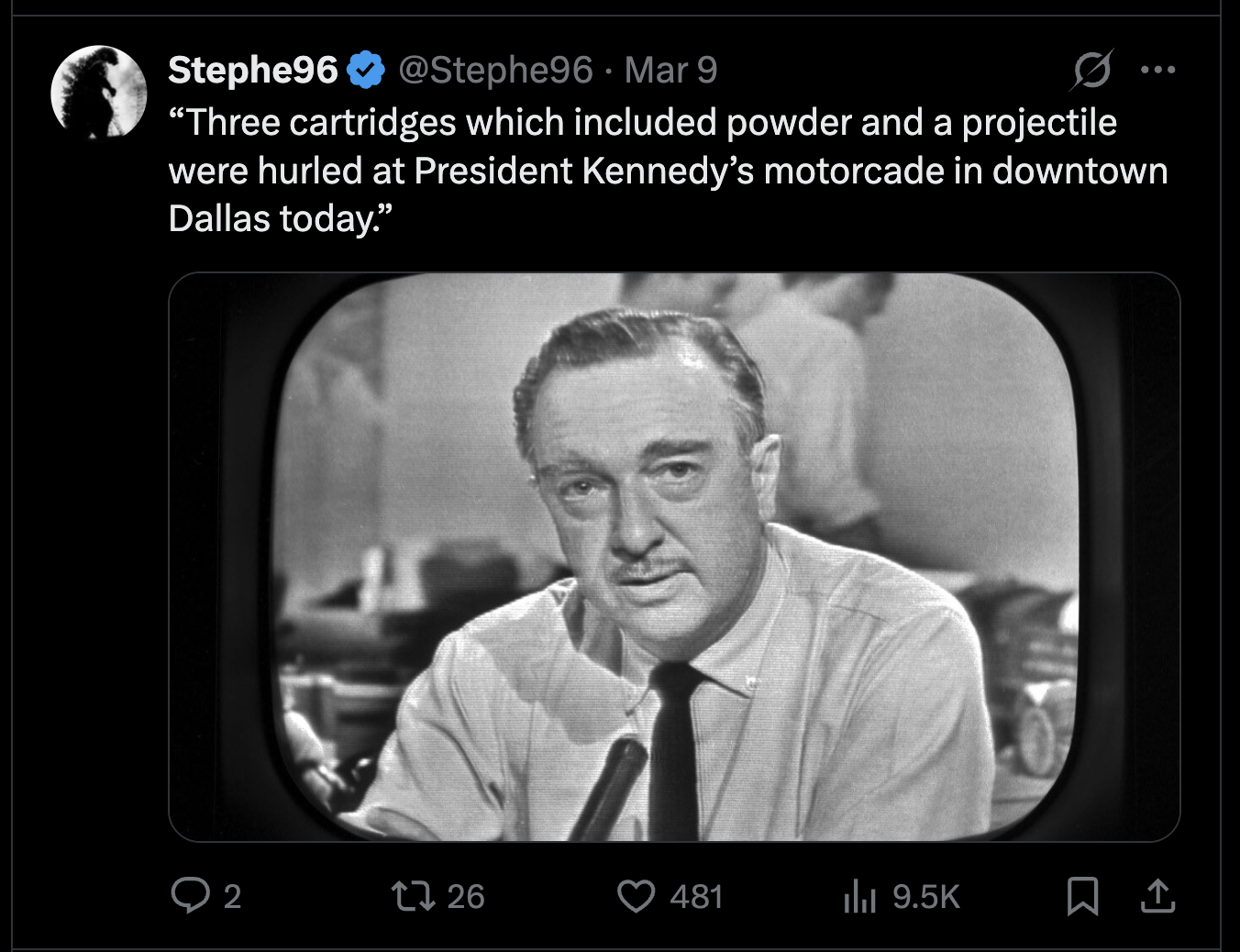
One offered a snarky take on a photo of a serious Walter Cronkite anchoring the CBS News coverage of one of the most important moments in American history. That acidic caption: “Three cartridges which included powder and a projectile were hurled at President Kennedy’s motorcade in downtown Dallas today.”
The Times editors made a few — repeat, “a few” — improvements with the revised headline for this important story:
Homemade Bomb Thrown at Protest Near N.Y.C. Mayor’s House, Police Say
The counterprotester accused of throwing the bomb was one of six people arrested after a clash with anti-Muslim protesters led by the right-wing activist Jake Lang.
But this Times story focused, for the most part, on the words and actions of the small band of protestors led by Lang — as opposed to relevant, emerging facts linked to the motives of the large “counterprotesters” flock, including the duo linked to what officials quickly determined were dangerous bombs that failed to explode.
The mayor immediately said that Lang was a “white supremacist” and that the protest was “rooted in bigotry and racism.” But what about the bombs? The Times noted:
“The attempt to use an explosive device and hurt others is not only criminal, it is reprehensible and the antithesis of who we are,” the mayor said, thanking the Police Department for its response.
The bombs were, of course, built to attack the conservative protesters. Thus, what was the proper term for the bomb thrower?
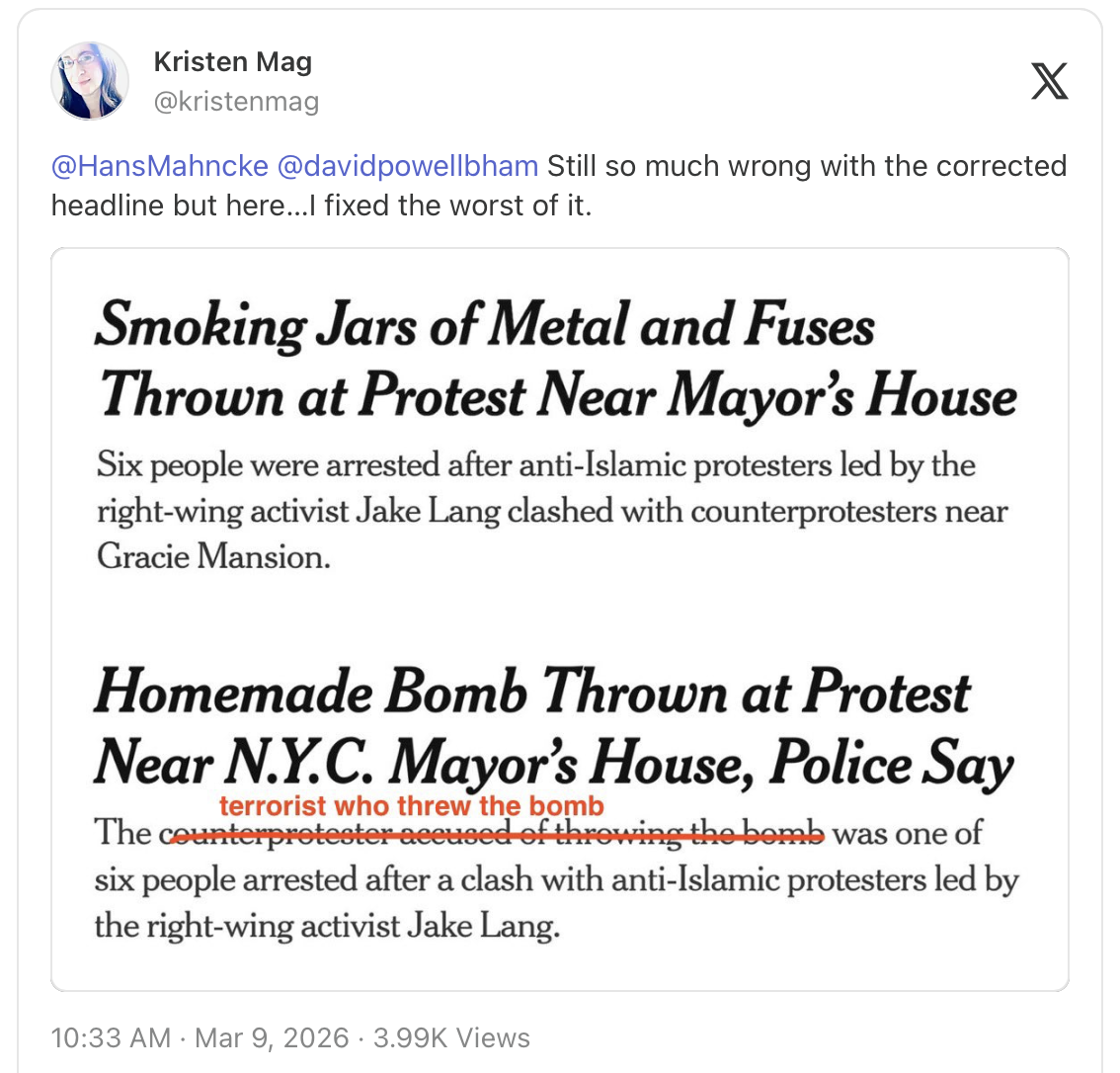
Apparently, despite facts that quickly emerged at the scene of this attempted mass murder, the accurate term was “counterprotester,” and that was that.
Thus, the Times story was packed with information about the motives, actions and rhetoric of the protesters, but not the counterprotesters. Information about the bomb duo would quickly emerge from alternative sources.
Over at CNN, anchor Abby Phillip — for several days — read scripts by producers who were absolutely sure that this was “an attempted terror attack against New York City Mayor Zohran Mamdani,” not an attack on the conservative demonstrators in front of the mayor’s house.
In another laugh-to-keep-from-crying moment, CNN posted a creative tweet about this potential mass murder. When that tweet was deleted, that CNN apology still avoided information that was already on the record about the ISIS-related motives of the bomb throwers.
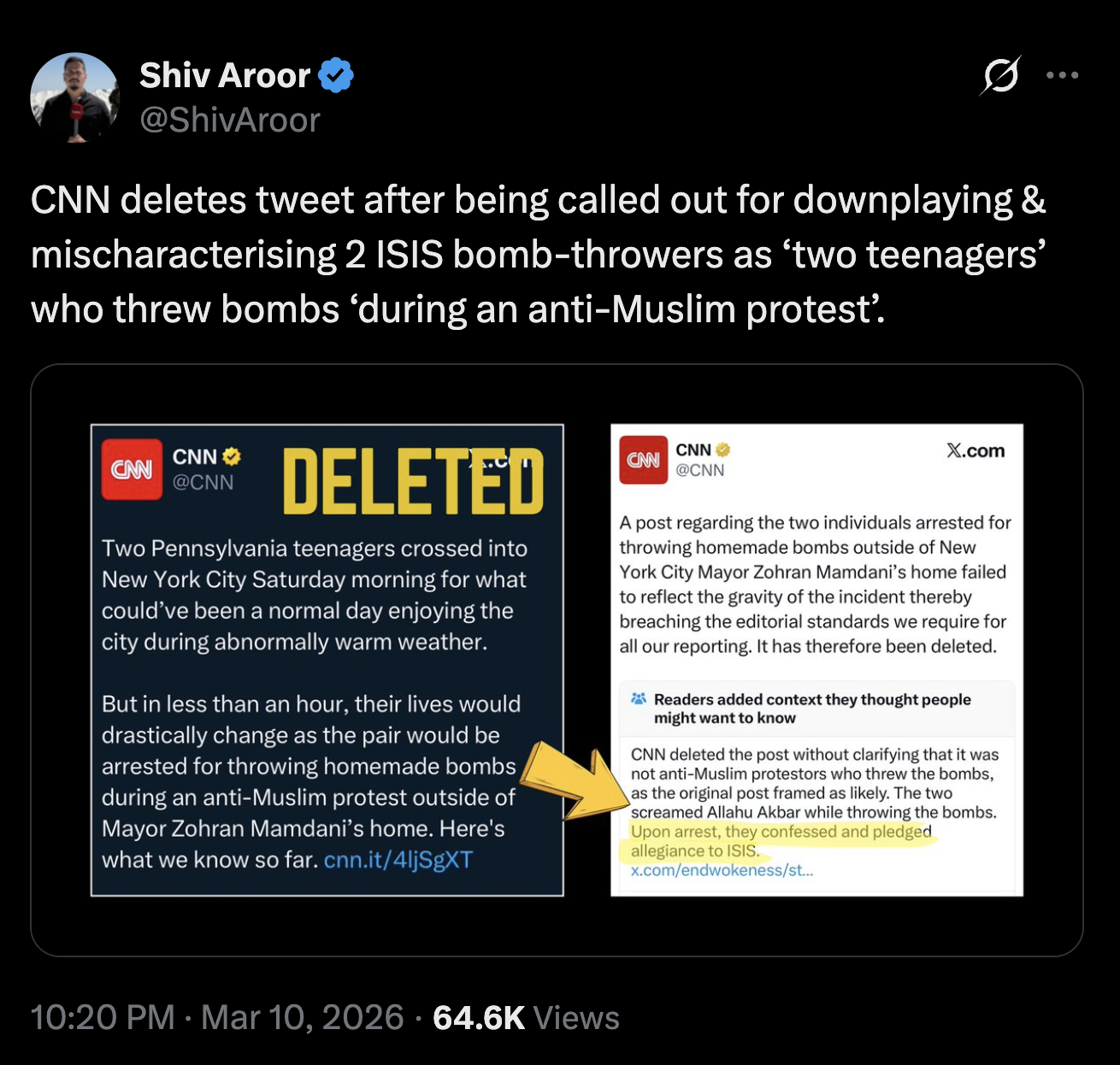
However, Phillip eventually offered an on-air apology for the inaccurate reports. Also, CNN began reporting on official statements providing information about the actions and statements of the bombthrowers.
In conclusion, what can news consumers learn from this complicated drama?
First, it was crucial that New York City still has another daily newspaper. Over at the New York Post, online readers were offered a wide variety of news reports about the attack based on statements from public officials, along with information from eye-witnesses at the scene. Click here for a file of some of those reports.
Also, in the age of omnipresent smartphones, images and information from the crime scene quickly made their way to X and other social-media platforms. In the podcast, Wilken and I stressed that news consumers — concerns about AI are real — must be skeptical about these kinds of reports.
The key is to look for images, videos and reports that overlap from multiple on-the-record sources and then watch to see how this alternative information bleeds into the mainstream press, including online platforms such as The Free Press.
In other words, readers and viewers should be careful (especially when clicking “forward”), but they now have alternative sources of information.
Thus, notice this rather different headline when the New York Times produced a follow-up report:
Homemade Bombs in ISIS-Inspired Attack Were Deadly, N.Y.P.D. Says
Prosecutors say one of the two men who were arrested hoped the attack would be deadlier than the Boston Marathon bombing. Officials said they are seeing increasing signs of radicalization.
That Times report contained this sobering information, drawn from official sources:
… [The] scene that unfolded could have turned deadly and put a spotlight on the dangers facing the country’s largest city, where the police have increased security since the United States and Israel launched airstrikes against Iran last month. It also served as a reminder of the continuing influence of the Islamic State, known as ISIS. Despite having been greatly diminished, it has inspired deadly attacks through online propaganda across the world for years. …
Federal prosecutors in Manhattan have since tried to learn more about Emir Balat, 18, who they say threw the bomb, and Ibrahim Nikk Kayumi, 19, who they say handed Mr. Balat one of the devices.
The men, who drove about 100 miles from where they live in Pennsylvania to New York, told law enforcement officials that they supported ISIS, according to a criminal complaint. They were charged on Monday in federal court in Manhattan with using a weapon of mass destruction and transporting explosive materials across state lines.
When law enforcement officers asked Mr. Balat if he was familiar with the 2013 Boston Marathon bombing, and if that was what he had hoped to accomplish, the complaint says he responded, “No, even bigger. It was only three deaths.”
Also, it’s important to note an important, dangerous side effect of journalists attempting to avoid information about the actions and statements of radicalized Islamists involved in stories of this kind.
Consider this summary material from an essay at The Free Press by Reihan Salam: “New York City’s Mayor Can’t Give Muslim Extremists a Pass.”
As New York City’s first Muslim mayor, Zohran Mamdani is the most prominent observant Muslim in American life. He has made his religious identity a central part of his political identity, and he has vowed not to “bite his tongue” in the face of Islamophobia. That gives him unique credibility and authority to speak out against the chauvinism, extremism, misogyny, and racism that exist within Muslim communities, and that has translated to violence again and again.
Those strains represent as much of a threat to Muslim-American flourishing as any external forces. Right now, Muslim Americans are desperate for leadership that addresses their internal communal challenges. Polling is spotty, but we know that Muslim Americans are concerned about extremism in their midst. In the last major survey on the topic, in 2017, a full 82 percent of American Muslims reported concern about extremism in the name of Islam (with 66 percent being “very concerned”).
Moreover, in that survey only 39 percent said that leading Muslim interest groups are doing a good job representing their interests.
Why were some, not all, elite news sources so anxious to avoid information about the identity and motives of the terrorists behind the bombs?
That’s a valid question. But it’s also important to note that alternative news sources were available for those willing to use them — while being cautious. Eventually, the wild world of alternative digital news forced the mainstream press to cover parts of the story that complicated their chosen narratives.
Enjoy the podcast and, please, pass it along to others.