
Crossroads Podcast: Religious Persecution And The Future Of Global Christianity
No one was surprised when, North Korea — for the 24th year in a row — seized the top spot in the Open Doors International list of the 50 most dangerous nations for religious believers.
But the next nine nations, when pinned on a map, showed a pattern familiar to human-rights activists and diplomats who have studied religion-freedom issues for decades. In order, those nations are Somalia, Yemen, Sudan, Eritrea, Syria, Nigeria, Pakistan, Libya and Iran. Nigeria was singled out as the “epicenter of deadly violence.”
During the new “Crossroads” podcast, I argued that religious-freedom issues haunted the mainstream news reports that we discussed this week. Host Todd Wilken and I focused on this Associated Press feature, “Muslims are projected to outnumber Christians by 2035 as the world’s largest religion,” and a Washington Post report with an almost identical headline.
The hook for this coverage was a new Pew Research Center study: “The Future of World Religions: Population Growth Projections, 2020-2070.”
Here is a crucial block of material near the top of that report:
Muslims are expected to outnumber Christians by 2035, according to new projections from Pew Research Center. Both religious groups are growing in size, but Muslims are growing faster. By 2070, if recent trends continue, there will be more than 3.6 billion Muslims and just under 3 billion Christians worldwide.
The world’s total population is projected to increase by 29% between 2020 and 2070. Muslims and Christians are the only religious groups analyzed here that are expected to keep pace, with Christians growing by 30% and Muslims by 80%.
What is the key factor in the worldwide growth of Islam and, to a lesser degree, Christianity in the Global South? The Associate Press noted this highly relevant fact:
“It’s the babies,” said Pew senior demographer Conrad Hackett, explaining that conversion and other ways of changing religious identity are much smaller factors than fertility rates.
During 2020-2025, the fertility rate for Muslims was 3.1 children per woman, followed by the rate for Christians at 2.5, according to Pew. The average fertility rate for all other women was 1.6, below the level of 2.1 that’s considered necessary for each generation to replace itself.
However, the relevance of the Open Door ratings, for those with the eyes to see, shows up in this next important chunk of the must-read AP report:
Over the coming decades, Pew said, most of the world’s population growth is expected to occur in Africa, particularly south of the Sahara Desert, where most people are Christians or Muslims. The region’s high fertility and rising life expectancy will boost the global numbers of both faiths, Pew predicted.
By 2070, Pew said, more than half of the world’s Christians will live in sub-Saharan Africa, and Congo will surpass the United States as the country with the most Christians, with their ranks increasing more than threefold to 299 million. …
If recent trends continue, according to Pew, Pakistan will have the largest Muslim population by 2070, followed by India, Nigeria and Indonesia — which currently has the most Muslims.
I asked the Grok AI program to create a map showing the nations that Open Doors listed as numbers two through 10, in terms of terrifying religious-freedom scores and it looks like this.
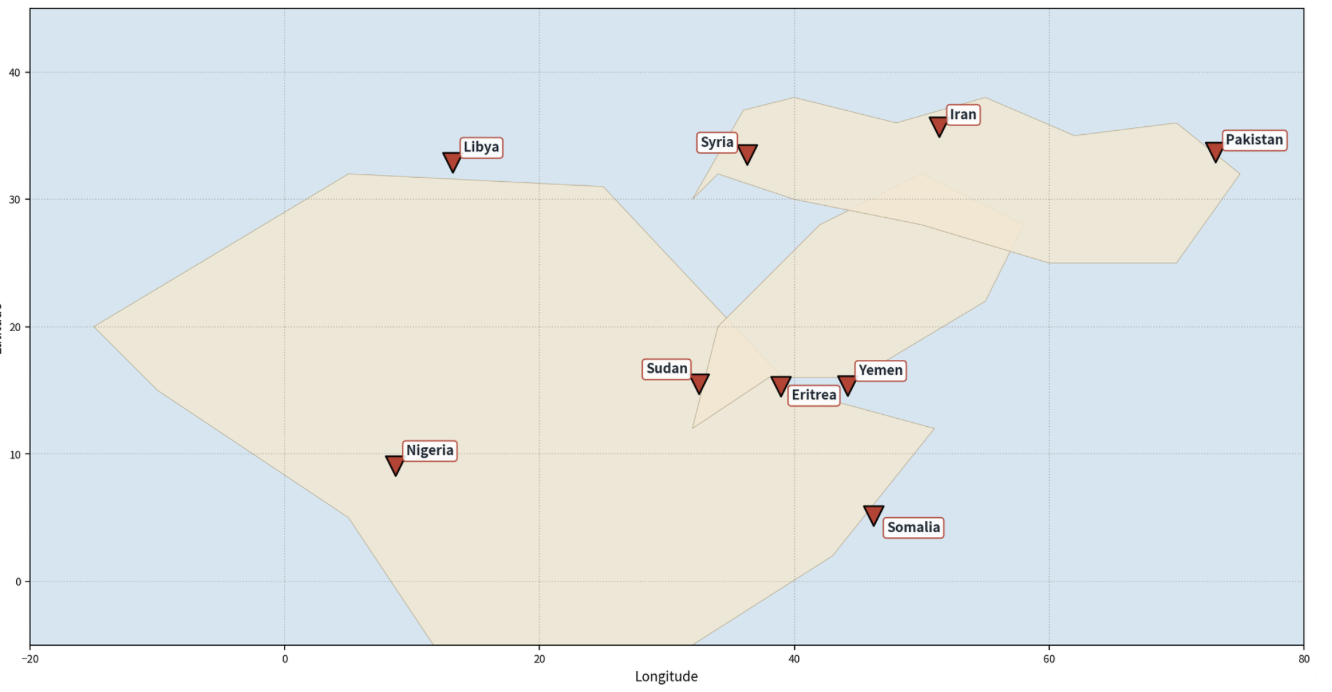
Image via Grok
The role of Africa and, especially, Sub-Saharan Africa is striking. The key is that Africa is the continent in which Islam is rapidly growing, but so is Christianity — especially in Pentecostal, Catholic and Anglican churches. It’s also easy to see the importance of regions in which ancient Christian communities, such as Syria, have been crushed by decades of war and violence, in the past and in the present.
Journalists looking for additional information on these issues should seek out this influential 2002 essay in The Atlantic, written by historian Philip Jenkins (which led to his Oxford University Press book, “The Next Christendom”):
The Next Christianity
We stand at a historical turning point, the author argues — one that is as epochal for the Christian world as the original Reformation. Around the globe Christianity is growing and mutating in ways that observers in the West tend not to see.
The Big Idea here is that troubling persecution statistics can be found along the arc from West Africa to Pakistan, India and over to Indonesia.
What is the spark that is igniting these fires? That’s easy to see in the Pew report, even if the researchers did not connect the dots between religious-freedom conflicts and rapid statistical growth — fertility and also conversions — in both Islam and Christianity.
While avoiding any references to religious-freedom clashes, the Washington Post report did add material from a respected scholar on these matters:
The shifts long underway include the move of the numerical center of global Christianity from the West to the Global South.
Mark Noll, a historian of Christianity, noted that the expression of Christianity in Africa, where the faith is most booming, is different from that of many American Christians in that it’s mostly charismatic.
“The supernatural elements in Christianity that were always present but modified and restricted in the West are anything but in most of the Christian world,” Noll said.
Christianity and Islam in Africa, he said, also are marked by competition because both faiths are so large.
The Post report also — once again without mentioning religious freedom-issues — stressed patterns of growth in the two crucial regions:
The percent of Muslims will continue to grow in the Asia-Pacific region, which extends from Turkey to the Philippines and is now home to 59 percent of Muslims. However, because of especially fast Muslim growth in sub-Saharan Africa, the Asia-Pacific no longer will be home to the majority.
Nigeria’s Muslim population will double, to 282 million, due to its young average age and high fertility rates, the study projects.
Mainstream coverage of the Pew survey briefly mentioned another hot-button topic linked to the growth of Islam and the decline of Christianity in the modern West — immigration.
Once again, these reports didn’t discuss ways in which Islamic growth in the European Union and Great Britain is leading to tensions, as well as public protests, by activists on both sides. There has been violence and crime outbreaks, as well. Trends in Europe, as I mentioned in the podcast, have also led waves of European Jews to move to Israel. France remains a key nation in this drama.
The AP feature noted that “the number of people living in Europe will shrink by 17% by 2070, Pew said, and the number of Christians there will drop by a third, from 505 million to 324 million. Over the same period, the percentage of Europe’s population that is Muslim is expected to increase from 6% to 13%.”
The Washington Post added: “The number of Jews will grow from 15 million to 18 million, Pew projects, with the majority of the world’s Jews living in Israel. Today Israel has 6.8 million Jews, the U.S. has 5.7 million, and Europe has 1.3 million, according to the Berman Jewish DataBank.”
The AP report did offer one indirect reference to issues of religious freedom and even persecution — by featuring a prestigious voice downplaying these concerns. Read the following carefully:
Gina Zurlo, a senior researcher at Harvard Divinity School specializing in religious demographics, said Christian-Muslim relations are “extremely important” in light of the evolving trends.
“The ‘clash of civilization’ theory still looms large in some religious communities and there is a lot of misunderstanding of both religions from both sides,” she said via email. “Many Christians are not happy to see that Islam will be the world’s largest religion and it’s causing even more angst.”
“I hope people seek opportunities for greater interreligious education,” she added. “Personal contact is important — when people have personal relationships across religious differences, it ‘humanizes’ the ‘other’ in fruitful ways.”
The bottom line?
At the end of the podcast, I offered my answer on that. To be blunt, it appears that efforts to increase interfaith dialogues with a “Can we all get along” message appear to work better at Harvard Divinity School than in the zones of terror and fighting that threaten the future of Nigeria.