
Faith On The Ballot: Guide To The 2026 Midterm Elections
Across several of the country’s most competitive congressional contests, religious identity has become a central issue for many voters.
In Senate races, faith has become an unexpected source of legitimacy for Democrats: From a Presbyterian seminarian invoking Jesus’ teachings in Texas to a Muslim Democrat making history in Michigan and a Methodist megachurch pastor testing his religious credibility in Kansas.
At the same time, in several House races, Christian, Jewish and Muslim candidates are navigating questions of religious representation, theology, Israel and Palestine and the role of faith in politics.
READ: How Will Democrats’ Israel Shift Affect Jewish Voters?
Together, these races offer a window into how religion is being used as both a source of political identity and a line of partisan conflict this election season.
Here’s a look at key races where religion has become a major storyline:
***

(Image via 270towin.com)
Senate
Texas: James Talarico (D) vs. Ken Paxton (R)
Talarico is a Presbyterian seminarian who has made Jesus' teachings and opposition to Christian nationalism central to his progressive political identity. Ken Paxton is a corporate lawyer and experienced politician who has directly rebuked progressive Christianity, stating simply that it does “not reflect what Scripture says.”
Recent polls have the race remarkably close for a traditionally red state. If Talarico were to win, he would be the first Democratic Senator elected in Texas since 1988.
Talarico argues that under the current administration, corporate greed has swayed politicians through Political Action Committees and lobbying under the facade of Christianity. He quotes scriptures like Matthew 23, “the greatest among you will serve,” to appeal to his audience, which includes small towns throughout Texas.
His use of biblical arguments for progressive policies has become a campaign issue, too. In a 2021 Texas House debate over an anti-transgender bill, Talarico said “God is non-binary.” That same year, in a committee debate discussing a bill requiring K-12 athletes to play on teams matching their sex at birth, Talarico said: “Science recognizes there are many more than two biological sexes – in fact, there are six.”
Talarico clarified his points, respectively: that God is not confined to one gender in the Bible and that some people are born with intersex characteristics.
Ken Paxton has served as Texas’ Attorney General since 2015. Paxton has invoked religious rhetoric of his own during his campaign. Paxton has urged his audience to pray that the Republican Party doesn’t lose Texas like they lost Georgia and Arizona in recent years.
Addressing allowing transgender athletes to compete in girls’ sports has been a big part of his campaign. He vows to keep boys out of girls’ sports. He argues that biblical values align directly with his policies on gender, the border and more.
“I think God hears our prayers and he answers them,” he said recently to loud applause.
Paxton also has a rocky past. He has been entrenched in accusations of solicitation, corruption and an alleged extramarital affair, which culminated in his impeachment by the Republican Texas House in 2023. Last year, Paxton’s wife filed for divorce on grounds of adultery, stating that in “light of recent discoveries, I do not believe that it honors God or is loving to myself, my children, or Ken to remain in the marriage.” Paxton has focused on his campaign, stating that the divorce is a private matter.
Many fringe voters in Texas are hesitant to vote for Talarico on grounds of his loose biblical interpretation. Critics have latched onto his past statements, including Lt. Gov. Dan Patrick, who said Talarico would “go to hell.”
At the same time, Paxton has received scrutiny for his rocky past, which Talarico criticizes.
“This isn’t just a political battle,” Talarico said. “This is a spiritual battle between selfishness and service.”
Michigan: Abdul El-Sayed (D) vs. Mike Rogers (R)
In Michigan, history could be in the making. If elected, Abdul El-Sayed would become the first Muslim U.S. senator in American history. His Muslim identity and the cultural rise of anti-Muslim rhetoric have all become part of his campaign’s storyline. On the other hand, Mike Rogers is an Army veteran and former FBI agent who sees El-Sayed’s identity as a hindrance, possibly even a danger to America.
El-Sayed said that his Muslim faith has instructed him to do good and seek justice. His progressive agenda includes universal healthcare and free public higher education. El-Sayed is also against American support of Israel and has criticized politicians for stealing tax dollars to sponsor foreign militaries. El-Sayed said he does not believe in “ethno-states.”
The Jewish population in Michigan is wary. Jewish leaders recently published a petition urging El-Sayed to agree that “Jewish sovereignty in Israel is non-negotiable.” At the same time, El-Sayed said that he “loves and reveres his Jewish brothers and sisters.” Having grown up being invited to seders and bar mitzvahs, he said he believes Jews are a “light unto the world.”
In light of the 25th anniversary of 9/11, El-Sayed has also received criticism for campaigning with podcaster Hassan Piker, who previously said America had “deserved” 9/11. He later walked back those comments. El-Sayed has disavowed those statements, but has kept Piker close and continued to campaign with him until recently.
Rogers has made 9/11 central to his campaign. Rogers said that he spent much of his life hunting down radical Islamic terrorists. Rogers has claimed, without any evidence, that El-Sayed has received campaign funding from the Muslim Brotherhood, a terrorist group.
Rogers has also claimed that El-Sayed is too extreme for the state of Michigan. To him, this election is about the “soul of the country: The ability to raise a family, speak freely, and worship freely.”
“It is about who you stand with,” Rogers said, “when that soul is threatened.”
The close race is one of the most important races to follow pertaining to the Israel/Palestine conflict and trends among Muslim leaders in America.
Kansas: Adam Hamilton (D) vs. Roger Marshall (R)
Adam Hamilton is the founding pastor of the largest United Methodist church in the United States: Church of the Resurrection.
Roger Marshall, the incumbent Senator, also has experience in the church, serving as an elder and Sunday school teacher at a mainline Protestant Church called First Christian Church. Both seek to align Christian values with their campaigns.
As a mainline Protestant in a traditionally Republican state, Hamilton said he is turned off by Republicans who make decisions inconsistent with the Bible. He is vocally critical of the Iran war, responses to immigration and Republicans' inability to stand up to President Donald Trump. He brings with him “45 years of studying scripture and trying to make decisions that are morally right,” he said.
Hamilton is the author of more than 30 books on Christianity and has seen his church grow from four members to 25,000 members in 36 years. He said that his experience leading a diverse church puts him in a unique place to “work across the aisle” and sow unity in Kansas. Hamilton has received scrutiny for being accepting of the LGBTQ community in the church.
Marshall is an Army veteran and medical doctor who has served as a senator for Kansas since 2021. He said that Hamilton’s preaching record reveals his true character. Sen. Marshall claimed that Hamilton has given “entire sermons on the Green New Deal and climate challenge.” Vice President JD Vance recently gave a similar critique, stating that Hamilton uses the pulpit to spread his political ideas. According to his campaign website, Sen. Marshall and his wife taught Sunday school at their church for over 25 years.
Marshall has also faced scrutiny over alleged hypocrisy. Kansans have critiqued the senator for his second residence in Florida, which is much larger than his Kansas home. Additionally, a recent report revealed he had sued over 700 patients while he was a physician.
“Those are common, common business practices,” responded Marshall during a recent debate.
The Kansas Senate race draws similarities to Texas: A Christian Democrat seeks to translate religious credibility into votes in a traditionally red state. Democrats have not won a Senate race in Kansas since 1932. Hamilton’s moderate political identity, along with his pastoral background, poses an unprecedented challenge to Marshall.
***
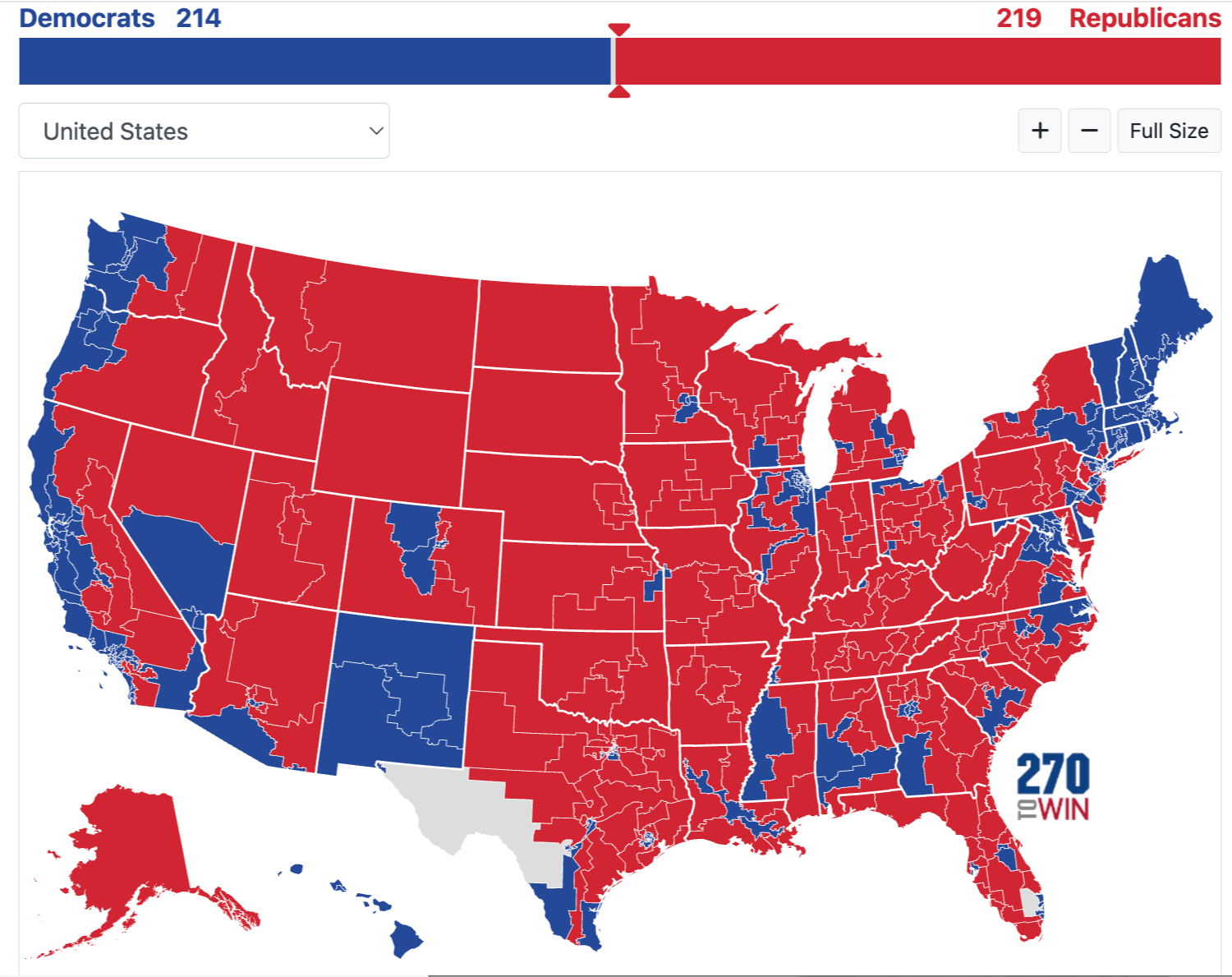
(Image via 270towin.com)
House:
Florida (25th District): Jared Moskowitz (D) vs. Scott Singer (R)
In Florida’s 25th district, which is 25% Jewish, support for Israel has become a campaign point for the Democratic and Republican candidates, who are both Jewish.
The Democratic candidate, Jared Moskowitz, is the incumbent representative. He recently received the support of the American Israel Public Affairs Committee over his opponent Scott Singer, who is also Jewish. Moskowitz has said Israel has the potential to stabilize the Middle East, but Singer warns that Democrats like Moskowitz have been known to pull their support for Israel.
Moskowitz said that if he were to criticize anything about Israel, he would criticize Israel's lack of regulation of settlers. Singer notes that President Donald Trump has been pro-Israel and that, as a Republican, he is willing to do what he needs to work with Trump, not against him.
Democratic candidate Moskowitz finds himself in a precarious position. From the Republicans, he has received skepticism about his willingness to follow through on pro-Israel sentiments. His opponent Singer noted that Moskowitz did not vote for the NDAA (National Defense Appropriations Act), which had a key provision on Israeli-U.S. cooperation. From Democrats, he has received criticism for being pro-Israel. In response, Moskowitz said, “I thought it was blue no matter who? I thought we had a big tent. Does the tent not include pro-Israel Jews?”
The battle is a test of pro-Israel sentiments across party lines.
Iowa (2nd District): Lindsay James (D) vs. Joe Mitchell (R)
In Iowa, Representative Lindsay James is the latest addition to a group of Christian Democrats receiving support in historically red states. Her opponent, Joe Mitchell, is a young politician who was sworn in to the Iowa House of Representatives at the age of 21 in 2019. Christianity has taken center stage in the race. James has used her background as a university chaplain to try to gain religious credibility, while Mitchell, who was endorsed by the late Charlie Kirk, has criticized her liberal Christianity.
In James’ political rhetoric, she has used Christian stories like the parable of the good Samaritan, comparing the current Trump administration to the priest who walks by the beaten and robbed traveler on the road. Washington D.C. is turning a “blind eye” to the challenges middle and lower class people face in their daily lives, she said.
Mitchell was endorsed by the late Charlie Kirk for his nonprofit Run Gen Z, which supports young Republicans running for Congress. He critiqued James for using a progressive Christianity to promote radical left ideas. Mitchell has said James threatens to bring socialism to America, just like Mayor Zohran Mamdani has done in New York. For some time it has been “common sense versus crazy,” he said, but now it’s common sense versus communism.”
Iowa (3rd District): Sarah Trone Garriott (D) vs. Zach Nunn (R)
Sarah Trone Garriott is an ordained Lutheran pastor who has previously worked as a hospital chaplain and pastor at several Lutheran churches. Her faith is unusually central to the race. GOP leaders, including her opponent and incumbent representative Zach Nunn, have questioned whether she is a “real pastor” and attacked her theology.
Garriott has emphasized healthcare issues, expressing support for re-funding Medicaid and preserving the Affordable Care Act. Her experience as a hospital chaplain gives her credibility to defend her views on healthcare. She criticizes Nunn, who voted in favor of the One Big Beautiful Bill, which cut Medicaid for many living in the state.
She has also criticized the war in Iran, which she said has doubled the price of gas and fertilizer in Iowa. Garriott said that her experience, which also includes working for nine years as an Interfaith Coordinator for a food pantry network, has prepared her well to go to Washington and serve.
Garriott’s critics have associated her with the rise of socialism, including House Majority Leader Steve Scalise, who compared her to New York mayor Zohran Mamdani and Michigan Senator candidate Abdul El-Sayed. Her opponent Nunn has also claimed that Garriott voted for “men in women’s locker rooms or boys in girl’s sports,” which Garriott has denied.
Nunn is a Catholic and said he has built his life based on faith. While Garriott supports abortion rights, Nunn is pro-life. To him, this race is about keeping Christian doctrine sound. He pointed back to a speech Garriott gave at a Methodist church in 2023, in which she criticized Christian nationalism.
“I was raised around Iowans who go to church every week and show up for their neighbors,” Nunn said. “Sarah Trone Garriott can't walk into a church without delivering a lecture about how their faith is threatening and their schools are racist.”
Nunn has received criticism for his unabashed support from Trump. Recently, Nunn broke with his party on Trump’s war powers in Iran.
Texas (30th District): Frederick Douglass Haynes (D) vs. Everett Jackson (R)
This Texas race pits Frederick Douglass Haynes III, a longtime Baptist pastor at Friendship-West Baptist Church and social justice advocate, against Everett Jackson, a business owner. Haynes won the Democratic primary, while Jackson secured the Republican nomination after a runoff. The heavily Democratic district strongly favors Haynes.
Haynes’ Baptist congregation at Friendship-West has grown to over 13,400 members since he started there 43 years ago in 1983. He sees his potential election not as leaving the pulpit but as “expanding the pulpit.”
He said he hopes to continue preaching at his church while making policies informed by his Christian background. He said his top priority is economic security in a district where around 15% of its population is below the poverty line. In the past, he has sourced donations from Friendship-West to provide over $3 million for HBCU student scholarships and funding.
Jackson characterizes himself as a small business owner. He has critiqued corruption in the black church and criticizes Haynes for running simply for an opportunity and a pay bump. Jackson said he has skin in the game, having grown up in the district, unlike Haynes who grew up in California. He has not spoken about his own faith but has made defending religious freedom one of the dedicated sections of his campaign website.
The district is majority blue and Jackson has an uphill battle to fight against a well-known pastor with a strong philanthropic history. Haynes’ challenge is that he must convince voters he can promote democracy and also uphold his role as a pastor.
When then-President Barack Obama endorsed marriage equality in 2012, Haynes gave a sermon applauding the president for promoting democracy.
“He is not the pastor of the United States, but the president of the United States,” Haynes said.
Luke Reinkensmeyer is a student at Baylor University and an intern at Religion Unplugged.