
Why Do Educated People Attend Church More?
(ANALYSIS) What do we do with the time that we have? That’s one of the most important questions we face, in my estimation. It’s certainly something I struggle with on a day-to-day basis. I have a really hard time taking a vacation that lasts more than four or five days because I feel a deep sense of guilt that I’m not doing enough with my life.
It’s that pesky Protestant work ethic that I will never be able to shake. And don’t try to lecture me about it in the comments, either. Many have tried and many have failed to convince me to work less.
I am, for better or worse, very deliberate about how I spend my time because it’s such a precious commodity. And my fatal flaw is that I think other people are as thoughtful about such matters as I am.
So whenever I hear someone say, “I just can’t make time for that,” what I actually hear is, “I am choosing to use my time on something I prioritize more.” I want to believe that people are parsing out their values when they make a decision about going on vacation, attending a concert, or staying at home with their kids.
And I want to believe that lots of people are very thoughtful when they make a decision of whether to attend a local house of worship each weekend. But I also know that this decision is not made purely randomly by each person. There are certain factors that make someone more inclined to get up on Sunday morning, put on some nicer clothes, and make the drive to their local church.
Educated people are more likely to be weekly attenders than those with a lower level of education. That comes through when looking at this data from Pew.
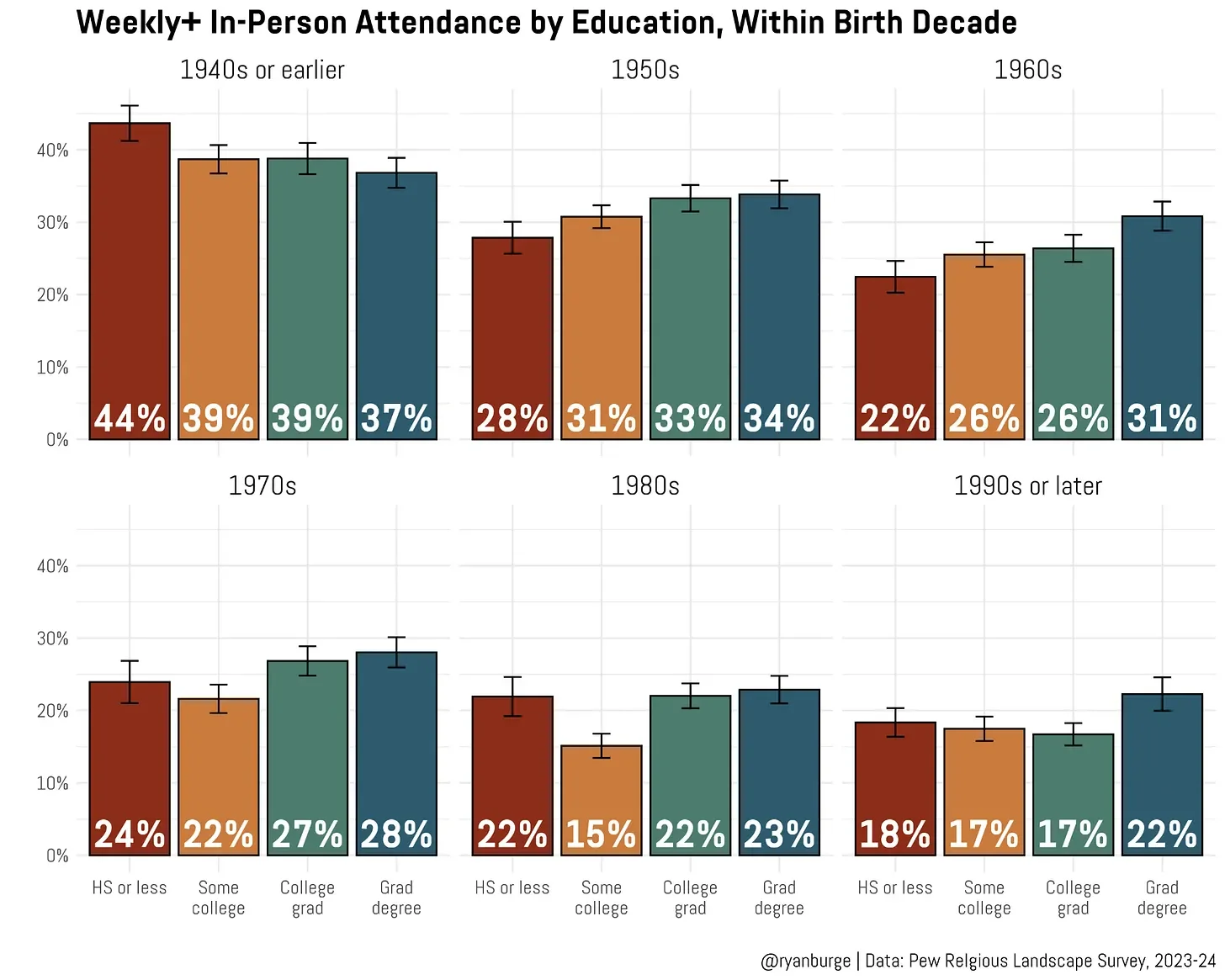
Now, I must admit that the positive association between education and attendance is age-dependent, to a certain degree. For the very oldest Americans, the relationship between the two factors is actually negative: educated folks are less likely to be weekly attenders than those who stopped at high school. But that’s the only age cohort where that’s the case.
For those born between 1950 and 1979, the line goes up in a pretty clear way. From left to right, the increase is six points for those born in the 1950s, nine points for those born in the 1960s, and four points for those born in the 1970s. The last two birth cohorts are a bit more of a mixed bag.
For those born in the 1980s, the line is flat. It may be tilting up for the very youngest adults, but I think I am going to reserve judgment on that until more data comes in.
You can read the rest of this post on Substack.
Ryan Burge is an assistant professor of political science at Eastern Illinois University, a pastor in the American Baptist Church and the co-founder and frequent contributor to Religion in Public, a forum for scholars of religion and politics to make their work accessible to a more general audience. His research focuses on the intersection of religiosity and political behavior, especially in the U.S. Follow him on X at @ryanburge.