
Emergency Expenses And American Religion
(ANALYSIS) Before there was Dave Ramsey, there was Suze Orman. The OGs will know exactly what I’m talking about right now. She had a show on CNBC that ran on Saturday nights. We would watch it almost every week.
I know — a young couple should have been out on Saturday night, exploring the town and meeting new people. But remember, I was a pastor during this time period, so I had to preach the next morning. So staying out late just wasn’t a good idea.
For those of you who don’t know Suze Orman, she basically did what Dave Ramsey does now — yell at people who call into the show and need advice on their financial situation. A popular segment was “Can I Afford It?“
Spoiler alert: The answer was almost always a resounding no.
But I’ve always been deeply interested in how people spend their money because it’s not a situation where people can just “opt out” of the conversation. We all have to make money; we all have bills to pay. It’s just fascinating to me on all kinds of levels because it seems that no two people have the same approach to money.
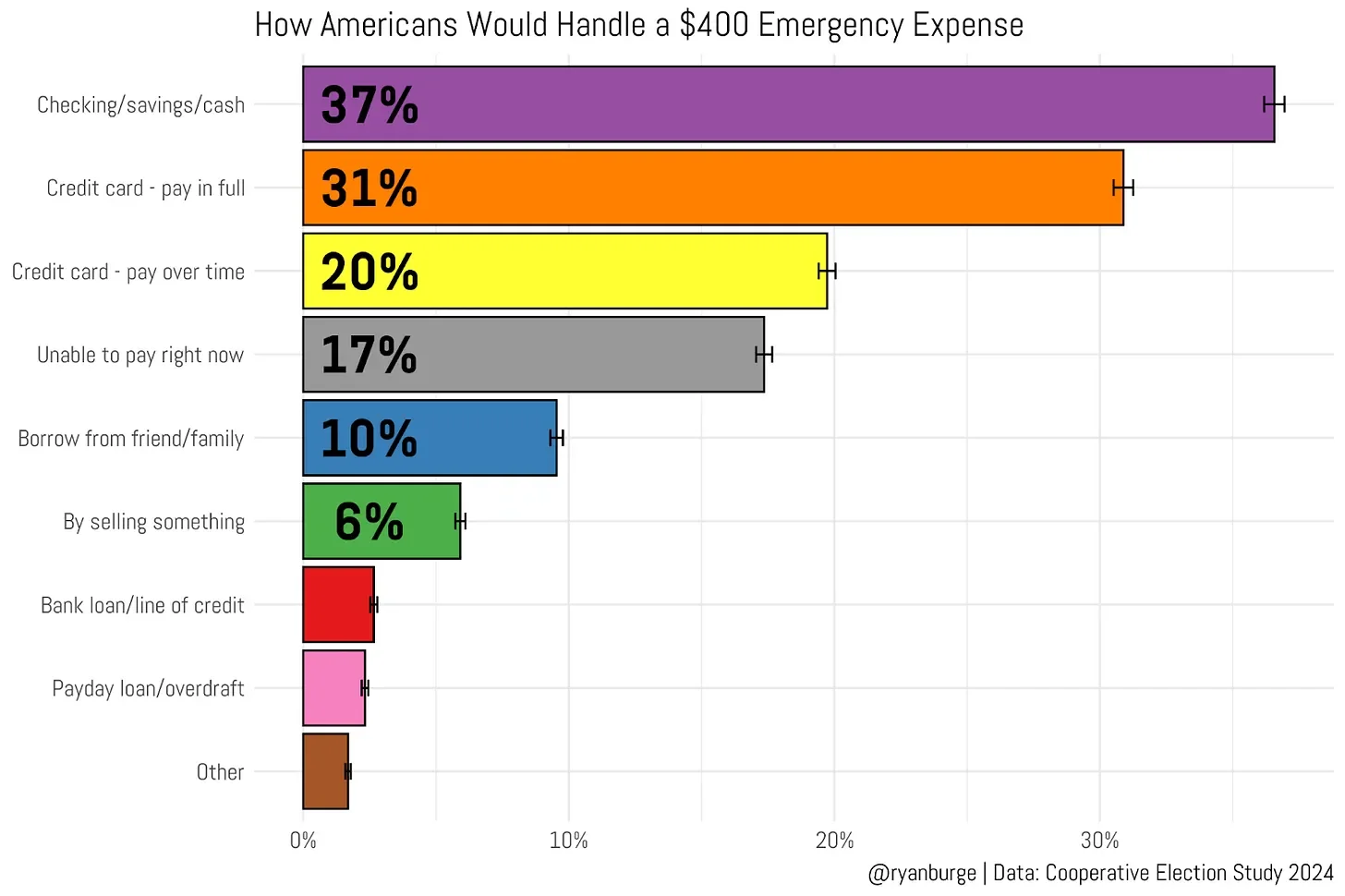
There’s this question battery in the Cooperative Election Study that asks about the respondent’s financial situation in an intriguing way: Suppose that you have an emergency expense that costs $400. Based on your current financial situation, how would you pay for this expense? Then they are given this long list of possible options, and they can check all that apply (but they do have to check at least one box). This is how respondents answered that question in the 2024 survey.
The most popular way to pay that $400 emergency expense was to just pull it out of cash on hand or a savings account. In this survey, 37% of folks would be able to find $400 without too much trouble at all.
Then another 31% said that they would put the expense on their credit card and pay the bill in full when it came due. To me, that’s some pretty compelling evidence that the average American does have at least a small semblance of a financial cushion. Over two-thirds of us can just pay a small bill without going into debt.
One in five Americans would put that expense on their credit card and pay it off over time (accruing interest), 17% would just be completely unable to find $400 right now, and 10% would have to ask a family member or friend for the money. I think we can all agree that the folks who chose these last three options are in some kind of dire financial straits. A $400 expense is certainly nothing to sneeze at, but it’s not like it’s a furnace replacement that could cost ten times that amount. You can’t even buy a decent refrigerator for $400 now.
You can read the rest of this post on Substack.
Ryan Burge is an assistant professor of political science at Eastern Illinois University, a pastor in the American Baptist Church and the co-founder and frequent contributor to Religion in Public, a forum for scholars of religion and politics to make their work accessible to a more general audience. His research focuses on the intersection of religiosity and political behavior, especially in the U.S. Follow him on X at @ryanburge.