
Crossroads Podcast: Preaching To The Choir And Washington Post Layoffs

While reading some of the outraged commentary about the spectacular staff cuts at The Washington Post, I keep thinking of the immortal words of King Theoden of Rohan, when facing dark waves of evil during the Battle of Helm’s Deep.
All together now: “How did it come to this?”
How did the dominant media force in the nation’s capital turn into a sinking ship that, in its most recent fiscal year, lost an estimated $100 million (small change to zillionaire owner Jeff Bezos)? In this week’s “Crossroads” podcast, host Todd Wilken and I used the Post crisis as a window into the growing schism between ordinary news consumers and many elite newsrooms.
What caused this possible death dive at the Post? What happens next? What role did media bias play, especially in coverage of hot-button issues linked to religion, morality, culture and, yes, politics?
In its main report on the crisis, The New York Times offered this summary:
The company laid off about 30 percent of all its employees, according to two people with knowledge of the decision. That includes people on the business side and more than 300 of the roughly 800 journalists in the newsroom, the people said.
The cuts are a sign that Jeff Bezos, who became one of the world’s richest people by selling things on the internet, has not yet figured out how to build and maintain a profitable publication on the internet. The paper expanded during the first eight years of his ownership, but the company has sputtered more recently.
Matt Murray, The Post’s executive editor, said on a call Wednesday morning with newsroom employees that the company had lost too much money for too long and had not been meeting readers’ needs. …
Mr. Murray further explained the rationale in an email, saying The Post was “too rooted in a different era, when we were a dominant, local print product” and that online search traffic, partly because of the rise of generative A.I., had fallen by nearly half in the last three years.
Yeah, right. Yadda, yadda.
But what really happened? And why is the Post sinking while (#DUH) the Times continues to print digital dollars?
In his Substack diary post on the subject, Rod “Live Not By Lies” Dreher was more candid, weaving together some trends he has seen in newsrooms since the 1990s. Here is a key part of that:
Why has the paper lost so many readers over the years?
The Internet is no doubt the main reason. But it is surely also the fact that the Post served as the parish newsletter for the Church of Good Liberals. I sometimes joke that I subscribe to The New York Times so I can know what the regime’s official story is. (By “regime,” I don’t mean the Trump administration, heaven knows; I mean what Curtis Yarvin calls “the Cathedral” — the ruling class that makes up the Deep State and that runs most American institutions.) A Kremlinologist back in the Cold War would read Pravda for the same reason. But that’s unfair to the Times, which, for all its many, many faults, remains a great paper (though one severely limited by its own biases).
Later, Dreher expanded on that thesis:
Before the Internet, a lot of people subscribed to the paper because it was the only way to get in-depth news. Many liberal journalists flatter themselves that people won’t subscribe to the paper because they can’t handle the truth (I’ve heard this, multiple times). It never occurs to them to think that maybe the people don’t value the product, because they don’t trust it. …
[My] guess is that the expertise that made the Post a great newspaper back in the day has been driven out of the paper by a progressive culture of militant hostility to anything that doesn’t fit the preferred Narrative, or at least self-satisfied incuriosity. As a young journalist, I dreamed of one day working at The Washington Post. I am certain there are good journalists still working there. But I would say something that wasn’t true in 1989, when I started working in daily newspapers: that they are places where curiosity about the world goes to die.
Well, I would say curiosity about half of the world, especially here in the divided states of America.
However, it helps to remember that for two decades, the Washington Post was the newspaper on my Capitol Hill desk, more often than not. I knew that paper inside out, since I was requiring my students to read it as our shared frame of reference.
I also remember, during the two decades of GetReligion.org, frequently praising Post coverage of moral and social issues in political life — WHEN the editors took the wise step of allowing skilled religion-beat professionals to take part. When that happened, readers had a chance to read valid, articulate, informed voices on both sides of those debates. Image that!
But that was long ago, of course. Today, we live in a journalism world defined by this recent Gallup Poll information:
Americans’ confidence in the mass media has edged down to a new low, with just 28% expressing a “great deal” or “fair amount” of trust in newspapers, television and radio to report the news fully, accurately and fairly. This is down from 31% last year and 40% five years ago.
Meanwhile, seven in 10 U.S. adults now say they have “not very much” confidence (36%) or “none at all” (34%).
Several years ago, I stopped reading the Post. As a third-party voter, I didn’t want to live in a world in which every single story I read centered on whatever Donald Trump did that day, or said that day. That remained true during the years when Joe Biden, once a rather moderate Democrat, was occasionally in the Oval Office.
Some conservatives on X publicly cheered these layoffs. That attitude is cruel. Most Post reporters and editors probably made $80,000-$140,000, which in a high-tax, high-housing-cost market like Washington doesn’t exactly give them a lot of room to build a cushion.
And the people who got laid off were generally not the paper’s top names. They were anonymous, middle-aged editors or second- and third-tier reporters on unglamorous beats. They will have a very hard time replacing their incomes.
But whatever their personal losses, the Post failed terribly as a news organization over the last 10 years, if not longer.
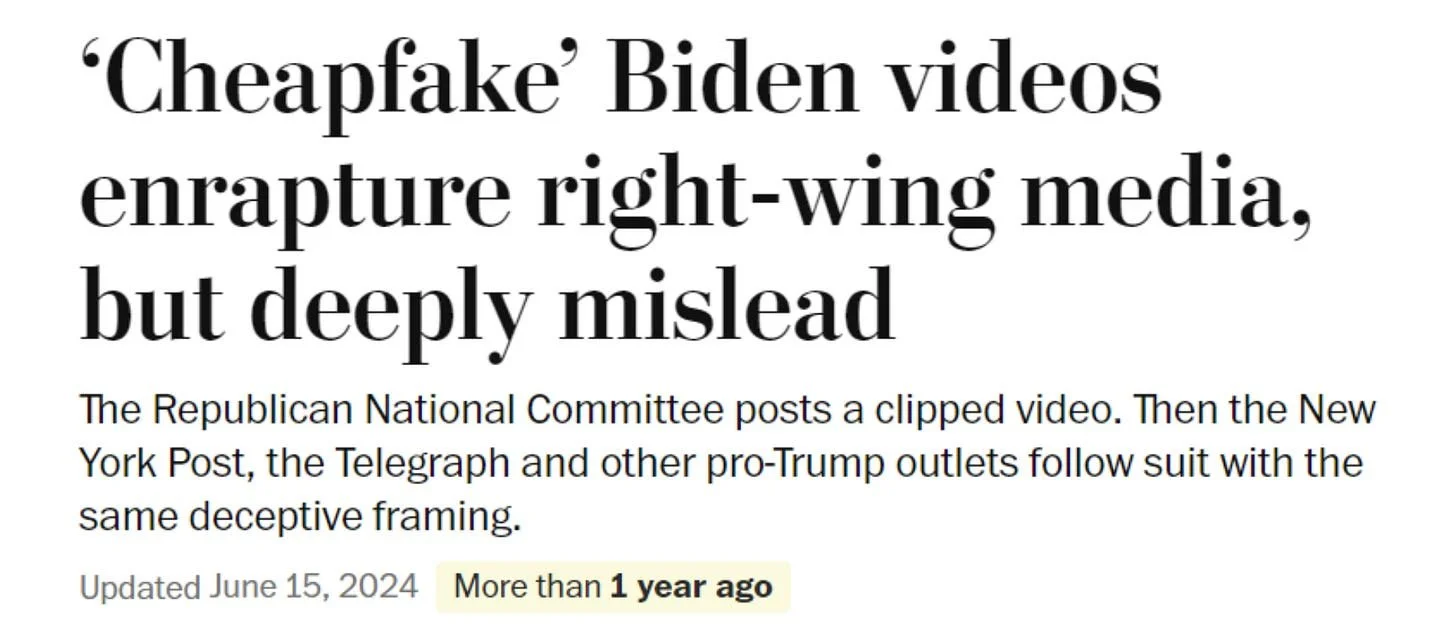
Even more than The New York Times, it became the stupid and reflexive voice of the left. It ran endless articles that went past self-parody, like this one — which came less than two weeks before Biden’s disastrous debate against Donald Trump:
Where do news consumers go from here?
We can start by hoping that Bezos puts the Post up for sale — kind of a “blue light special” at journalism Kmart deal.
Who should buy this strategic newspaper? No, not Elon Musk. He has plenty of work to do with electric vehicles, robots, rockets and clean energy. And not Paramount-Skydance, although I kind of hope for a do-or-die wedding of CBS News, CNN and the old-liberal talent pool at The Free Press.
Here is my hot take: I hope that a certain billionaire scientist on the West Coast has enough money in the bank to pull off what has been proposed several times in the past — a partnership between The Washington Post and The Los Angeles Times.
Dr. Patrick Soon-Shiong has, for example, scared his West Coast Times team with suggestions that it might help — in terms of economics and basic journalism ethics — to stop preaching to the deep-blue choir, and that’s that.
Check out this section of a Soon-Shiong interview at The Free Press, which ran with this rather Hollywood-friendly headline: “The Owner of the LA Times Takes the Red Pill.” Consider this:
In the beginning, Soon-Shiong said, his idea was “to create a media platform that was for all Americans—whether it be left, right, middle. It was to find a way to inform, engage, and to inspire all Americans from whatever leanings, from the rich to the poor, to the unserved, to those without voices.” He added: “That has never changed.”
But here are the words that caused metaphorical heart attacks among Times staffers, in which he said that a form of “ideological rot” existed in his newspaper’s “nearly 400 reporters, editors, copy editors, and photographers, among others.”
The “ideological rot” image came from Free Press writer Peter Savodnik, who then added:
When I suggested the problem is that many young journalists, like many young people in general, are steeped in a politicized postmodernism that insists that there is no objective reality, that everything is simply a perspective, he said: “What you’ve outlined is exactly my concern.”
The solution, he offered, was not new reporters but new technology: an AI-run “bias meter” gauging articles’ ideological tilt; and hyperlinks — “factual statements, which could be identified and linked to the report.” He had also tapped GOP contributor Scott Jennings to be a columnist.
“His reasoned, fact-based approach perfectly aligns with our commitment to inclusivity,” Soon-Shiong tweeted in late November, referring to Jennings. …
“That’s the best we can do right now,” he told me.
Ah, but when Bezos meekly sounded similar themes about the future of The Washington Post, many of his newspaper’s true-blue subscribers walked away in fury. That’s one of the weaknesses of the whole niche-news, “preaching to the choir” business model.
The question I keep asking (“The Evolving Religion of Journalism”) is whether many Americans, at this sad moment in news history, truly want to read accurate, fair-minded, balanced news reporting that shows signs of respect for Americans in red America, as well as blue America. Here’s the final paragraph of my Religion & Liberty essay, once again:
The sobering bottom line: When seeking journalism they can trust, perhaps even news that offers balanced, accurate coverage of views other than their own, American citizens are on their own as they search the World Wide Web. God help them.
Enjoy the podcast and, please, pass it along to others.