
Violence Against Christians Reaches All-Time High In 15 Nations
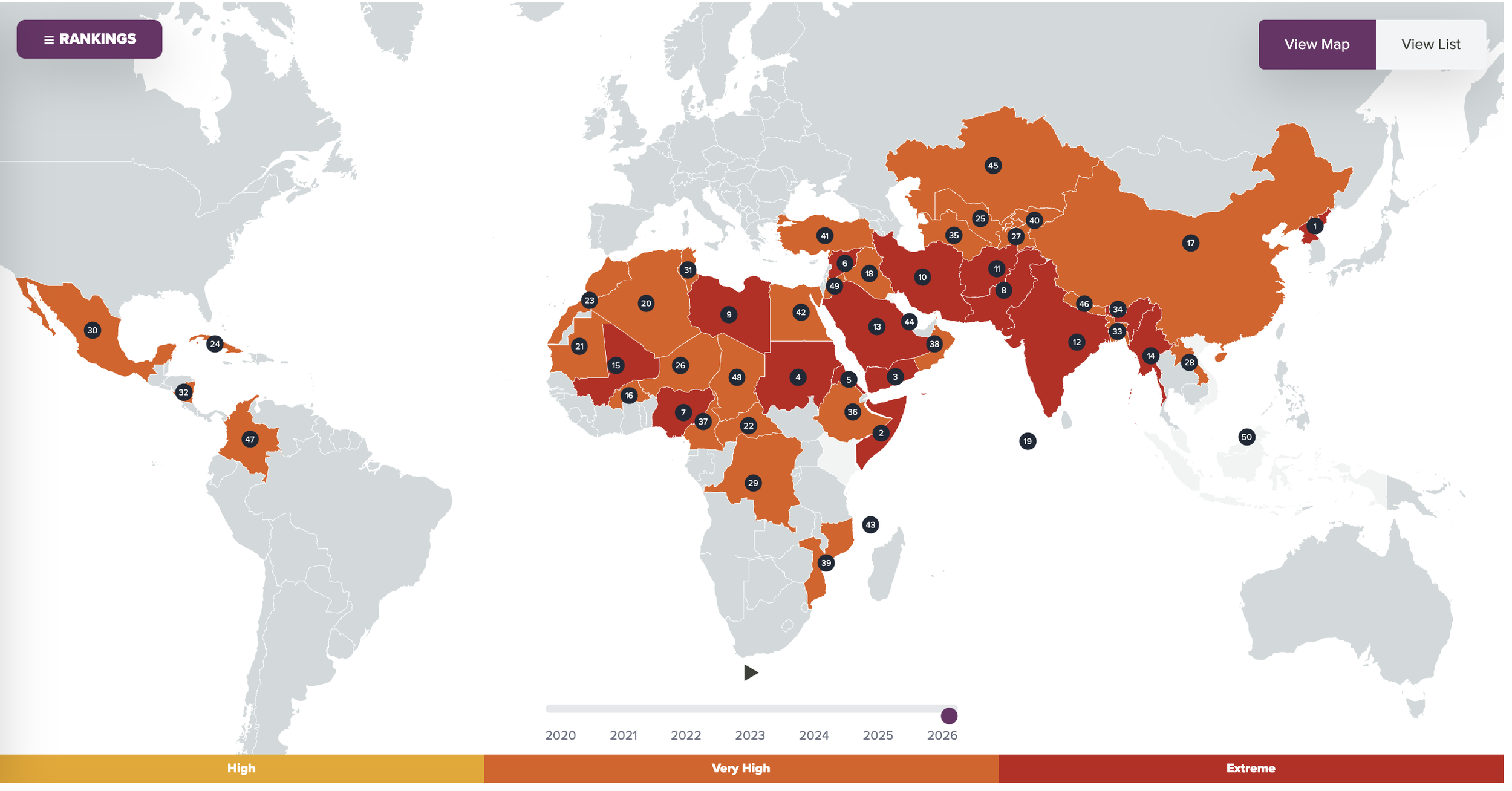
Violence against Christians is at an all-time high in 15 nations including Nigeria and Syria, Open Doors International said on Wednesday in releasing its annual World Watch List of the 50 most dangerous countries for believers.
With 388 million Christians enduring high levels of persecution and discrimination globally, compared to 380 million in the previous reporting year, Open Doors CEO Ryan Brown said persecution is increasing in breadth and severity.
“It’s because the Church is advancing. That’s why the Church is coming under attack,” Brown said. “The enemy is seeking to attack that which is advancing. … As those numbers increase, it shows that the enemy is working even harder to try to squelch the Church.”
READ: Nigerian Humanitarian Calls For Peaceful US Response To Religious Persecution
Since Open Doors launched the WWL in 1993, violence against Christians is at its highest point not only in Syria and Nigeria, but also Sudan, Mali, Burundi, Pakistan, Myanmar, Niger, India, Burkina Faso, the Central African Republic (CAR), the Democratic Republic of the Congo (DRC), Cameroon, Mozambique and Chad.
Regarding “the lived experience of Christians on the ground,” Brown said, “more people are being impacted, and are being impacted more severely.”
Yet Christians persevere and are strengthened by the knowledge that Christians are praying for them, Brown said, emphasizing Bible prophecy that the gates of hell will not triumph over the Church.
“Our founder Brother Andrew (Andrew van der Biji) used to say our prayers can go where we cannot. “And I have heard from our brothers and sisters over and over again that those words are true, because they’ve said it as they’ve sat in prison cells, as they’ve endured experiences that many of us would have difficulty comprehending, the simple fact that they know brothers and sisters around the globe are lifting them up in prayer, they draw comfort and encouragement from that.”
Syria suffered the largest single-year increase in the history of the list, Brown said, moving up 12 spaces on the list this year to rank as the 6th most dangerous nation for Christians. It ranked 18th last year, but has become increasingly unstable since the fall of the Bashar al-Assad regime in December 2024.
“What we have seen is that things have gotten very bad for Christians in Syria, not necessarily at the hand of the government, but more so by the inability of the government to have adequate rule of law,” Brown said, “in that there has been tremendous instability in the country as the regime fell and as HTS (Hay’at Tahrir al-Sham) stepped into power, which has created all sorts of vacuums of power throughout the country.”
Extremists have taken advantage of the new dynamic as an opening for increased persecution in efforts to spread their ideology. At least 27 Syrians were killed for their faith in the 2026 reporting period, according to the WWL, with researchers speculating the number is much higher.
In Nigeria, where international debate has centered on whether extremists target Christians or the general population, the persecution score increased 1 point as Nigeria maintained its spot as the 7th most dangerous place for Christians, and the deadliest among all nations studied.
Nigeria’s place on the list did not change because the top 10 countries because of the extreme persecution among those countries, with persecution scores ranging from 87 to 97 out of 100. Nigeria scored 89, based on analysis from Open Doors’ extensive base of on-the-ground researchers who monitor violence and how Christians lives are impacted privately, within the family, within communities, within churches, and in the national sphere.
“The country is beset by a severe combination of ethno-religious hostility, Islamist militancy, weak governance and organized crime,” Open Doors said in its analysis of persecution in Nigeria. There, more Christians were killed in the 2026 study period for their faith than in all other nations combined, 3,490 deaths in Nigeria among a global tally of 4,849. The numbers are up from the 2025 report, which counted 3,100 deaths in Nigeria among a global count of 4,476.
Boko Haram, Jama’a Nusrat ul-Islam wa al-Muslimin (JNIM), Fulani ethnic militia and Lakurawa are active militants targeting primarily Christians there, with well as the emergence in 2025 of a new group, Mahmuda.
WWL 2026 rankings
North Korea maintains its top spot on the list for the 24th year, with a persecution score of 97; followed by Somalia, second on the list with a persecution score of 94; Yemen, third at 93; Sudan, fourth at 92; Eritrea, fifth at 90; Syria, sixth at 90; Nigeria, seventh at 89; Pakistan, eighth at 87; Libya, ninth at 87, and Iran, 10th at 87.
Rankings continue respectively with Afghanistan, India, Saudi Arabia, Myanmar, Mali, Burkina Faso, China, Iraq, Maldives, Algeria, Mauritania, CAR, Morocco, Cuba, Uzbekistan, Niger, Tajikistan, Laos, DRC, Mexico, Tunisia, Nicaragua, Bangladesh, Bhutan, Turkmenistan, Ethiopia, Cameroon, Oman, Mozambique, Kyrgyzstan, Turkey, Egypt, Comoros, Qatar, Kazakhstan, Nepal, Colombia, Chad, Jordan and Brunei.
By the Numbers
— 224,129 Christians were forced to leave their homes and go into hiding or leave their respective country.
— 67,843 Christians were beaten, threatened, or physically or psychologically abused. 163 of those were in Mexico.
— 5,202 Christians were sexually assaulted, harassed or forced to marry non-Christians, with an estimated 1,000 of those in the DRC.
— 25,794 attacks were made on Christian homes, shops and businesses.
— 4,849 Christians were killed for faith-related reasons, 3,490 of them in Nigeria.
— 4,712 Christians were detained without trial, arrested, sentenced or imprisoned, with more than 1,600 of these incidents occurring in India.
— 3,302 Christians were abducted.
— 3,632 churches or public Christian properties were attacked or closed, with about 1,000 of those in China.
Download the free WWL here and the companion advocacy report here.
This article has been republished with permission from Baptist Press.
Diana Chandler is Baptist Press’ senior writer.