
How Big Is ‘The God Gap’ On College Campuses?
(ANALYSIS) It’s the most important feature of American religion and politics that I wish more people understood: The God Gap.
Simply put, religious people tend to gravitate toward a conservative political ideology and tend to favor the Republican Party on election day. Among the non-religious, it’s just the opposite — they are more apt to say that they are politically liberal and that they align with the Democratic Party.
But I wanted to try and figure out if that gap may begin to narrow or if it will widen in the future by using a new dataset I’ve gotten my hands on from FIRE (Foundation for Individual Rights and Expression), which is doing a really great annual poll of college students.
The total sample size is 68,510 students attending 257 universities across the United States. It’s not a representative sample of all college students, but it is definitely in the ballpark of a solid sample.
There are two questions about religion in the survey: Affiliation and attendance. That means I have more than enough to start poking around on the God Gap.
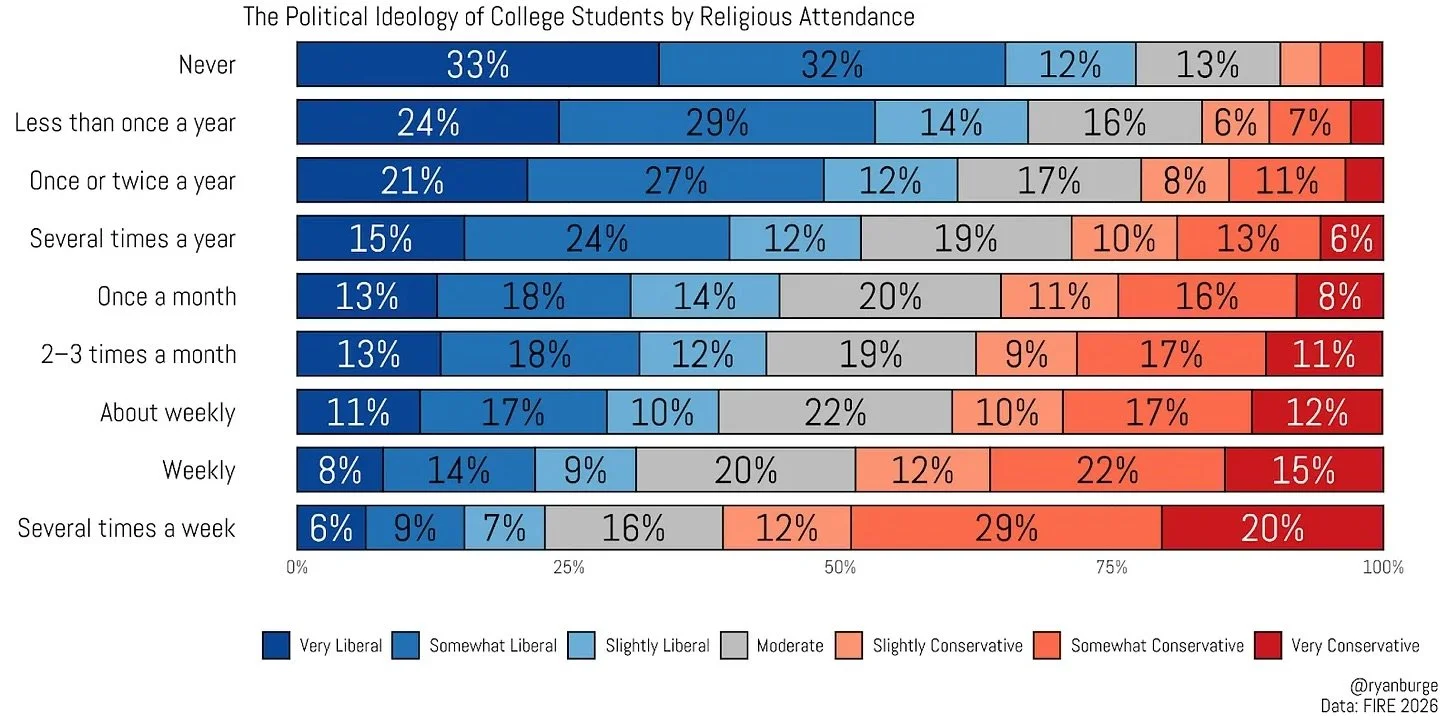
Let me start by showing you the distribution of political ideology based on self-reported levels of religious attendance.
And, boy, that is a beautiful cascade of stacked bars. Among college students who report that they never attend religious services, 33% report that they are “very liberal,” and nearly the same share (32%) indicate that they are “somewhat liberal.” If you throw in the “slightly liberal” portion, you get two-thirds of never attenders on the liberal side of the spectrum. In contrast, conservatives make up 10% of the never attenders.
As attendance goes up, the liberal share goes down and the conservative responses begin to rise. The liberal share drops below 50% of the sample when you get to attendance that’s once a month or more.
But here’s a fun fact — the only attendance level where conservatives make up a majority is among those who attend a house of worship multiple times per week. Those folks make up 3% of the sample.
Meanwhile, the never attenders are 10 times that large (32%, to be exact).
You can read the rest of this post on Substack.
Ryan Burge is an assistant professor of political science at Eastern Illinois University, a pastor in the American Baptist Church and the co-founder and frequent contributor to Religion in Public, a forum for scholars of religion and politics to make their work accessible to a more general audience. His research focuses on the intersection of religiosity and political behavior, especially in the U.S. Follow him on X at @ryanburge.