
Never In The Pews: Are America’s Non-Attenders Growing More Secular?
(ANALYSIS) There’s this well-worn phrase you hear in Christian circles: “Going to church doesn’t make you a Christian any more than standing in a garage makes you a car.”
It’s often used by pastors to remind people that simply showing up on Sunday isn’t enough to be a faithful Christian. The point is that authentic faith is more than just checking a box once a week.
But there’s another way to read that line — especially for people who don’t go to church much. I hear it all the time: “I don’t need to show up at some worship service to grow deeper in my faith.”
READ: Young Mormons Aren’t Blue — Just A Little Less Red
They’ll say a walk through nature is more edifying than Sunday worship. From a social-scientific standpoint, that’s basically someone saying that religious behavior doesn’t matter much — they place more emphasis on belief or maybe belonging instead.
That’s something I’ve been thinking about a lot lately: people who say they’re religious but rarely (or never) go to church, mosque or synagogue. More specifically, I wondered whether those who never attend services today are further removed from other measures of religiosity than people were 20 or 30 years ago.
Put simply — are never-attenders becoming more secular each year? I can actually answer that question using data from the General Social Survey, hosted by the Association of Religion Data Archives (ARDA). They just posted the 2024 GSS data, which makes this analysis as up-to-date as possible.
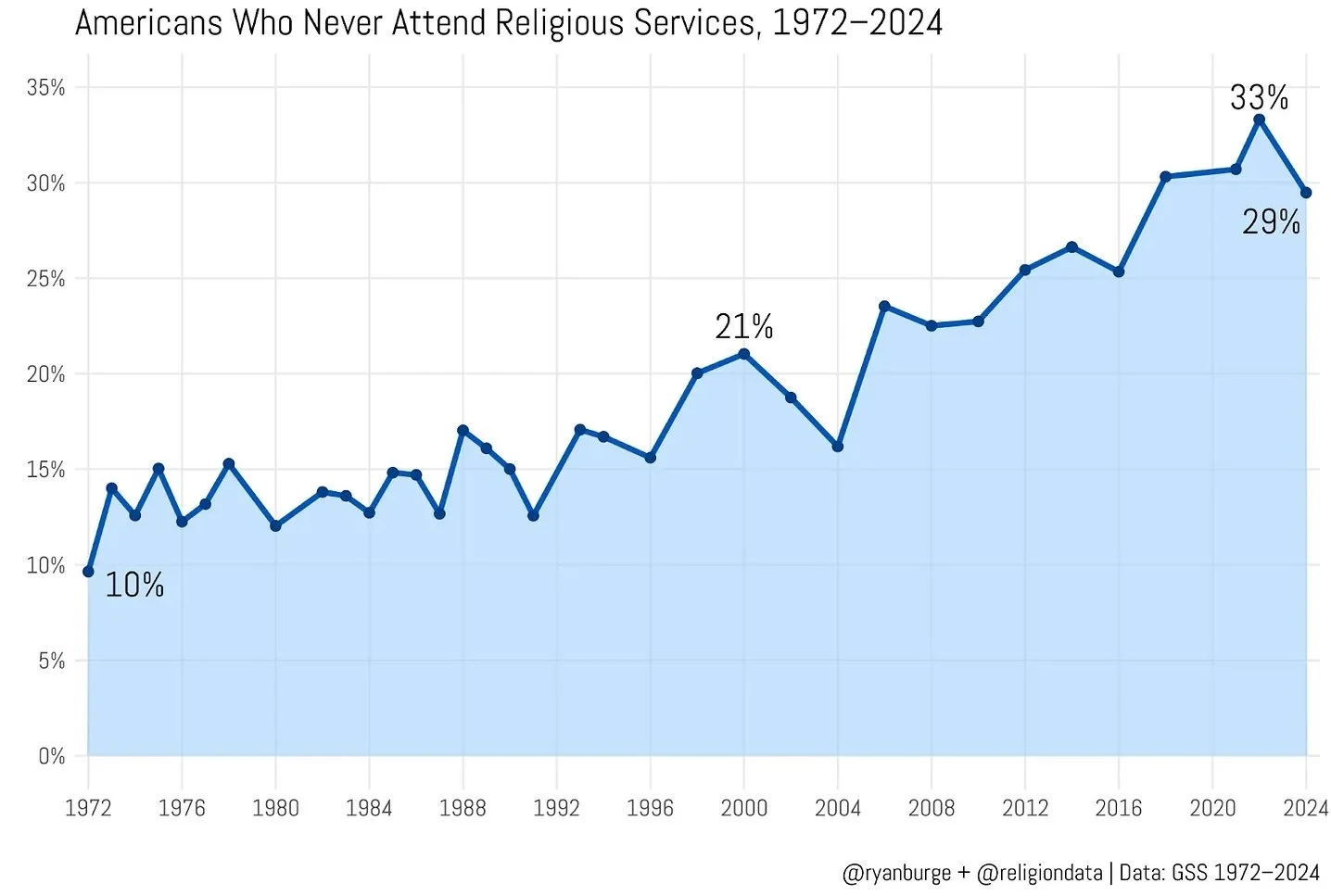
Let’s start by looking at how the share of “never attenders” has changed over time, using the GSS question on religious attendance.
It’s pretty wild to think that in 1972, only about one in ten American adults said they never attended religious services. In contrast, more than 40% were going nearly every week or more. Think about that — in the early 1970s, weekly attenders outnumbered never-attenders by roughly four to one.
But that gap didn’t last long. By the early 1990s, the share of never-attenders had climbed above 15%.
It hit 20% for the first time around 2000 and was clearly above 25% by 2012. In the last four waves of the GSS, more than 30% of adults reported never attending in three of those years. In the most recent data, that number slipped slightly to 29%—a bit lower than in 2016 and 2018.
But let’s not go calling that a revival, OK? For comparison, about 25% of Americans reported weekly attendance in 2024.
You can read the rest of this post on Substack.
Ryan Burge is an assistant professor of political science at Eastern Illinois University, a pastor in the American Baptist Church and the co-founder and frequent contributor to Religion in Public, a forum for scholars of religion and politics to make their work accessible to a more general audience. His research focuses on the intersection of religiosity and political behavior, especially in the U.S. Follow him on X at @ryanburge.