
U.S. Religious Decline Stalls, But No Revival Detected Among Young People
NEW YORK — After decades of falling religious affiliation and participation, key measures of religiousness in the United States have leveled off in recent years — although no revival has been detected among young people, according to new study.
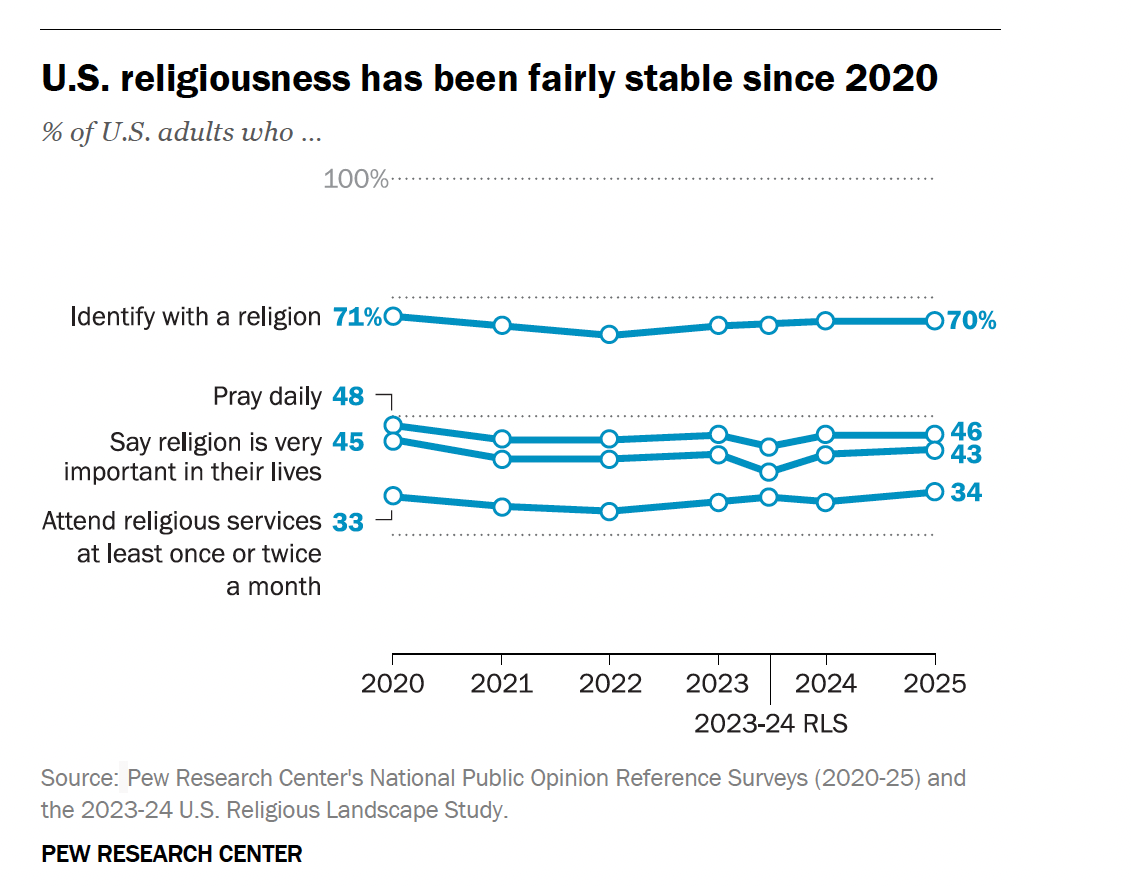
The findings from the Pew Research Center suggest that a period of relative stability — first observed around 2020 — has continued five years after the pandemic.
Pew reported that the proportions of Americans who identify as Christian, who follow another religion or who are religiously unaffiliated have all remained largely unchanged in its latest surveys. Levels of daily prayer, the share of adults who say religion is very important in their lives, and regular attendance at religious services have also held steady.
READ: Faith Deserves Better News Coverage — And Here’s How You Can Help
The stabilization stands out because it follows a long and well-documented decline in religious belonging, belief and practice. For years, generational turnover played a major role: Older, more religious generations were gradually replaced by younger cohorts that were significantly less religious.
“We know that the previous long-term declines were driven largely by generational shifts,” the report said. “Older ‘birth cohorts’ … tend to be highly religious. As people in these cohorts have died, they’ve been replaced in the population by younger cohorts of adults who are far less religious.”
A religious revival?
The data released on Monday, however, tried to clarify the question that has drawn recent attention: Are young adults becoming more religious? Some have suggested the possibility of a revival, particularly among young men who are converting to Orthodoxy or Catholicism. But Pew’s findings show no sign of a nationwide resurgence.
Overall, only 1% of U.S. adults ages 18 to 24 currently identify as Orthodox Christians “after having been raised in another religion or with no religion. An equal share of these adults has left Orthodoxy,” the report said.
“On average, young adults remain much less religious than older Americans,” the report added. “Today’s young adults also are less religious than young people were a decade ago. And there is no indication that young men are converting to Christianity in large numbers. Of course, it’s possible smaller changes are happening in some places that just aren’t widespread enough to show up in national surveys.”
When it comes to Catholicism, Pew said “far more young people have switched out than in.”
Overall, 12% of today’s youngest adults have “switched out of Catholicism. Meanwhile, 1% of adults ages 18 to 24 have switched into Catholicism, meaning that they identify as Catholic today,” the report added.
Young men as relgious as young women
Still, the data reveals some notable shifts within younger generations. For the first time, young men are about as religious as young women — a reversal of the longstanding pattern in which young women tended to be more religious. Among older Americans today, that earlier pattern still holds, with women far more religious than men.
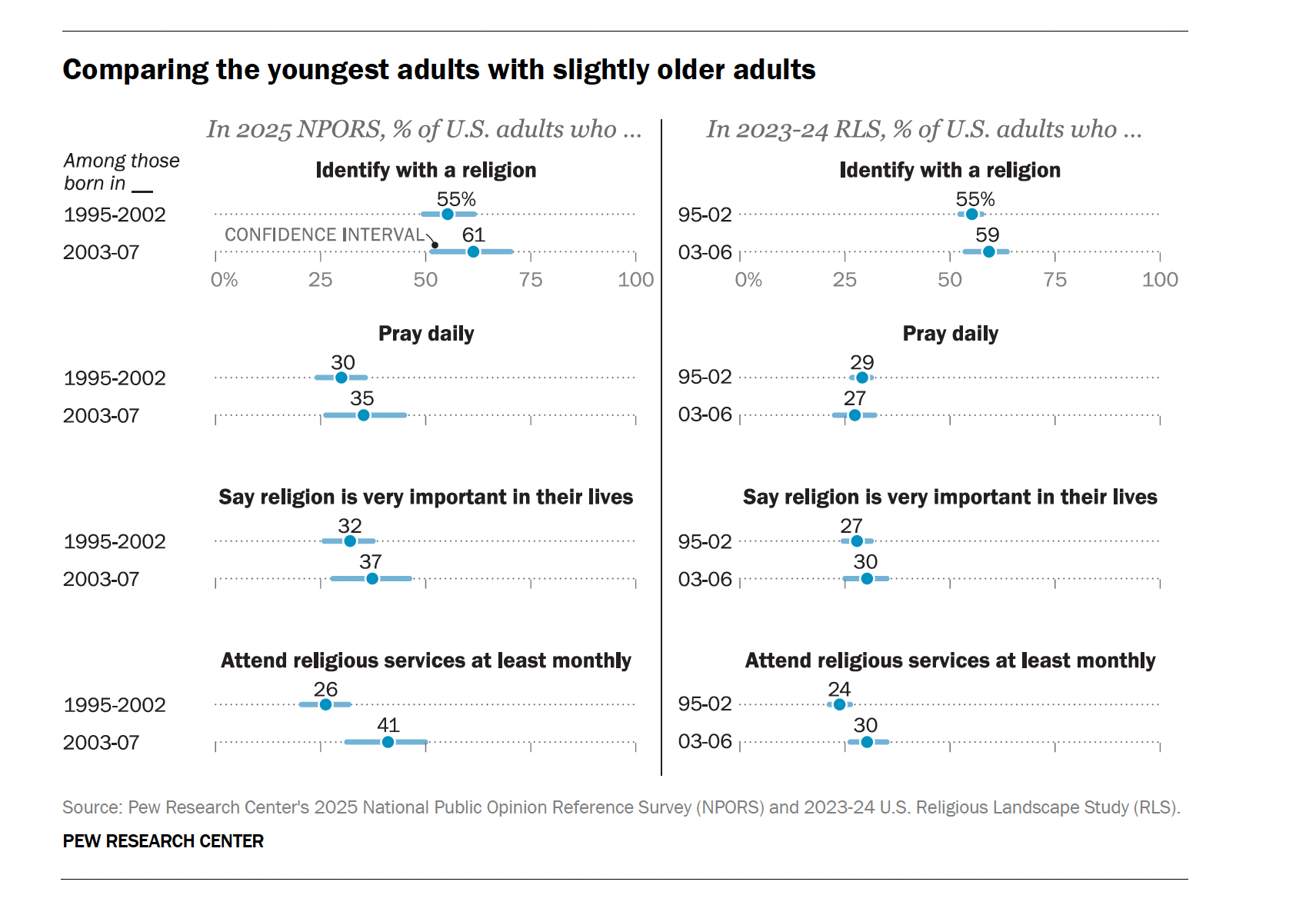
For example, this year’s date shows that 83% of the oldest adults identify with a religion — almost identical to the share measured in the 2020 figure of 84%. Similarly, among the youngest adults we can track across recent surveys, 55% now identify with a religion – about the same as 2020 at 57%.
“These patterns may reflect the fact that many of the youngest adults still live in their childhood homes and follow the religious customs of their families. As they get older and more of them leave home, their religious habits may change,” the report added.
But the report also emphasized that this narrowing gap among young adults is being driven by declining religiousness among young women – not rising religiousness among young men.
Pew also found that the very youngest adults — between the ages 18 to 22 — are at least as religious as those now in their mid- to late 20s.
Researchers cautioned that this is not a new phenomenon. Among previous generations, the youngest adults sometimes matched or slightly exceeded the religiousness of those just a bit older, only to grow less religious as they grew older.
Clemente Lisi is executive editor at Religion Unplugged.