
Number Of Catholics Drop In Latin America, More Identify As ‘Nones’
The Catholic Church’s long-dominant hold on Latin America is continuing to loosen, even as most people across the region remain deeply religious, according to new survey data from the Pew Research Center.
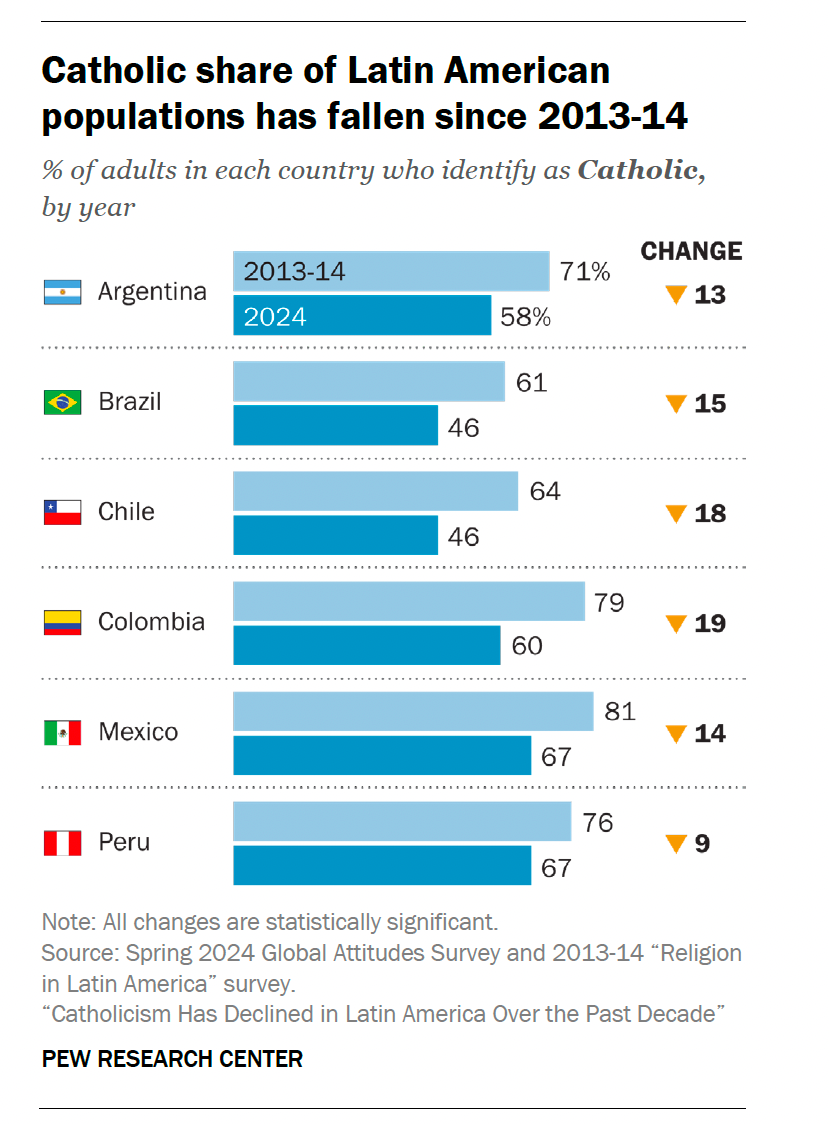
Across six of Latin America’s most populous nations — Argentina, Brazil, Chile, Colombia, Mexico and Peru — the share of adults who identify as Catholic has dropped sharply over the past decade, according to a new Pew Research Center study released on Wednesday.
At the same time, Pew found that a growing proportion of Latin Americans now describe themselves as religiously unaffiliated, saying they are either atheist, agnostic or have no particular faith tradition.
READ: Data Shows Protestant Church Closures Eclipse Openings In the US
Catholicism, however, remains the region’s largest religious tradition, but its numerical dominance has weakened in recent years. Today, Catholics account for between 46% and 67% of adults in each of the six countries surveyed. In contrast, Pew said the share of adults who are religiously unaffiliated now ranges from 12% to 33%.
Taken together, the findings suggest a region in religious transition rather than secular collapse. Catholicism is shrinking, institutional affiliation is loosening and more people are choosing no formal religious label. Yet belief in God, prayer and the personal importance of religion remain deeply embedded in Latin American society — pointing to a future in which faith persists.
Catholicism has been deeply rooted in Latin America due to Spanish and Portuguese colonization that started in the late 15th century. There were instances where Catholic missionaries were opposed to the colonizing forces and protected people from enslavement — a major factor in the expulsion of the Jesuits from the Americas in 1767. Although Latin American nations eventually gained independence from Spain and Portugal, the religious legacy of colonialism has persisted.
Nonetheless, in every country Pew studied, the Catholic share of the population has fallen by at least nine percentage points since 2014, while the unaffiliated population has grown by seven points or more. In several countries, religious “nones” now even outnumber Protestants.
The findings are based on Pew Research Center surveys conducted in 2024 among more than 6,200 adults in the six nations. Since Pew conducted similar surveys across Latin America a decade ago, these latest results offer a comparison of how religion in the region has changed over a decade.
In 2014, each of the six countries had solid Catholic majorities, with roughly six-in-10 adults identifying as Catholic. Today, that is no longer the case in Brazil and Chile, where just 46% of adults said the same. Elsewhere, Catholic majorities persist, but are significantly smaller: 58% in Argentina, 60% in Colombia and 67% each in Mexico and Peru.
The long-term trend is not new. Data reveals that Catholicism has been declining in these countries since the 1970s. But Pew, in releasing these latest figures, said the pace of change over the past decade has been particularly striking.
“In sum, the realignment of Latin America has been the most dramatic storyline in global religious demography in the last century. Such rapid and massive change requires explanation, and over the last few decades there’s been no shortage of punditry on the subject,” noted Vatican observer John Allen said in 2024.
Matthew Blanton, who studies migration and religion in Latin America, said last year that the region’s “500-year transformation into a Catholic stronghold seemed capped in 2013, when Jorge Mario Bergoglio of Argentina was elected as the first Latin American pope. Once a missionary outpost, Latin America is now the heart of the Catholic Church. It is home to over 575 million adherents — over 40% of all Catholics worldwide. The next-largest regions are Europe and Africa, each home to 20% of the world’s Catholics.”
Nonetheless, Pew found that the number of religiously unaffiliated adults has roughly doubled in Argentina, Brazil and Chile, tripled in Mexico and Peru, and nearly quadrupled in Colombia.
Chile, meanwhile, now has the largest share of unaffiliated adults among the six countries surveyed at 33%. In Argentina, nearly one-quarter of adults say they have no religious affiliation, while about one-in-five Mexicans now fall into that category.
In Argentina, Chile, Colombia and Mexico, the unaffiliated population is larger than the Protestant population. In Mexico, for example, about 20% of adults identify as atheist, agnostic or “nothing in particular,” compared with roughly 10% who identify with any Protestant tradition.
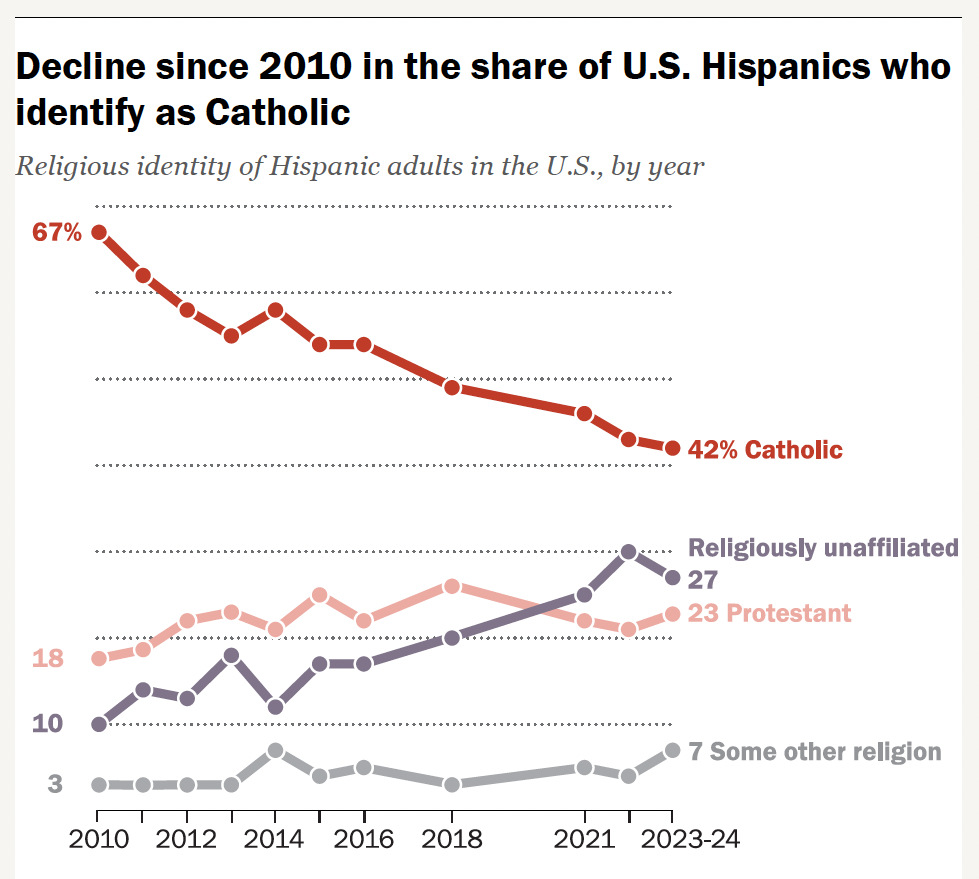
Blanton’s research also mirrored these findings, saying “the region’s religious landscape is changing.”
Noting that Protestant and Pentecostal groups “have experienced dramatic growth,” Blanton also noted that “a growing share of Latin Americans abandoning institutional faith altogether. And, as my research shows, the region’s religious decline shows a surprising difference from patterns elsewhere. While fewer Latin Americans are identifying with a religion or attending services, personal faith remains strong.”
Despite these shifts away from Catholicism, Latin America remains highly religious by many measures, especially compared with Europe and other parts of the world. Belief in God is nearly universal across the region, with around nine-in-10 or more adults in every country surveyed saying they believe in God.
Religion also continues to play an important role in daily life. About half or more of adults in Brazil, Colombia, Mexico and Peru say religion is very important to them. Regular prayer remains common. Majorities of adults in Brazil, Colombia and Peru report praying at least once a day.
By these standards, Latin Americans are considerably more religious than adults in many countries surveyed by Pew in recent years, particularly compared to Europe, where large numbers of people have left Christianity. Notably, levels of belief in God in Latin America have remained largely stable over the past decade, even as institutional affiliation has shifted.
Even among those who say they are religiously unaffiliated, belief in God is widespread. Majorities of “nones” across the region say they believe in God, suggesting that many people who leave organized religion do not necessarily abandon spiritual belief.
One key driver behind the decline of Catholicism is religious switching — adults leaving the religion in which they were raised. Across the six nations surveyed, roughly two-in-10 adults said they were raised Catholic but no longer identify as such.
As a result, most former Catholics have become religiously unaffiliated, though smaller shares have joined Protestant churches. In Colombia, for instance, 22% of adults said they were raised Catholic but have since left the church. Of those, 13% of all Colombian adults now identify as atheist, agnostic or “nothing in particular,” while 8% have become Protestant.
Brazil stands out as the only country surveyed where former Catholics are more likely to have become Protestant than unaffiliated. In Brazil, 13% of all adults said they were raised Catholic and are now Protestant, compared with just 7% who are former Catholics and now religiously unaffiliated. In Peru, former Catholics are split more evenly, with similar shares becoming Protestant or unaffiliated.
Meanwhile, Protestantism has remained relatively stable overall. In Brazil, 29% of adults now identify as Protestant — up slightly from 26% a decade ago.
You can read this story in Spanish here.
Clemente Lisi serves as executive editor at Religion Unplugged.