
‘The 200-Church Gap’: Data Shows Closures Eclipse Openings In the US
The changing religious landscape in the United States includes a decline in the total number of Protestant churches.
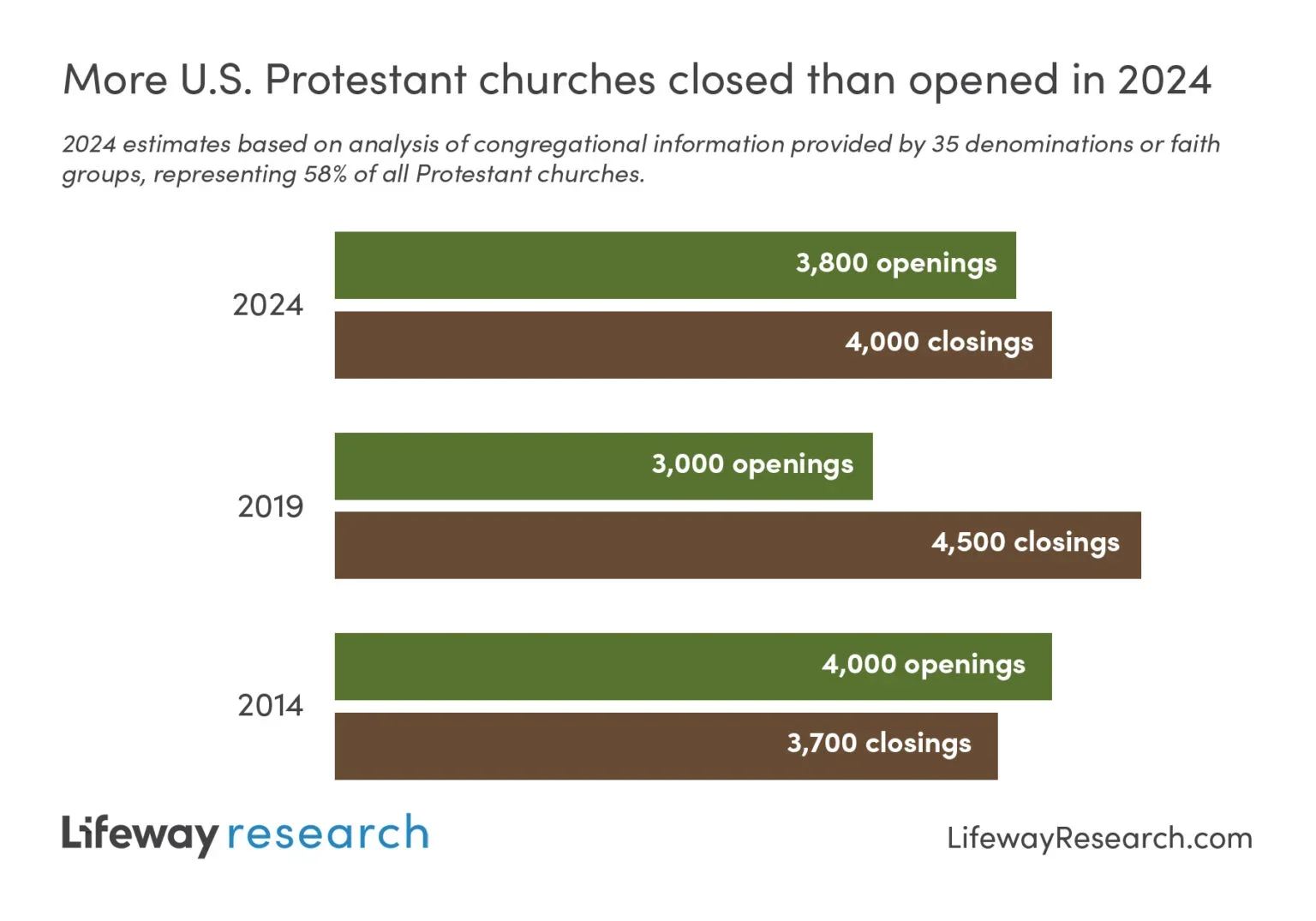
In 2024, Lifeway Research estimates 3,800 new Protestant churches were started in the U.S., while 4,000 churches were closed. This is based on analysis of congregational information provided by 35 denominations or faith groups, representing 58% of all Protestant churches.
“Some individual denominations release annual numbers related to church plants and church closures, but we are grateful many more were willing to contribute unpublished numbers to help us understand the bigger picture of Protestant churches today,” said Scott McConnell, executive director of Lifeway Research.
READ: Teaching Ways To Reimagine America’s ‘Spiritual Brownfields’
“Given recent declines in Americans identifying as Christians, churches show a remarkable ability to remain open, even with fewer attendees on average.”
The 200-church gap between those closed and those opened represents a significant improvement over the 2019 numbers. In the most recent previous analysis, 1,500 more churches closed than opened. Five years ago, there were 4,500 closures compared to 3,000 openings. Ten years ago, however, Lifeway Research found more Protestant churches were planted (4,000) than closed (3,700) in 2014.
“It’s hard to overstate the importance of church planting in the landscape of faith in America today,” said Ed Stetzer, dean of the Talbot School of Theology at Biola University and author of several books on church planting and church growth.
“Simply put, without church planting, every denomination that’s growing would be shrinking and every denomination that’s shrinking would be shrinking more. Church planting is the most significant engine for evangelistic growth that we have in the world today.”
Using the U.S. Religion Census 2020 estimate of approximately 293,000 Protestant congregations in the U.S., the 4,000 closures in 2024 represent almost 1.4% of all U.S. Protestant churches. Protestant congregations in the U.S., the 4,000 closures in 2024 represent slightly more than 1% of all U.S. Protestant churches.
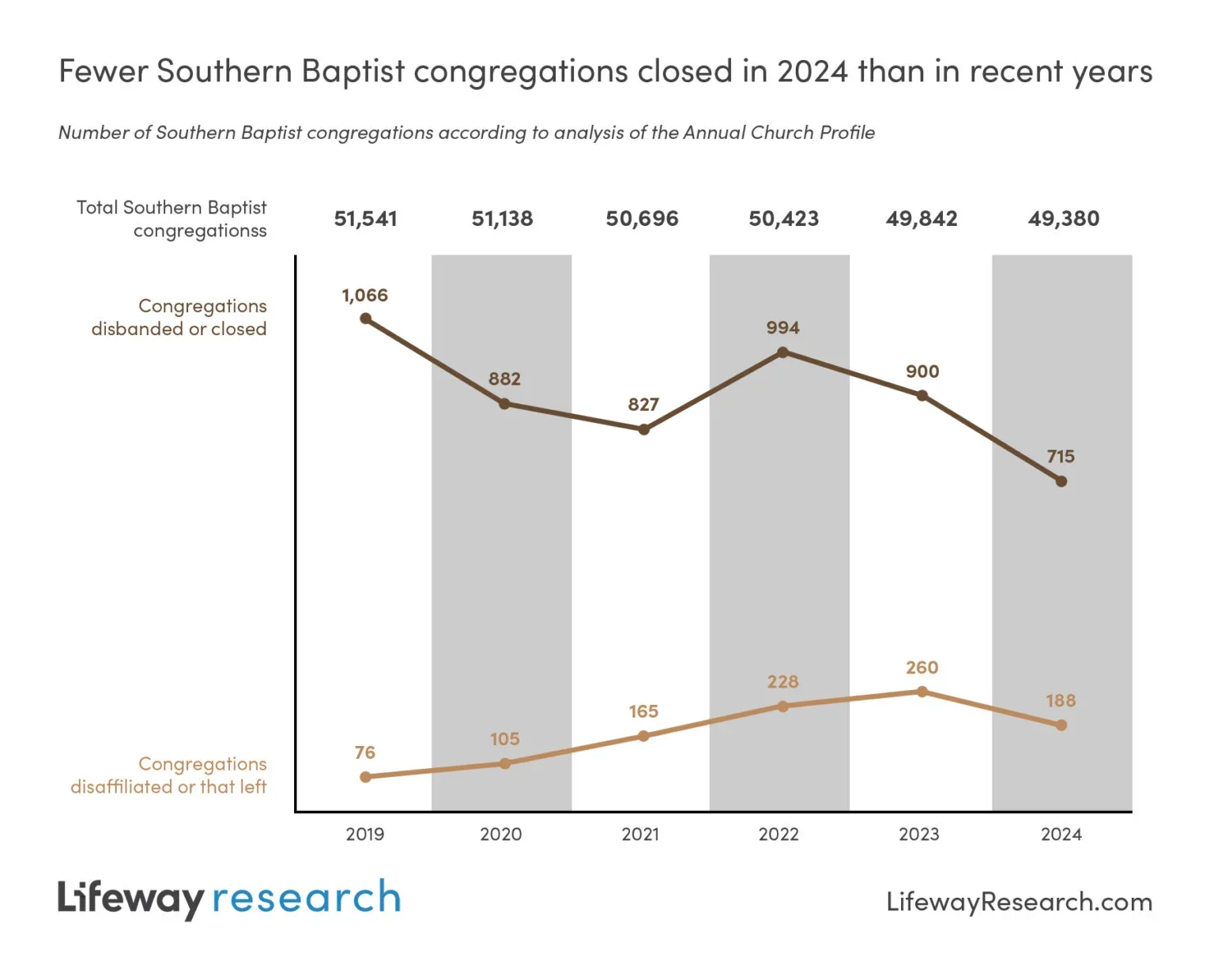
Lifeway Research’s analysis of the Southern Baptist Convention (SBC), the nation’s largest Protestant denomination, found 1.4% of active Southern Baptist congregations disbanded or closed and 0.4% left or were disaffiliated between 2023 and 2024.
In 2024, 906 of the 49,380 active Southern Baptist congregations from the previous year were no longer part of the convention, including 715 that disbanded or closed and 188 that left or were disaffiliated. However, many new churches were planted, and some existing churches became affiliated with the SBC. So, the Southern Baptist Convention had just 183 fewer congregations in 2024 compared to 2023, according to the SBC’s most recent Annual Church Profile.
The number of Southern Baptist congregations peaked in 2017 and has declined each year since. However, the 715 that disbanded or closed in 2024 represent the smallest annual loss during the decline.
“The immediate impact of COVID appears to have passed. Denominations have discovered those that closed during quarantine and never reopened. However, the typical church in America has fewer attendees than it did 20 years ago. These assemblies are often weaker than prior generations. But at the same time, new churches are flourishing and a subset of churches are growing,” said McConnell.”
Existence expectations
Most pastors aren’t planning on their churches shutting down any time soon, but a few have concerns.
The vast majority of U.S. Protestant pastors don’t expect their church to be among those closing. A Lifeway Research study found 94% of pastors believe their churches will still exist in 10 years, 4% disagree and 2% aren’t sure.
Even among those who believe their churches have an extended future, some are concerned. Fewer than 4 in 5 (78%) strongly agree they expect their church to have at least another decade.
Smaller church pastors are most likely to be worried. Those leading churches with fewer than 50 in attendance are the least likely to agree their church will still exist in 10 years (88%) and most likely to disagree (8%).
“The typical American church has always been small. But the aging of church attendees and higher cost of living mean even a church with the same number of attendees may have fewer resources than a generation ago,” said McConnell. “However, those churches would say their power is not found in numbers or the strength of the attendees but in the God they serve.”
Church planting priorities
A recent Lifeway Research study found more than a third of U.S. Protestant churches have participated in helping to start new churches. But while 36% say they were involved in planting new churches, the levels of participation vary.
Around two in five of these churches have helped with training (42%) and coaching (38%) for church planters. Three in 10 (30%) have been involved with church planting assessments. Just 2% of all churches have accepted direct financial responsibility as the primary sponsor of a new church in the last three years.
Not only do new churches help offset the losses of churches that close, but newer congregations are statistically more likely to be growing than others.
Specifically within the Southern Baptist Convention, the only group of churches that demonstrated overall membership growth in the past five years is those founded in the last 25 years, according to Lifeway Research analysis. Those that began since 2000 grew by 12%. Membership among congregations founded between 1950 and 1999 (-11%), 1900 and 1949 (-13%) and before 1900 (-11%) all declined.
“While the American church landscape changes slowly, it is not standing still,” said McConnell. “The future of Protestant churches in America lies in reaching new people with the offer of salvation through Jesus Christ. Most growth in the U.S. happens in new communities. Church planting is vital to share the gospel in these new communities as well as communities in which the population is changing or previous churches have closed.”
For more information, view the report on Southern Baptist Convention ACP analysis.
Aaron Earls is the senior writer at Lifeway Research.