
The Anti-Abortion Democrat Has Become A Politically Endangered Species
(ANALYSIS) The conventional wisdom in American politics holds that abortion is a litmus test issue. Simply stated, Republicans must be pro-life and Democrats must be pro-choice to survive in their respective primaries. Let alone a general election.
On the Republican side, the most prominent example of a pro-choice Republican finding electoral success is Charlie Baker, the former governor of Massachusetts, who won two terms in a deep blue state while maintaining a pro-choice position.
Susan Collins of Maine represents another case. She has won four Senate elections in a state that leans Democratic in presidential years while consistently supporting abortion access.
READ: UK Preacher Latest Convicted For Gospel Outreach In Abortion Buffer Zone
But let’s be clear about something in the case of Baker and Collins — the states that they represent aren’t the reddest in the Union. It makes me wonder if their success reflects genuine cross-pressured voters or simply the fact that pro-choice Republicans can do well in a handful of states in the Northeast.
It’s even more difficult to find a pro-life Democrat, though. Bob Casey of Pennsylvania built a career as one of the last prominent pro-life Democrats in the Senate, though his 2024 reelection loss to Dave McCormick raises questions about whether his brand of cross-pressured politics had finally run its course in a nationalized electoral environment.
Tim Ryan, who ran a competitive Senate race in Ohio in 2022, moderated his historically pro-choice position during the campaign, suggesting that even candidates in red-leaning states felt pressure to move toward the party mainstream after Dobbs.
For whatever reason, I see a lot of pontificating on social media about what the Democrats and Republicans should do on abortion, and I thought I would try to inject some signal in all that noise by just tracing how abortion has shifted over time and whether candidates are capable of actually splitting the votes of pro-life or pro-choice people in any effective way.
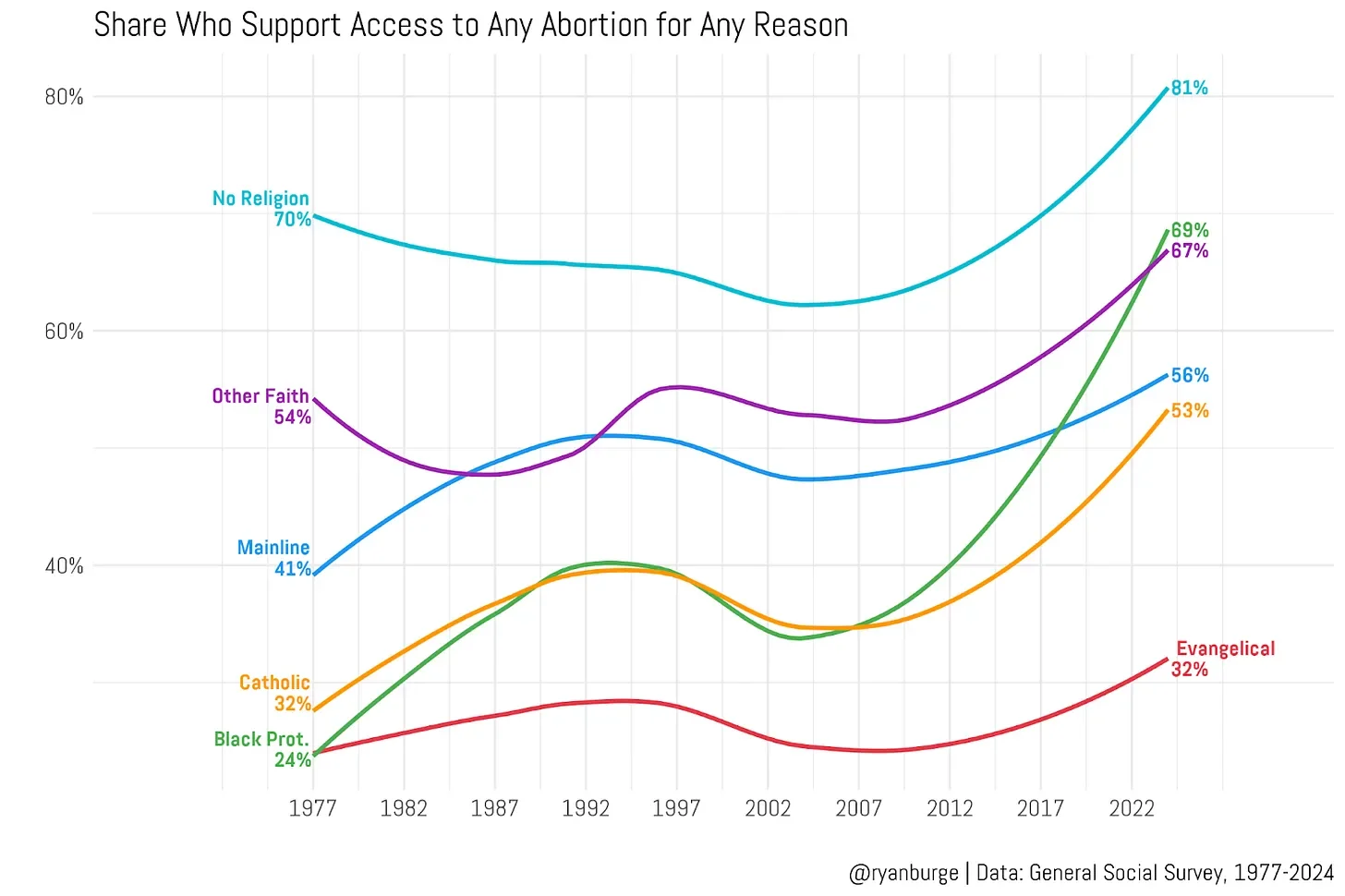
First, let me just show you a couple of graphs that lay out the long term trends surrounding access to abortion. Since 1977, the GSS has been asking, “Do you think it should be possible for a pregnant woman to obtain a legal abortion if the woman wants one for any reason?” The trend is certainly in the pro-choice direction.
Obviously the non-religious stand out on this metric. Even back in the late 1970s, the vast majority favored abortion access. That share has only grown over time and now 81% of the nones think a pregnant woman should be able to obtain an abortion if she wants one for any reason. The “other faith” category went from slight majority support (54%) to strong support (67%) over this 45 year window of time.
Every Christian group has moved to the pro-choice side on this question over time. For some groups, the shift has been large, for others it’s been relatively small.
Among mainline Protestants, the movement was 15 points to the left — now a bare majority support access (56%). For Catholics, they went from strong opposition back in 1977 (only 32% in favor) to being almost evenly split on this now: 53%. Evangelicals have moved the least of any group: 24% back in 1977 to 32% today. They are the only religious group where a majority did not favor abortion access.
You can read the rest of this post on Substack.
Ryan Burge is an assistant professor of political science at Eastern Illinois University, a pastor in the American Baptist Church and the co-founder and frequent contributor to Religion in Public, a forum for scholars of religion and politics to make their work accessible to a more general audience. His research focuses on the intersection of religiosity and political behavior, especially in the U.S. Follow him on X at @ryanburge.