
Crossroads Podcast: Life And Death In America’s Churches
Once upon a time, there were so many children at St. Paul’s Episcopal Church in Levittown, New York, that the parish outside Long Island needed a circus tent to hold Sunday school.
Now, the parish has five members and zero children or young families. The good news is that the flock gets to celebrate Holy Eucharist once or twice a month. The parish keeps the doors open with revenue from bingo and fees for renting rooms. Shows by Elvis impersonators have been popular, but a drag queen jubilee sold more tickets.
That’s a local hook for a big national story. The prestigious, powerful U.S. Episcopal Church in 2025 slipped below 1.4 million members for the first time in its modern life. In 1959, that number was 3.5 million.
Statistics at the St. Paul’s Episcopal Church are a sharp-edged case study of the stunning national trend that we discussed during this week’s “Crossroads” — the challenges journalists face when covering news about waves of church shutdowns in many parts of the United States.
The main story that we discussed was this CNN piece: “A ‘tsunami’ of church closings is poised to remake America.” The CNN story was linked to a series of Journey Films documentaries — “Christianity at a Crossroads” — carried by PBS. As is often true with subjects linked to mainline Protestantism, the project drew funding from the Lilly Endowment. Here is the CNN overture:
One summer morning, the Rev. Melissa Wagner stepped into the pulpit of her church and delivered a sermon that no pastor ever wants to give.
Wagner fought back tears as she spoke in her stately United Methodist church that had stood in Belding, Michigan, for 120 years. To celebrate their faith and prosperity, the town’s leaders had built a grand edifice with a soaring domed ceiling, massive stained-glass windows and an 8-foot painting of Jesus overlooking the altar.
But on that Sunday in 2024, Wagner spoke to a nearly empty church — about 12 elderly members, sitting far apart from one another in a sanctuary built for a thousand people. Wagner stood alone in the pulpit. There was no choir, no church organist, and no children or young families.
She was delivering a eulogy — not for a person, but for her congregation.
There are quite a few hints at newsworthy topics in those paragraphs, from the Rust Belt location to the ordained woman in the pulpit, one of the most significant trends in liberal Protestantism in the past half century. Also note the poignant image of a dozen elderly worshippers in the pews in a sanctuary built to hold 1,000 or more.
The CNN feature is blunt, when describing the impact of this “tsunami,” calling it “arguably the most urgent challenge facing churches across America.”
This is a religion story, of course, but the trend is larger than that because “mass church closures will hurt communities across America” in many ways, in terms of civic culture and practical programs for ordinary people and the needy. Thus, CNN says this story should interest “people who don’t attend church or care nothing for organized religion.” The thesis:
Experts project an estimated 100,000 churches in the US will close or be repurposed over the next decade. Many churches will be unable to escape this “tsunami” of closings — a grim trajectory one pastor described as, “Every year the pews are getting emptier and the collection plates getting lighter.”
And also this, which opens with a not-so-subtle shot at conservative Protestants:
Some churches have rightly been accused of being partisan, hypocritical and discriminatory toward women and minorities. But this film argues that most American churches are “engines of social good.” At a time when the social safety net is fraying and affordability is a midterm-election mantra, churches are stepping into the void.
Various studies show that regular churchgoers donate more to charity, are more active in politics and more likely to join civic groups. Volunteerism has declined for years in America, but churchgoers step into the gap.
The problem, I noted several times in the podcast, is that this story has been growing in importance for many years.
Within a decade of hitting the religion beat, around 1980, it was obvious to me that the demographic collapse of the “seven sisters” of liberal Protestantism was going to create a giant hole in American life. We are talking about these flocks — American Baptists, the Disciples of Christ, the Evangelical Lutheran Church, the Presbyterian Church (USA), the Episcopal Church, the United Church of Christ and the United Methodist Church.
It also didn’t take long to note that the “dying churches” story wasn’t one story, but a complex puzzle of stories that were connected, but radically different, in different ZIP codes and different denominations.
For example, some churches — often in the same denomination — were growing rapidly while others were dying or, at best, stuck on a sad plateau. In many American cities there are thriving Catholic parishes that are not that far away from parishes that are shrinking.
Right now, many journalists are writing about waves of converts into my own church, Eastern Orthodox Christianity. It’s true that many convert-friendly parishes are packed with converts and young families, but many other Orthodox parishes are not experiencing this “boom.” Some are dying. Some of these churches that are headed in different directions are in the same regions in the same Orthodox jurisdictions.
Like I said, there are several important stories involved in this puzzle. Here are some of them:
— Consider the classic 1972 book “Why Conservative Churches Are Growing: A Study in Sociology of Religion” by Dean Kelley of the National Council of Churches. In many ways, this was the story that the mainstream press didn’t want to write. The liberal establishment denominations were already declining, while the Southern Baptist Convention, the Assemblies of God and similar bodies were on the rise. That plot line is still important, but way too simplistic.
— Churches in Red America vs. those in Blue America. We’re talking about the rise of the modern Sunbelt and the decline of the religious structures of the Northeast and the Rust Belt. That story is important, but it’s too simplistic as well. There are growing churches and dying churches in the Bible Belt.
— The rise of the suburbs, while numbers have been trending down in urban churches and also in many rural churches. In practical terms, this story is linked to the rise of independent, nondenominational, “Bapticostal” congregations and even megachurches. But you know what? Some of those churches have struggled to transition to new leadership. Stay tuned.
— Location, location, location! If you know anything about liberal mainline churches, you know that many of their churches are located on downtown land or in old neighborhoods nearby. When those churches close, who gets that real estate? Do those beautiful buildings become art galleries, condos, museums, concert halls, mosques or, maybe, sanctuaries for growing denominations?
— To some degree, churches are dying because (1) their fertility rates have crashed, (2) their children are not choosing to stay in the faith, (3) there are few new marriages that lead to faithful families, (4) they are not winning and baptizing new converts and (5) they are not producing new pastors and priests. Journalists need to seek out statistics linked to the three questions an Anglican bishop from Africa once asked his colleagues from America and Europe: “Where are your children? Where are your converts? Where are your new priests?”
I could go on. The key is that, when faced with growing and dying congregations in the same denominations and very similar ZIP codes, journalists need to ask a lot of detailed, complicated, practical questions. Start with statistics for adult converts, baptisms (children and adults), marriage rites and ordination services of new clergy.
Look for signs of life, and death, baptisms and funerals.
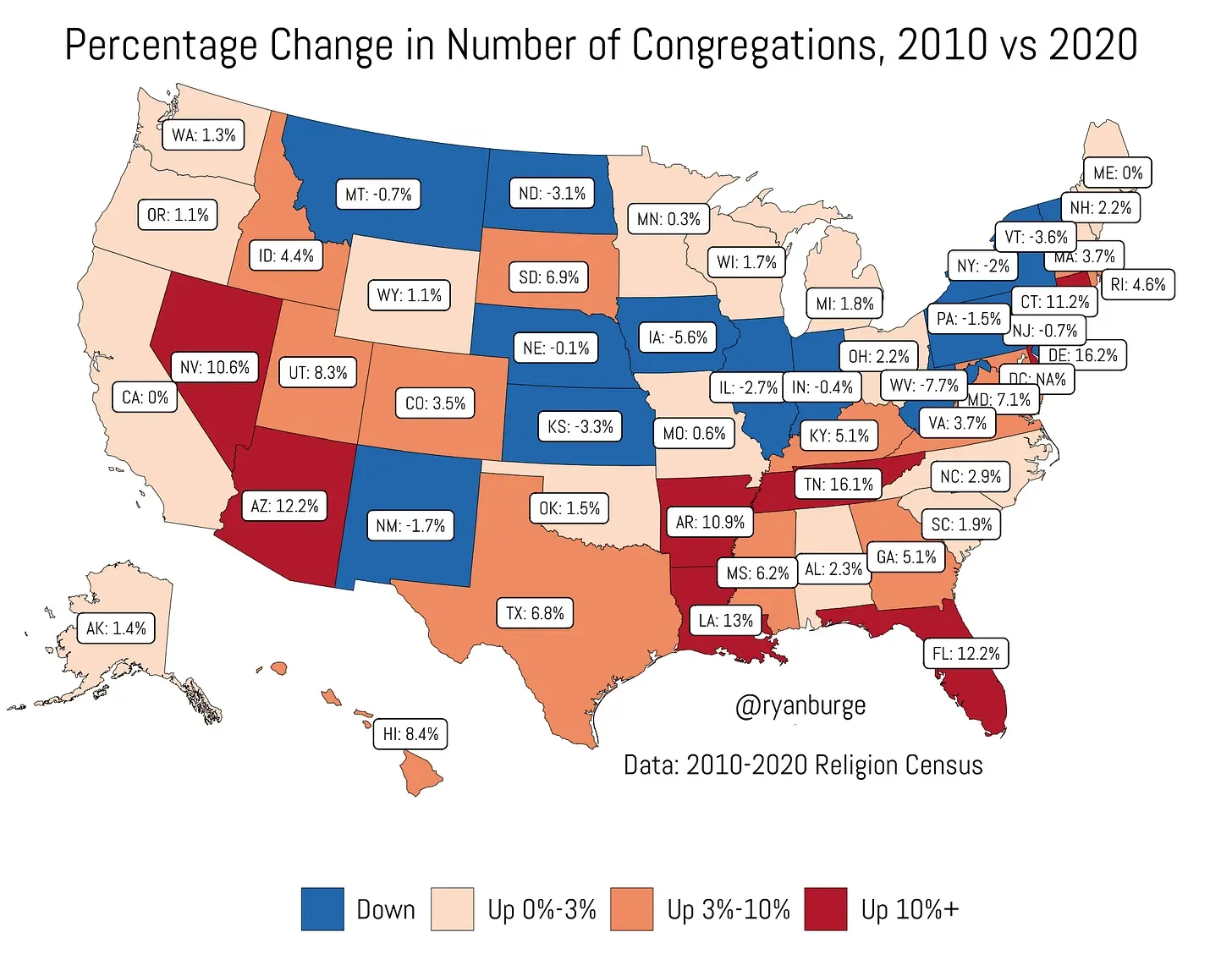
Two years ago, the statistics maven Ryan “Graphs about Religion” Burge (a must follow on X) posted an essay, laden with maps and charts, entitled “Where Have Churches Disappeared?”
Here are two summary statements from Burge that I think will help folks preparing to watch the “Christianity at a Crossroads” documentaries. This is really practical stuff and some of the major trends are clearly visible/
There are a total of thirteen states that report fewer religious congregations in 2020 compared to 2010. I think that a common way to describe their location is the Great Plains and the Rust Belt. Kansas and North Dakota are on the list. But then the line extends eastward in a nearly unbroken fashion all the way to the Atlantic. It includes Iowa, Illinois, and Indiana. It skips Ohio, but then picks back up with Pennsylvania and New York and a couple of other states in the Northeast.
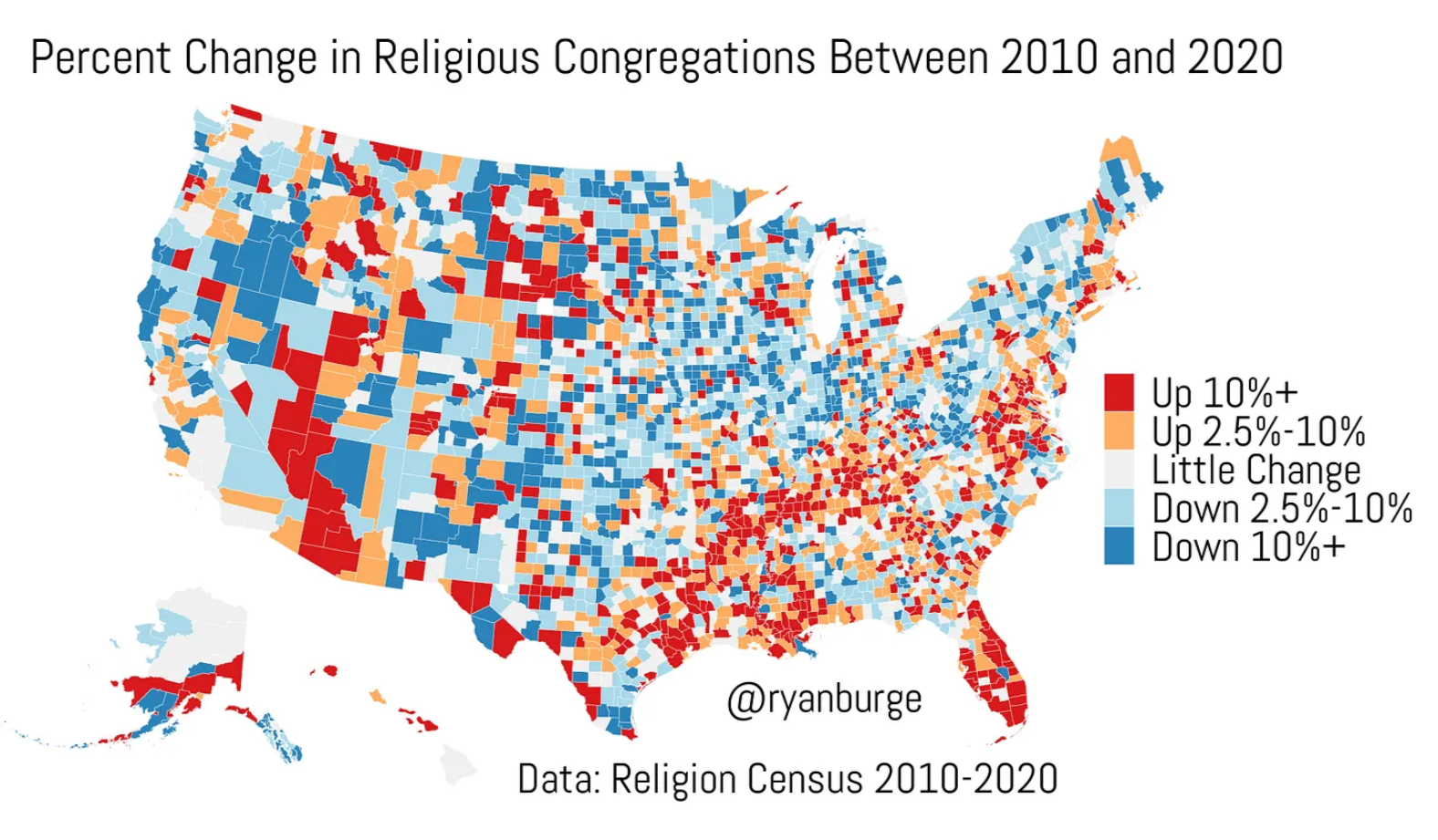
Now, look at another map from Burge. Yes, there are lakes of blue ink (numbers are down), but look at the wide variety of locations in which there are red statistics showing growth.
Does this look like a super-simplistic map? Not really, but there are familiar trends that I mentioned above. Burge noted:
Eight states have seen a double-digit increase in the number of congregations. If you were to broadly describe those eight it would be: the South and the Southwest. Besides Delaware (which seems like an aberration) the state with the biggest jump in congregations was Tennessee at 16.1%. But then you have Louisiana at 13% and Florida and Arizona at 12.2% each. This is some pretty good evidence congregations are starting where people are moving. Planting follows migration patterns.
Finally, I will end with yet another sign of complexity, care of a recent survey by Lifeway Research noting that Protestant church closures are up, but the picture is rather complex.
Lots of churches are dying. Lots of missions are opening and many of them are surviving. Once again, there’s life in these numbers, as well as a depressing amount of death.
There are more than a few news stories out there worth covering, if editors have the patience to let good reporters do some hard, complicated work.
In 2024, Lifeway Research estimates 3,800 new Protestant churches were started in the U.S., while 4,000 churches were closed. This is based on analysis of congregational information provided by 35 denominations or faith groups, representing 58% of all Protestant churches. …
The 200-church gap between those closed and those opened represents a significant improvement over the 2019 numbers. In the most recent previous analysis, 1,500 more churches closed than opened. Five years ago, there were 4,500 closures compared to 3,000 openings. Ten years ago, however, Lifeway Research found more Protestant churches were planted (4,000) than closed (3,700) in 2014.
Enjoy the podcast and, please, pass it along to others.