
Sylvester Stallone Revisits ‘Rocky,’ Faith And Redemption In New Memoir
NEW YORK — Sylvester Stallone has spent five decades being asked about those famous steps in Philadelphia. Now, with the release of his new memoir, “The Steps,” the actor is finally telling that story on his own terms — and the timing couldn’t be more right.
The book arrives as “Rocky” approaches the 50th anniversary of its Best Picture win at the 1977 Academy Awards. Stallone has structured the memoir explicitly around his life and the film that made him a household name.
It’s a narrative bookended by struggle and vindication — which happens to be the exact structure of a story that has, for half a century, invited comparison to something older and more foundational than a boxing movie. From his tough childhood to his rise in Hollywood, Stallone has kept his story very much a secret for the past five decades.
READ: Vance’s Faith Memoir Evidences America’s ‘Invigorated Public Christianity’
“It was very hard because I spent 50 years burying that stuff,” Stallone, who turned 80 this past July, told The Associated Press. “And it’s like you come across a lost city, and you start to become your own spiritual archaeologist, digging down. And it’s not pretty. But I didn’t want this to be, ‘Oh, woe is me.’ Everyone has issues and a lot worse than me.”
Why write the book? Stallone said he “wanted to touch on the essence because I still have this conundrum. If everything was really nice, maybe I wouldn’t be here, you know what I mean? If I didn’t have that insecurity which drives us. You know, insecurity is a great motivator.”
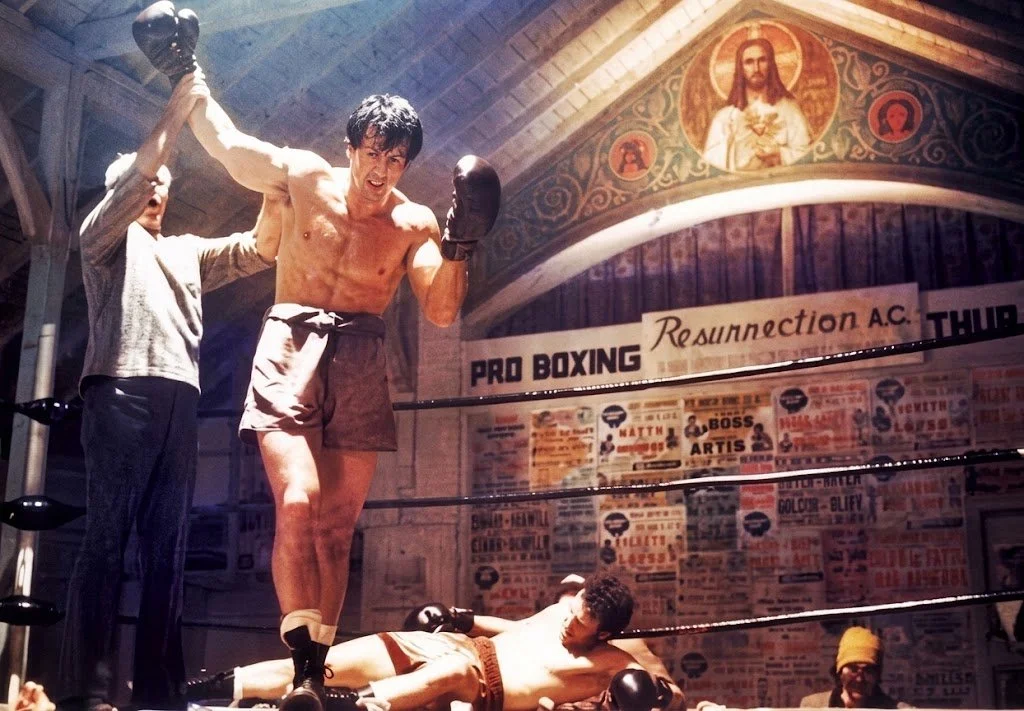
A scene from the Oscar-winning film “Rocky.” (Photo courtesy of Amazon MGM Studios)
‘Resurrection gym’
At the same time, the movie “Rocky” has always carried a current of religious symbolism just beneath its underdog surface. Revisiting that imagery on the film’s 50th anniversary — alongside a memoir explicitly framed around Stallone’s own years of struggle before deliverance — makes the parallel harder to ignore.
The film’s most iconic image, Rocky Balboa’s arms raised triumphantly at the top of the Philadelphia Museum of Art steps, has often been read as a kind of ascension: A man rising above the circumstances that defined him, arms outstretched in a pose that echoes far beyond sports cinema. He is reborn a contender.
The climactic fight itself carries its own resonant image: Rocky, bloodied and battered, has frequently been described by critics and scholars as visually evoking a crucifixion — absorbing punishment not to win outright, but to prove that endurance itself is a form of victory. Rocky doesn’t just beat Apollo Creed in the first film. He survives, goes the distance and suffers.
Stallone said his ability to write — and ultimately star — in the movie “Rocky” at age 29 was a gift from God.
“I don’t want to rely upon some idol, god, symbol, anything. But maybe we need something that makes us believe in the invisible — faith. I had no faith [at the time]. I was agnostic, and then it came literally back that night,” said Stallone, who grew up attending Catholic school. “And that’s why I pay homage in the “Rocky” movie. The first scene is, you know, at ‘The Resurrection’ [gym]. It’s amazing we found that place. A boxing club called ‘The Resurrection.’”
This storyline is very much connected to Stallone’s own life. He has spoken over the years about a Catholic upbringing and a complicated, searching relationship with faith that runs through much of his personal mythology — the difficult birth that left him with partial facial paralysis, a tough childhood with parents who did not show him love and years of near-total obscurity before “Rocky” changed his life overnight.
Stallone’s ambition and ability to persevere has taken on an almost parable-like quality. “The Steps” frames Stallone’s path as a “profound meditation on the importance of vision and willpower” — language that sits comfortably alongside the kind of redemption narrative “Rocky” itself tells.
“Rocky,” however, is by no means a religious film. It’s a boxing movie and one deeply rooted in the specific texture of blue-collar Philadelphia in the mid-1970s. But the persistence of this symbolic reading across five decades of scholarship and pop-culture commentary shows that the film also taps into something Stallone understood intuitively, even if he never set out to make a religious allegory.
The movie is a story about an anonymous, overlooked man who is tested, endures suffering and eventually emerges transformed taps into a narrative structure that long predates cinema.
Fifty years later, with Stallone himself now revisiting that same story arc of struggle and vindication in his own life story, the overlap between “Rocky” and resurrection feels less like retrospective critical projection and more like something the film’s own creator has spent decades quietly gesturing toward. It’s ultimately an underdog story about rebirth and perseverance.
Clemente Lisi serves as executive editor at Religion Unplugged.