
Trump, Pope Leo And A New Chapter in America’s Religious Politics
(ANALYSIS) American religion has rarely — if ever — seen anything quite like these past weeks.
Start with President Donald Trump’s profane Easter Sunday message to Iran: “Open the [unprintable f-bomb] Strait, you crazy bastards, or you’ll be living in Hell — JUST WATCH! Praise be to Allah." The last phrase presumably disdains a religion practiced by millions of Iranians and Americans.
The official White House Easter message proclaimed that “President Donald J. Trump stands as a fierce defender of the Christian faith.” On that theme, the president’s plans for a 25-story arch between Arlington National Cemetery and the Lincoln Memorial now include “One Nation Under God” emblazoned in gold.
READ: What Happens When Sacred And Secular Power Collide?
Trump then warned Iran that unless it repents, “a whole civilization will die tonight, never to be brought back again.”
Proponents of “just war” limits were alarmed. Most importantly, Pope Leo XIV responded, “Today, as we all know, there has also been this threat against the entire people of Iran. And this is truly unacceptable. There are certainly issues of international law here, but even more, it is a moral question concerning the good of the people as a whole.”
Pope Leo XIV and Trump are the two dominant American leaders on the world stage. Yet on April 12 (coinciding with Eastern Orthodox Easter), Trump issued the most incendiary verbal assault a U.S. president has ever aimed at a pope.
“I don’t want a Pope who criticizes the President of the United States,” he stated, calling Leo “WEAK on Crime, and terrible for Foreign Policy” in thinking “it’s OK for Iran to have a Nuclear Weapon.” He contended that the Cardinals only elected Leo as pope because an American would be “the best way to deal with President Donald J. Trump.”
And the president gave the pope marching orders: “Leo should get his act together as Pope, use Common Sense, stop catering to the Radical Left, and focus on being a Great Pope, not a Politician. It’s hurting him very badly and, more importantly, it’s hurting the Catholic Church!”
U.S. Catholics may or may not agree with the pope on Iran, but this broke all precedent. Among others, an influential conservative serving on Trump’s religious freedom commission, Minnesota’s Bishop Robert Barron, called Trump’s outburst “entirely inappropriate and disrespectful,” and though his “administration has reached out to Catholics and other people of faith,” the “President owes the Pope an apology.” No apology came.
Next, Trump posted an image that most everyone thought depicted himself as a white-robed Jesus bathed with heavenly light as glowing hands miraculously heal a bedridden patient.
“This goes too far. It crosses the line,” fumed Christian Broadcasting Network’s David Brody.
Megan Basham of the Daily Wire wondered “what possible explanation he could have for this OUTRAGEOUS blasphemy,” insisting that Trump needs to “ask for forgiveness from the American people and then from God.”
Prominent Orthodox author Rod Dreher told The Wall Street Journal, “Not saying Trump is the Antichrist, but he’s radiating the spirit of Antichrist, no question.”
When prodded, Trump removed the image (again, no apology), saying he thought it merely showed him as a doctor. Days later, the president re-posted an image in which Jesus gives Trump a close, fond embrace with a caption saying, “God might be playing his Trump card” by exposing “satanic, demonic, child-sacrificing monsters.”
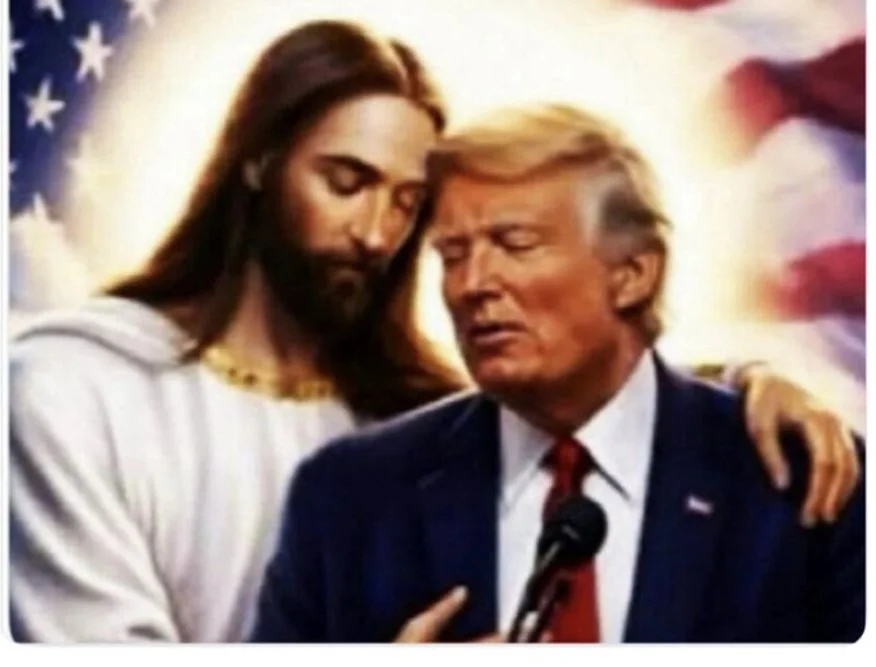
An AI image President Donald Trump posted online.
Trump knows Catholics feel free to disagree with their Holy Father, yet most expect basic respect. Pew Research finds 84% of U.S. Catholics feel “very” or “mostly” favorable toward Pope Leo.
Republicans might not need to worry about lopsided evangelical Protestant voting, but Catholics cannot be taken for granted. Trump obtained his second term in part by winning 62% of white Catholics and 41% of Hispanic Catholics, according to Pew polling.
Two unnerving articles last week cited these recent events. Peter Baker, chief White House correspondent for The New York Times, reported that “many” have the impression of a “deranged” President. “Never in modern times has the stability of a president been so publicly and forensically debated — and with such profound consequences.”
Phyllis Zagano, a Catholic columnist with Religion News Service, contended that Trump “is so detached from reality” that Vice President J.D. Vance, the cabinet and Congress should “do what needs to be done” and oust him under the 25th Amendment.
Apart from the politicking, Trump himself, who turns 80 in June, provoked an unusual public discussion on the state of his eternal soul. He was raised in the “mainline” Presbyterian Church (USA), but told RNS just before the 2020 election, “I now consider myself to be a non-denominational Christian.” Unlike those loyal evangelical supporters, he rarely attends worship or displays piety otherwise.
In August, Trump told Fox News: “I want to try to get to heaven if possible,” but "I’m hearing that I’m not doing well. I am really at the bottom of the totem pole.”
Soon afterward, Trump, in a fund-raising email, cited his near-assassination and said: “I want to try and get to heaven.”
He told reporters, “I don’t think there’s anything going to get me in heaven. I really don’t. I think I’m not maybe heaven-bound.”
At the National Prayer Breakfast in February, Trump repeated that “I just don't think I qualify. I don't think there's a thing I can do.”
Last October, Trump-aligned evangelist Franklin Graham sent the president a letter that he made public on Palm Sunday. Trump has indicated he thinks salvation depends on proper behavior, so Graham stated that “good works, prominence, success — none of these get us to Heaven. The only way to Heaven is through the shed blood of Jesus Christ. God requires us to turn from our sins and, by faith, believe in our heart that Jesus came to earth, died on the cross for our sins, was buried, and God raised him to life on the third day. If you accept that by faith and invite Him to come into your heart, you ARE heaven-bound, I promise you.”
Richard N. Ostling was a longtime religion writer with The Associated Press and with Time magazine, where he produced 23 cover stories, as well as a Time senior correspondent providing field reportage for dozens of major articles. He is a recipient of the Religion News Association's Lifetime Achievement Award. He has interviewed such personalities as Billy Graham, the Dalai Lama, Mother Teresa and Joseph Cardinal Ratzinger (later Pope Benedict XVI); ranking rabbis and Muslim leaders; and authorities on other faiths; as well as numerous ordinary believers. He writes a bi-weekly column for Religion Unplugged.