
How Partisanship Differs For People Who Work In Religious Organizations
(ANALYSIS) Boy, do I have a treat for you all today! Do you ever wonder how the partisanship of people who work for religious organizations varies compared to folks who work in other industries?
Of course you do — and I think I can answer that question with a high degree of specificity, thanks to an amazing data collection effort from a team of researchers.
They created what they call VRScores, a database of over 500,000 people that links their workplaces with their voting records. I know you have lots of questions about how that’s even possible, and I don’t want to bog you down with all the nuts and bolts, but here’s the simple version:
Some states require you to declare yourself as a Republican or a Democrat so they know which ballot to give you during a primary election. These are called closed primary states. You can find a map of those here. A company called L2 has aggregated that registration data with a bunch of other variables, which the VRScores research team then matched with employment data from Revelio Labs. Of course, there are lots of states that don’t have closed primaries, so the research team used sophisticated prediction models to extrapolate to a much larger sample.
I know some of you really want to dig into this more, so here’s the methodology page from Politics at Work. And here’s a link to the preprint of the paper where they lay out all the nitty-gritty details on SSRN.
I was skeptical of the accuracy of this data too, dear reader — but after working this dataset over in a variety of ways, I can say this: it absolutely passes the sniff test. It’s really good.
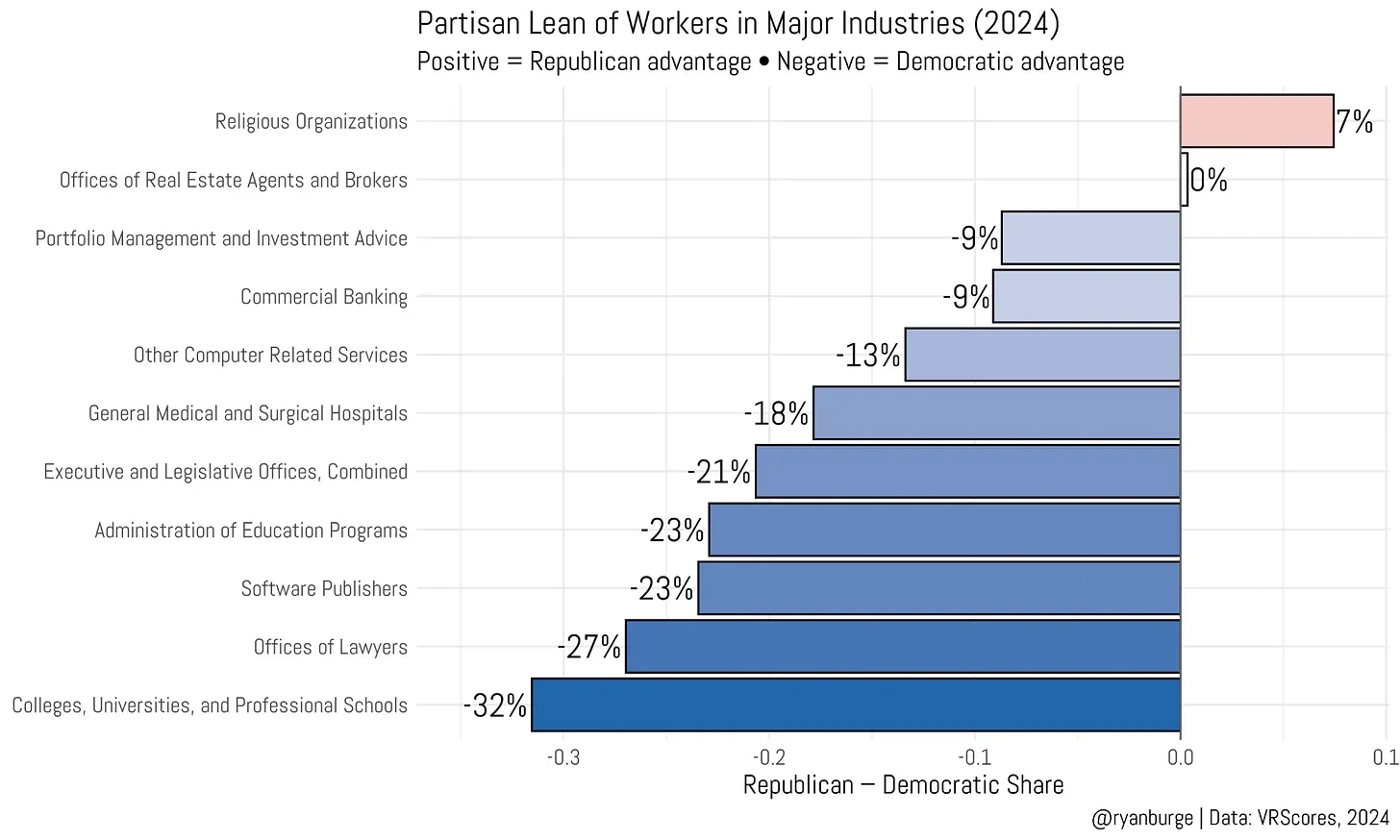
Let me show you what I mean. This first graph is just me grabbing a handful of the largest employment sectors in the data and comparing the partisan lean of those sectors to folks who work in “Religious Organizations.” (Don’t worry, I’ll get more granular later).
The partisan lean is a really simple calculation — it’s just the Republican share minus the Democratic share in each industry.
Is anyone shocked that people who work in higher education are 32 percentage points more Democratic than Republican? Of course you aren’t, because that’s certainly the perception.
The next most left-leaning sector is people working in law offices, followed by software engineers. Again, that definitely has a lot of “face validity” to it.
You can read the rest of this post on Substack.
Ryan Burge is an assistant professor of political science at Eastern Illinois University, a pastor in the American Baptist Church and the co-founder and frequent contributor to Religion in Public, a forum for scholars of religion and politics to make their work accessible to a more general audience. His research focuses on the intersection of religiosity and political behavior, especially in the U.S. Follow him on X at @ryanburge.