
Faith And Voting: How Trump’s Approval Is Trailing The 2024 Share
(ANALYSIS) “I don’t particularly like Donald Trump; I just voted for him because I really didn’t like the alternative.” That’s a comment that I feel like I hear on a nearly weekly basis in various environments.
It’s usually during the Q&A portion of a talk about my newest book, “The Vanishing Church.” I totally understand what that person is trying to articulate, by the way: American electoral politics is a “this or that” phenomenon. If your disdain for Candidate A is an 8/10 and it’s a 7/10 for Candidate B, then the second person is probably going to begrudgingly get your vote when you walk into the voting booth. It’s just the nature of our “winner-take-all” system.
I also think that our binary choice drives this much bigger issue in American politics: Affective polarization. This is the idea that a growing number of Americans feel negatively toward the other party not because of their policy positions on things like healthcare or immigration, but simply because they are the other party.
READ: Talarico’s Theology Draws Scrutiny During Senate Run
It’s the “cry more, libs” approach for Republicans. A Democrat will demonize or mischaracterize the other side of the argument because this helps them justify their own voting choices. It really goes both ways.
But now that we have data from the 2025 Cooperative Election Study, we can actually dig into how vote choices are relating to approval ratings of Donald Trump.
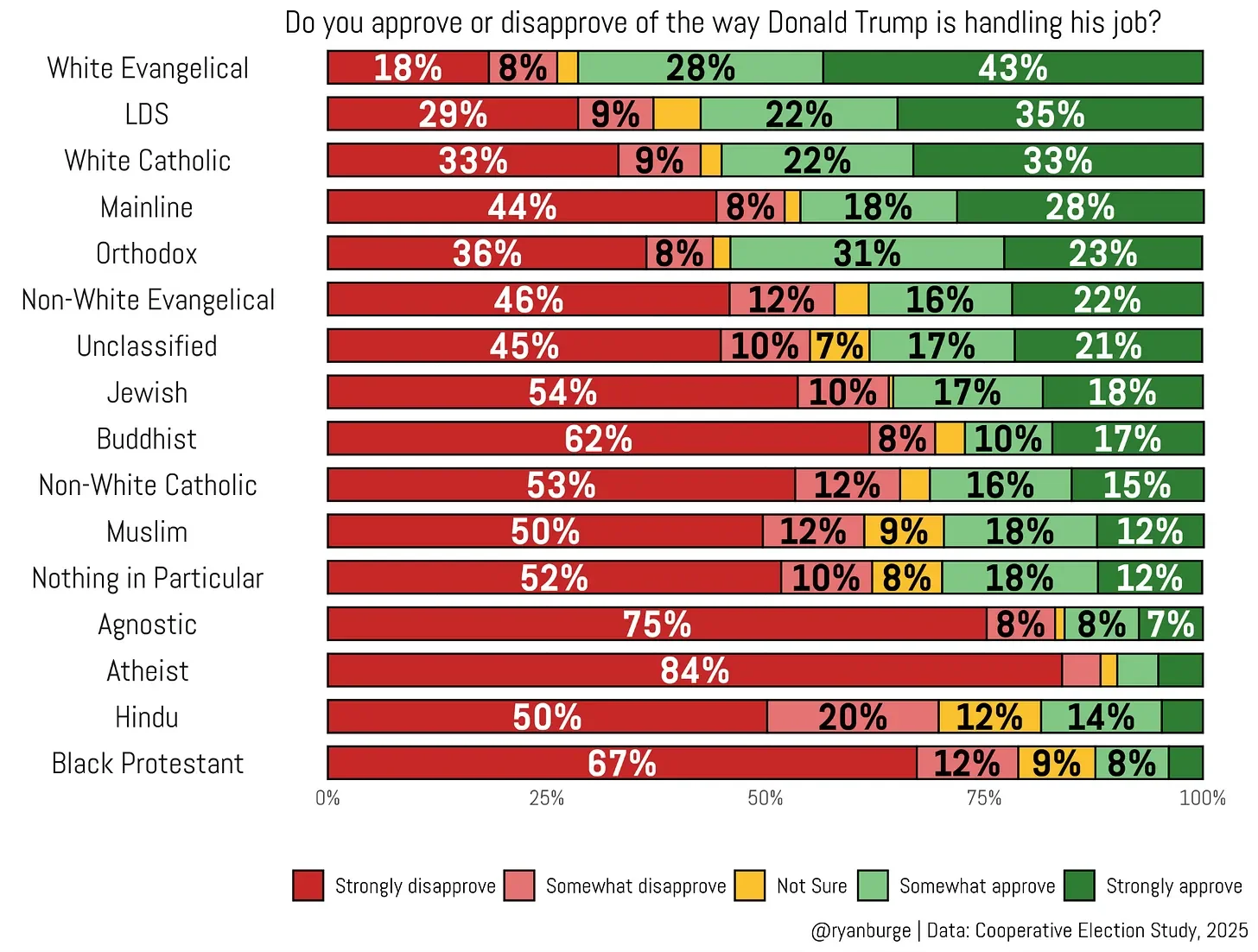
Let me start by just showing you the most basic analysis - here’s Trump’s approval rating in October of 2025 across a whole bunch of different religious groups.
I sorted these traditions in terms of the ones that were the most approving of Trump up top and those who didn’t like him as much near the bottom. You can pretty easily ascertain which groups are the most MAGA. Among white evangelicals, 71% said that they somewhat or strongly approved of his job performance. Next in line were Latter-day Saints at 57% job approval, followed closely by white Catholics at 55%.
There was only one other group where Trump was above water: Orthodox Christians with a 54% approval rating. I mean, it doesn’t take a lot of deduction to figure out the common thread among the groups I just listed: white and Christian. That’s Trump’s base. It’s always been that way.
You can read the rest of his post on Substack.
Ryan Burge is an assistant professor of political science at Eastern Illinois University, a pastor in the American Baptist Church and the co-founder and frequent contributor to Religion in Public, a forum for scholars of religion and politics to make their work accessible to a more general audience. His research focuses on the intersection of religiosity and political behavior, especially in the U.S. Follow him on X at @ryanburge.