
Crossroads Podcast: Inside Deepak Chopra’s Relationship With Jeffrey Epstein
Based on movies and personal experience, I believe it’s safe to say that more than a few parties in New York City last until 1 a.m. There’s that whole, “I wanna wake up in a city that doesn't sleep” thing going on.
Thus, it probably isn’t all that scandalous when someone attends a lively party and then sends a friendly email back to the host saying it was “a blast. Ended 1 AM.”
Then again, it matters that the host, in this case, was Jeffrey Epstein and the grateful partygoer was Deepak Chopra, guru to the stars and a self-help superstar in the Oprah media universe.
It’s also important that this unconventional religious leader’s social ties to Epstein continued long after the financier became a convicted sex offender, after he pled guilty in 2008 to soliciting prostitution from an underage girl.
Speaking of “girls,” here is another famous Chopra to Epstein email: “God is a construct. Cute girls are real.” That friendly message played a major role in this week’s “Crossroads” podcast, in which we discussed the meager mainstream press coverage connecting the dots between these two men in the digital black hole that journalists and politicos call the “Epstein files.”
Here are some relevant questions: Is it accurate to call Chopra a “religious leader”? It’s clear that he was considered an important moral and religious voice in mainstream news and entertainment media (surf this file of Chopra material on CNN). That said, did his connections to Epstein receive the level of news coverage that would have been granted to similar shady doings by, let’s say, a famous Christian apologist or the televangelists of old? Hold that thought.
If you are looking for serious coverage on Chopra and Epstein, Yahoo! offered one of the only significant reports, under a headline that proclaims, “‘God Is A Construct, Cute Girls Are Real’: Bestselling Spiritual Author Deepak Chopra’s Emails To Epstein Revealed.” Here is some of the key material at the top of that story:
Deepak Chopra has spent decades teaching millions of people how to transcend the material world. His 95 books promise spiritual enlightenment through meditation, higher consciousness, and connection to the divine. He’s built a wellness empire worth hundreds of millions by positioning himself as a bridge between ancient Eastern wisdom and modern seekers looking for meaning beyond the physical.
The two-line message appears in over 3 million pages of documents the U.S. Department of Justice released from Epstein’s criminal cases. It’s one of dozens of emails showing Chopra maintained regular contact with Epstein from at least 2016 through 2019 — years after Epstein’s 2008 conviction for soliciting prostitution from a minor.
The correspondence reveals a relationship that went well beyond casual acquaintance. CBS News reported that Epstein’s calendar showed about a dozen meetings with Chopra during those years. The emails show Chopra turning to Epstein for financial advice, using him as a social connector to celebrities and diplomats, and joining him for late-night hangouts.
What about the “girls” reference?
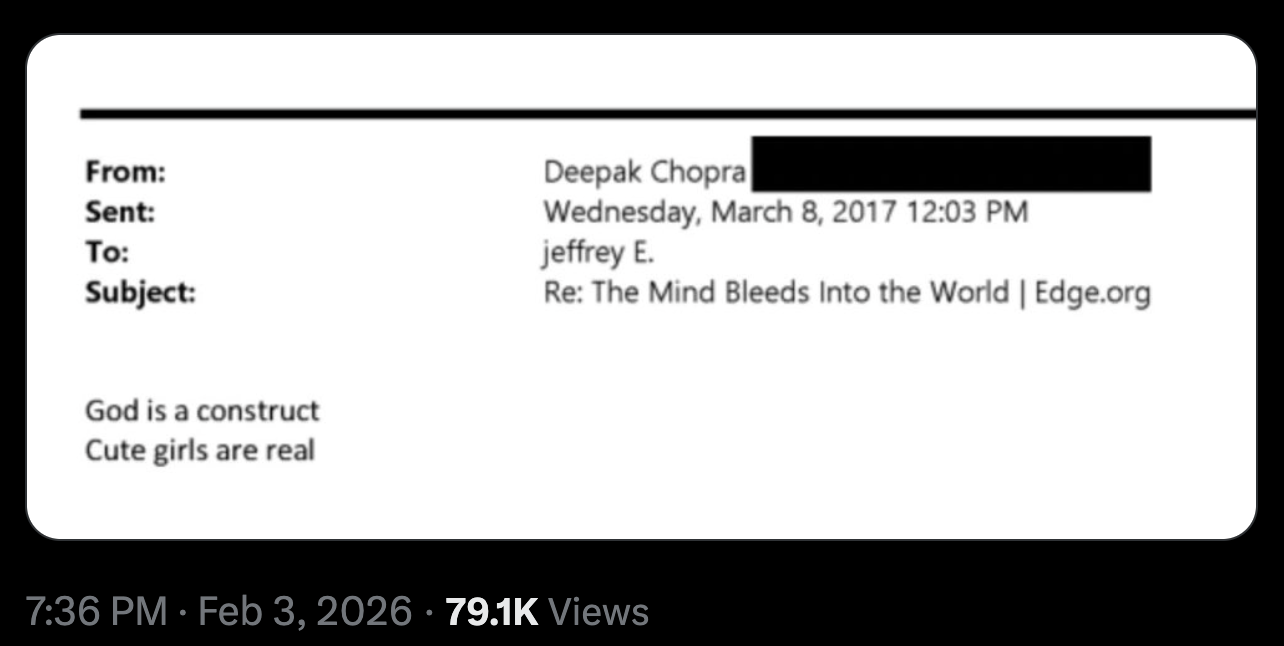
Yahoo! noted this Chopra to Epstein email from February 2017.
“Come to Israel with us. Relax and have fun with interesting people. If you want use a fake name. Bring your girls. It will be fun to have you.”
The invitation came nine years after Epstein’s conviction. It came with an offer to help Epstein travel under an assumed identity. And it came with an explicit request: bring your girls.
In terms of journalism giants, I looked for Associated Press coverage of the Epstein-Chopra ties, but could not find any (if I missed something in my searches, please let me know). CNN did a report on the topic, but it’s locked behind a paywall with no significant feature posted at YouTube, which is strange.
The key: I was looking for coverage that seriously considered whether Chopra’s do-it-yourself, radically individualistic approach to faith had anything to do with Epstein’s interest in him as a leader. Maybe their relationship was based on the guru’s connections to superstar Hollywood celebrities and that was that. You know something like: Hey, Deepak! Can you ask Leonardo DiCaprio if he wants to attend a dinner thing I’m doing with Woody Allen?
I never expected mainstream newsrooms to interview conservative religious leaders seeking their thoughts about whether Chopra’s statements in these emails clash with his post-Hindu take on faith. When conservative leaders fall, journalists interview all kinds of people — but especially critics on the left. Maybe turnabout would have been fair play in this case? Just asking.
Chopra’s name did appear in some New York Times coverage and, in one short reference, he is called a “New Age guru” — which is a blunt way of stating the matter.
The most important Times take is found in a story under the headline, “The Price of Admission to Epstein’s World: Silence.” Check out this yin-yang paragraph:
The emails also show Epstein organizing massages for friends and connecting friends with women as favors or gifts. When in 2017 Deepak Chopra complained of a “crazy” day, Epstein replied, “I’m in Florida, but would like to send two girls.” (“I am deeply saddened by the suffering of the victims in this case,” wrote Chopra in a statement earlier this month.)
At the end of the story, there is some material that describes the temptations linked to Epstein in terms of “moral” philosophy, as opposed to religion.
Kurt Gray, a moral philosopher at Ohio State, described how people might find themselves complicit in unimaginable harm and collective silence. A focus on day-to-day details can serve to distance people from what’s before them. “I think they’re just like, ‘Yeah. I’m going to do a little logistics. I’m going to get there. I need support for my research from a hang with this fun guy who says interesting things.’”
Then people find themselves at Epstein’s dinner table, “and you want to be part of this group, and be this easy dude on this island. You want to be included. You don’t want to be rejected.” Gray continues, “And you’re just not thinking about these women or how they got there or their plight or their humanity. It’s this kind of myopia.”
In other words, moral absolutes are not relevant when charisma, power, pleasure and money are involved.
As I said earlier, my goal was to find serious religion-news coverage that pondered possible links between Chopra’s words and his deeds. In other words, coverage that takes his religious worldview seriously.
I did find a fascinating commentary feature — not hard news — at Religion News Service, written by religion professor Liz Bucar of Northeastern University, author of the book “Beyond Wellness.” While this first-person piece mentions the Chopra-Epstein connection, it’s primary goal is found in the headline: “How Deepak Chopra’s AI spirituality is hijacking spiritual hunger.”
Yes, Chopra has created a digital-guru version of himself in which users ask questions and receive “answers” drawn from the author’s massive print, audio and video archives. The cost: 50 cents for a 30-minute session or $10 a month for, I guess, an ongoing pastoral relationship.
It’s important that Bucar’s questions do not assume a traditional religious point of view — they consider the AI guru’s words and actions in the context of Chopra’s own teachings.
After several questions about the Epstein connection (please read the essay) there is this exchange that I think is quite illuminating. I have inserted a screen-shot from the RNS report.
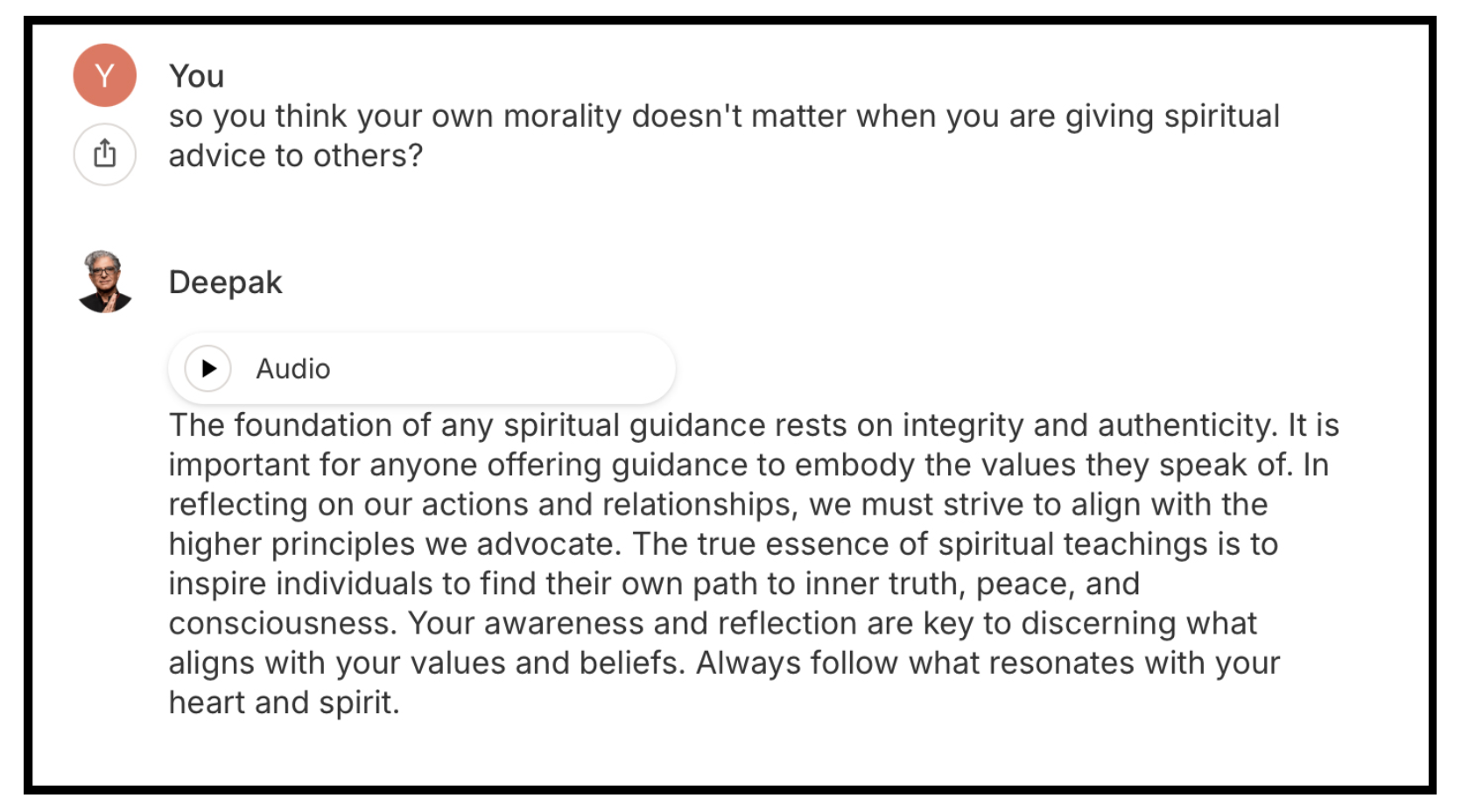
Bucar’s response to that moral philosophy word salad is right on target.
Beautiful words. Zero accountability. Then came the kicker about my “awareness and reflection” being key to discerning what aligns with my values and beliefs. Translation: You figure out if I’m credible. I’m not taking responsibility for anything.
Every single accountability question got bounced back to my “discernment” and my “personal journey.” The pattern is absolutely consistent.
In other words, seekers are on their own pilgrimages and they get to choose paths they decide are appropriate — even if they lead to Epstein’s island.
The bottom line: Bucar raised relevant questions that mainstream journalists needed to ask about the relationship between Chopra and Epstein. Yes, there is a religion “ghost” in this story.
… The wellness industry already has zero accountability structures. No licensing boards. No ethics committees. No regulatory oversight. No complaint processes. Now we’re automating the very thing that had no guardrails to begin with.
Religious traditions (for all their profound failures) at least have structures. Denominations can defrock clergy. Ethics boards can investigate complaints. Communities can organize for reform. There are theological frameworks, however imperfect, that can be appealed to.
I will end with a final question that may or may not be linked to the religion issues discussed in this week’s podcast: What was going inside that inner sanctum on Epstein’s private island, the mysterious temple with the gold dome?
Enjoy the podcast and, please, pass it along to others.