
Most US Jews Feel Less Safe Amid Surge In Antisemitic Attacks
The recent rise in antisemitism is making Jewish Americans feel unsafe, causing many to change the way they live their day-to-day lives, according to a new report.
The American Jewish Committee said Jews living in the United States felt less safe last year compared to 2024 amid a growing number of high-profile antisemitism incidents.
The report comes as 2025 marked “one of the most violent years against American Jews in recent history” and many high-profile hate crimes on American soil, the study found.
Those crimes, the group said, included an arson attack during Passover on the Pennsylvania governor’s residence and the murders of Sarah Milgrim and Yaron Lischinsky in Washington D.C. and Karen Diamond in Colorado.
Ninety-one percent of American Jews say they feel less safe as a Jewish person in the United States following these attacks — and experts from the AJC pointed to growing concerns about antisemitism online.
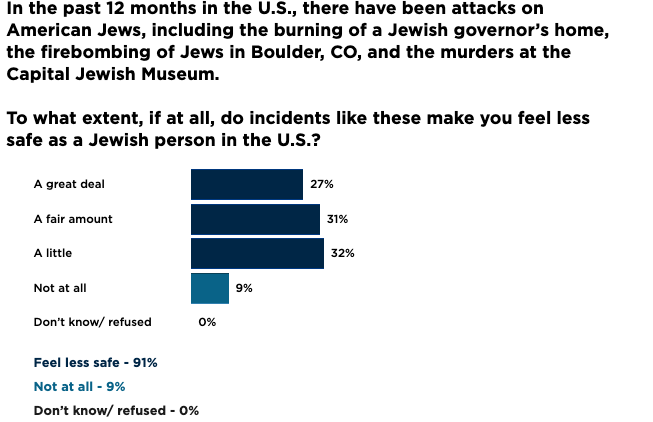
AJC surveyed 1,222 American Jews aged 18 or older
The organization has conducted a version of the study for the past seven years, and this year, for the first time, more than seven in 10 American Jews say they have experienced antisemitism online — either by seeing or hearing it or by being personally targeted. And a majority are worried about AI chatbots creating or spreading antisemitic messages.
Experts said that the spread of online antisemitism is disproportionately impacting younger people, in part due to the fact that they spend more time online and on social media platforms.
“It breaks my heart to say this, but the spike in antisemitism is definitely affecting young jews more than it is older jews,” said AJC Vice President for the Center for Education Advocacy Laura Shaw Frank during a public webinar discussing the report on Wednesday.
Those online messages are impacting young people’s real-life decisions. More than three in 10 American Jewish college students said they avoided wearing, carrying or displaying things that would identify them as Jewish because of fears of antisemitism.
However, it seems the mass protests against the Gaza war on campuses throughout the country in the spring of 2024 gave way to more subdued demonstrations and a slightly more peaceful existence for Jewish college students in 2025, according to the AJC.
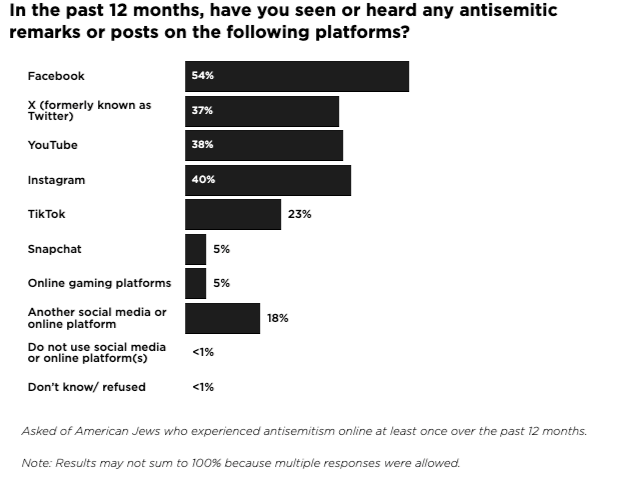
AJC surveyed 1,222 American Jews aged 18 or older
“Campuses are much quieter now,” Shaw said, adding that the change was due in part to university administrators enforcing their code-of-conduct policies and establishing “time, place and manner” restrictions, which aim to balance campus safety with students’ right to freedom of speech.
Advocacy by groups such as AJC have also helped by establishing relationships with numerous university administrators to educate and guide them to create a welcoming culture for all students.
Now, the AJC said it is in conversations with tech companies to help pinpoint the ever-evolving antisemitic slang and code words that have popped up online.
While 90% of Americans agreed antisemitism is a society-wide problem, rather than solely a Jewish problem, AJC advocates said there is still a long way to go in spreading awareness and finding solutions.
“There are big gaps in even knowing the word ‘antisemitism,’” said Julie Rayman, AJC Senior Vice President of Policy and Public Affairs. “So many in the Jewish community feel that others don’t understand what they are going through.”
To read the full 2025 report, visit the AJC website.
Cassidy Grom is the managing editor of Religion Unplugged. Her award-winning reporting and digital design work have appeared in numerous publications.