
This Thanksgiving, Recalling ‘The Holy Fool’ in ‘Planes, Trains and Automobiles’
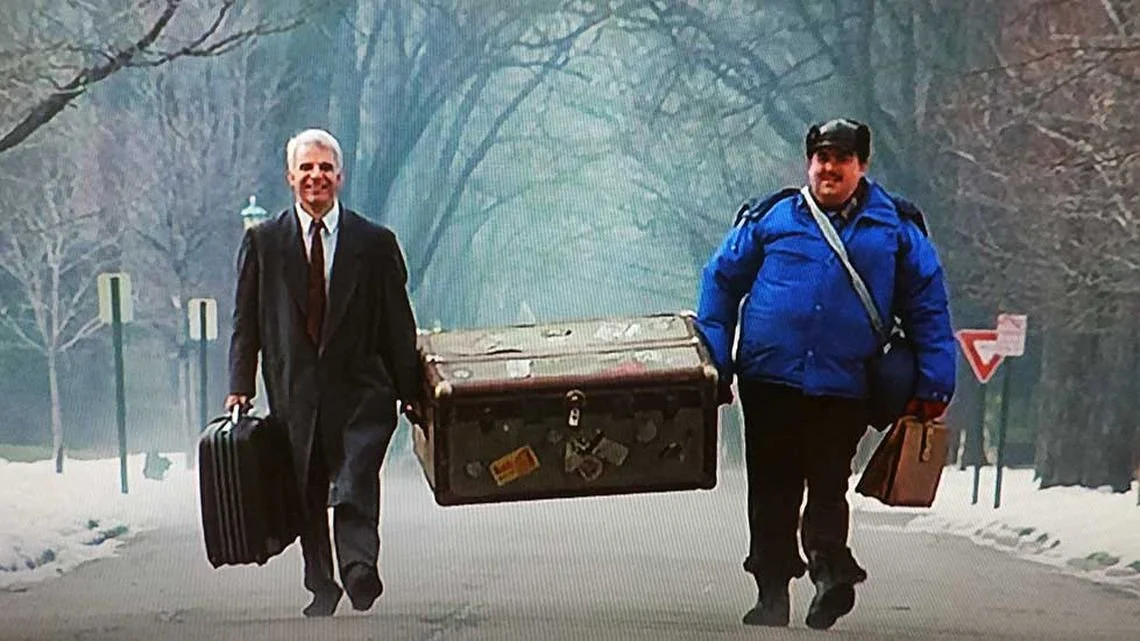
(ANALYSIS) With its blend of family, patriotism, food, shopping and faith, Thanksgiving is a strange bird that has failed to inspire classic movies — with one exception.
“Planes, Trains and Automobiles” is the “only movie our family watches as a custom, most every Thanksgiving,” wrote the late Roger Ebert, a Pulitzer Prize-winning film critic.
“Steve Martin plays Neal, a Chicago advertising man, sleek in impeccable blues and grays, smooth-shaven, recently barbered, reeking of self-confidence, prosperity and anal-retentiveness. John Candy plays Del, a traveling salesman from Chicago who sells shower curtain rings.”
Del Griffith is huge, hapless, generous, irritating, vulnerable and relentlessly helpful. “Del wants only to please,” noted Ebert, while Neal Page “wants only to be left alone.”
While John Hughes didn't weave religious content into this 1987 film — unlike his "Home Alone" script — viewers familiar with the writings of Fyodor Dostoevsky and William Shakespeare will spot a sacred archetype in this tale about two men on a slapstick, but endearing, journey home.
“Del is totally a holy fool. ... His tender heart is the heart of the movie,” noted actress and writer Susan Isaacs, who was cast as Del's wife, Marie — the face in the portrait he carries during his sales trips.
“God uses the foolish to shame the proud. ... Del doesn't change. But Del helps redeem Neal. He gets Neal home,” she added, between teaching film studies and screenwriting classes at Chapman University in Southern California. “Del isn't trying to teach Neal a lesson. But that's what a holy fool does -- he brings change at the level of someone's heart, slowly but surely.”
In church history, and great literature, “holy fools” embrace foolishness, poverty and even feign madness while challenging the sins and hypocrisies of the powerful. They embody St. Paul’s words in scripture: “God chose what is foolish in the world to shame the wise.”
The men in this unlikely buddy movie endure every imaginable travel calamity when a blizzard prevents their plane from reaching Chicago, making them share sketchy motel rooms, a junky taxi, rental car disasters and jammed buses before a final train.
At one point, Martin's character — after shouting “You're no saint!” — explodes into a tirade about his companion's common, blue-collar personality, including his salesman's shtick, stinking feet, boring anecdotes and everything else.
While his face shows shame, Del replies: “You wanna hurt me? Go right ahead if it makes you feel any better. I'm an easy target. Yeah, you're right, I talk too much. I also listen too much. ... Well, you think what you want about me. I'm not changing. ... My wife likes me. My customers like me, 'cause I'm the real article.”
In an essay for the Catholic website Word on Fire, Matthew Malone noted that while Candy struggled with obesity, anxiety and drug abuse, he remained a practicing Catholic, going to Mass with his family and praising how Catholic education influenced his work ethic. The actor died of a heart attack in 1994, at age 43.
In “Planes, Trains and Automobiles,” movie lovers see his "extraordinary acting and deeply human nature — a modern incarnation of the fool, who through his unruly behavior disguises profound spiritual insight, ultimately breaking through Neal's pride, cynicism and selfishness to inspire forgiveness, tolerance and compassion,” wrote Malone.
“We see this transformation in the end sequence when Neal invites Del to Thanksgiving dinner with his family.”
That family meal follows the poignant revelation that Del's wife, Marie, had died eight years earlier and that he has no home or family of his own. The movie's final image is Del's face, showing both grief and thanksgiving as he is welcomed by his new friend's wife and family.
“Oh my gosh, that face. It's heartbreaking,” said Joseph Holmes, who writes for Religion Unplugged in New York City.
What makes this movie timeless is that these “pilgrims on a journey” represent a great division — between the “winners” and the “real people” who struggle through life, he said, reached by telephone.
“It's a story about family and togetherness,” he said. “What we learn is that, when everything stops working, that's when you need real people to help you out. Candy's character is human and real, for better or for worse. ... These two men needed each other to get home for Thanksgiving.”
COPYRIGHT 2026 ANDREWS MCMEEL SYNDICATION
Terry Mattingly lives in Elizabethton, Tennessee, and writes Rational Sheep, a Substack newsletter on faith and mass media. He is a retired mass media professor at Milligan University.