
🗳️ 5 Religion Questions To Watch In The Midterm Election 🔌

Weekend Plug-in 🔌
Editor’s note: Every Friday, “Weekend Plug-in” meets readers at the intersection of faith and news. Click to join nearly 10,000 subscribers who get this column delivered straight to their inbox. Got feedback or ideas? Email Bobby Ross Jr.
OKLAHOMA CITY — I have vivid memories of voting in my first presidential election in 1988, when Republican George H.W. Bush defeated Democrat Michael Dukakis.
As a junior journalism major at Oklahoma Christian University, I reported on a variety of campaign stops that fall — including Oklahoma City rallies by Bush and Democratic vice presidential candidate Lloyd Bentsen.
On the other hand, I recall little about my inaugural time casting any ballot two years earlier. That non-presidential election came in the middle of Ronald Reagan’s second term. The big news in 1986: Democrats regained control of the Senate and strengthened their majority in the House.
Alas, midterms tend not to leave the indelible impression of presidential years. But they, too, are consequential. That’ll no doubt be the case as Americans go to the polls Tuesday. Even Pope Leo XIV has requested an absentee ballot to vote. In doing so, Leo would become the first pontiff to ever to cast a vote in an American election (if he mails his ballot from the Vatican).
Religion will, of course, play a role on Election Day, from mobilizing participation to seeking precinct integrity to influencing voter decisions.
Here are five faith-related questions to watch:
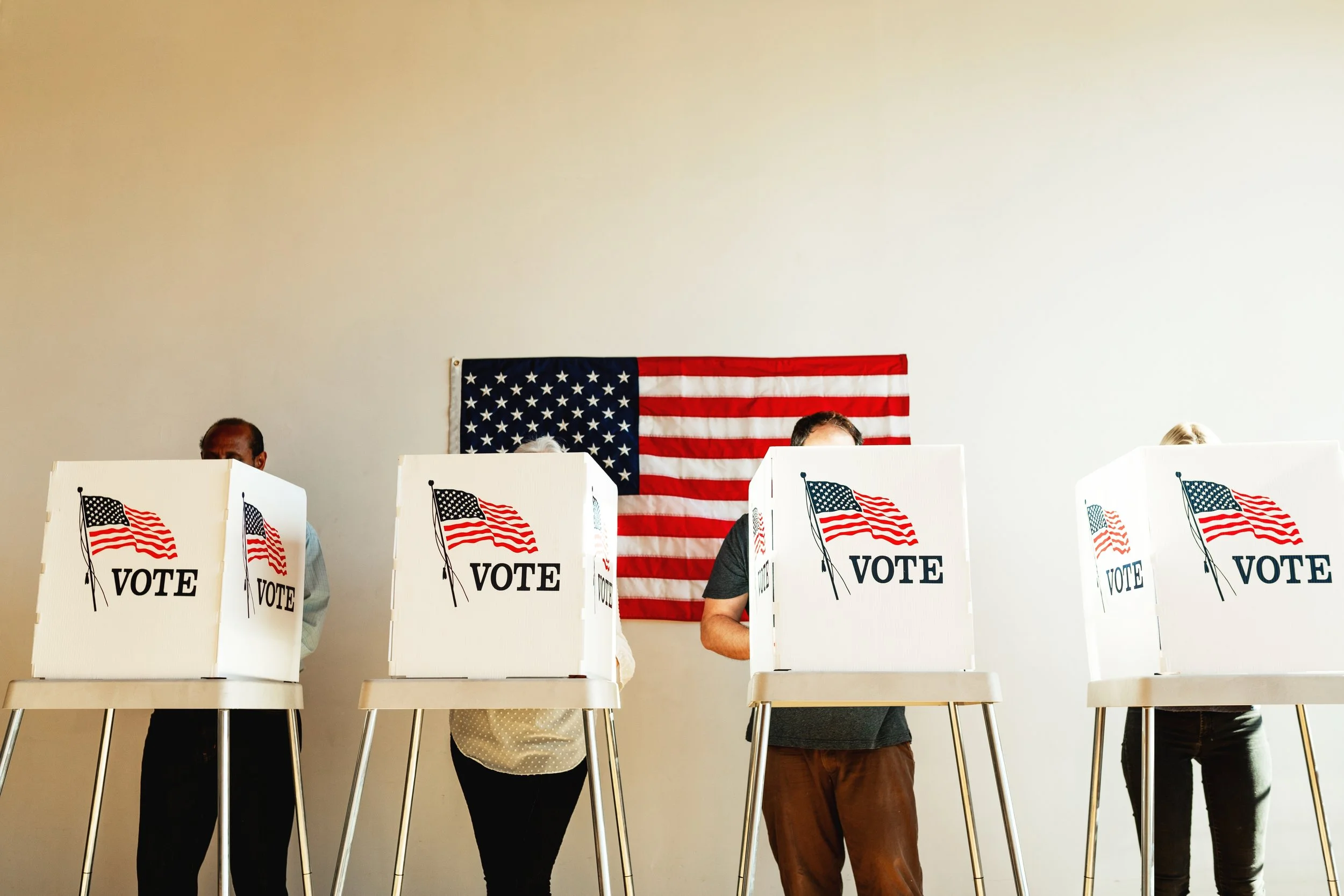
Americans will vote in the midterm election Tuesday. (Shutterstock photo)
1. At a time of deep unpopularity for President Donald Trump, will evangelicals turn out to support Republican candidates?
“Trump’s approval ratings among members of every religious group we can study are among the lowest of his second term,” the Pew Research Center reported earlier this month. “Even religious groups who have traditionally been his strongest supporters see him less favorably than they used to.”
Evangelicals represent “the Republican Party’s core voting bloc — and a crucial player in President Donald Trump’s rise to power,” Religion News Service’s Jack Jenkins noted. Leaders such as Ralph Reed, head of the Faith & Freedom Coalition, “are rushing to ensure evangelicals still turn out with their usual gusto — or at least vote enough to limit conservative losses.”
Republicans worry that evangelicals sitting out the midterms could cost them in key races, according to CNN’s Lauren Fox and Morgan Rimmer:
In 2016, 2020 and 2024, roughly 8 in 10 White evangelicals cast ballots for President Donald Trump nationally. While they make up only 13% of the country’s population, they vote in such large numbers that they often account for roughly 20% of the electorate in any given election, according to the Public Religion Research Institute.
“The evangelical vote is Trump’s strongest coalition. Thirty-eight percent of his voters were White evangelicals. [Republicans] cannot win — I don’t care where you are in the country — without the evangelical vote,” said Ryan Burge, a professor at the John C. Danforth Center on Religion and Politics at Washington University in St. Louis.
But at a moment when gas and grocery prices are high, the president’s approval rating is underwater, and enthusiasm among Republicans is tepid, the 2026 election could be a critical test of whether White evangelicals still have enough faith in the GOP to turn out in full force on Election Day.
The Wall Street Journal’s Damien Paletta wrote that “Democrats’ stealthy advance into the South” — read: the Bible Belt — “during this midterm cycle could end up being the story of the year.”
2. How will culture war issues — including ballot measures in 10 states on abortion, sex and gender policy — fare at the ballot box?
The nonprofit Ballotpedia News outlined the specific state questions:
All 10 statewide measures that voters will decide on Nov. 3 on abortion, sex-based requirements for school sports, medical procedures for transgender minors, and parental review and notification in education are part of our top 50 measures.
Measures in Idaho, Nevada, and Virginia would establish a constitutional or legal right to abortion. Missouri Amendment 3 would repeal the reproductive freedom amendment, prohibit abortion with exceptions, and prohibit certain medical or surgical procedures for transgender minors. Colorado Proposition 135 would also prohibit certain procedures for transgender minors.
Measures in Arizona, Colorado, Nebraska, and Washington would establish sex-based requirements for school sports participation. Washington Initiative 1 would address parents' rights to review educational materials, receive notifications, and opt their children out of sexual-health education.
Religion News Service’s Ellie Ashby and Aleja Hertzler-McCain reported:
Officially, abortion is still a top policy priority for many religious leaders. The U.S. Conference of Catholic Bishops calls preventing abortion its “preeminent priority,” and prominent conservative evangelicals continue to mobilize their voters around the issue.
But as Idaho, Missouri, Nevada and Virginia prepare to vote on abortion-related measures in the midterm elections, polling suggests it is less of a priority for voters than in other recent election cycles.
Republicans are emphasizing transgender ads in midterm campaigning, putting cultural issues over voters’ economic anxiety, according to The Associated Press’ Steve Peoples and Aaron Kessler.
3. Will Michigan voters elect a sharp critic of Israel as the first Muslim American ever to serve in the U.S. Senate?
I mentioned Democrat Abdul El-Sayed’s Senate bid in my recent story on America’s war of words over Muslims:
El-Sayed has said his faith instructs him to do good and seek justice. But his Republican opponent, Mike Rogers, has characterized El-Sayed’s identity as a hindrance and possibly even a danger to America. President Donald Trump has described Democratic candidates in the midterm election as “jihadists.”
Religion Unplugged’s Clemente Lisi produced an analysis piece on “Muslims, The Upcoming Midterms And America’s Political Future.”
Religion News Service’s Yonat Shimron delved into another aspect of El-Sayed’s candidacy:
The race points to the deep divisions among Michigan Jews over El-Sayed. The Senate candidate who has said he would vote to cut off U.S. military aid to Israel, and earlier this week said he did not consider Israel an ally, has created a rift among Jews there, one few voters wanted to talk about publicly.
It pits Jews for whom Israel is a big part of their identity against other Jews for whom it isn’t.
El-Sayed’s campaign test, according to RNS, is this: “Can he win over Black and Jewish voters?”
In the campaign’s final weeks, El-Sayed has faced attacks on his faith and family ties, as explained by the New York Times’ Reid J. Epstein, Brian M. Rosenthal and Michael Kruse.
An interesting twist, via the Times’ story:
He has featured his grandparents in advertisements, including one that began airing on Tuesday in which they declared, “We’re Presbyterians.”
Sen. Gary Peters, the two-term incumbent Democrat, did not seek re-election.
4. Can a Methodist megachurch pastor defeat a Republican incumbent to become Kansas’ first Democratic U.S. senator since 1932?
I first mentioned Adam Hamilton in a Plug-in column in May on pastors running for Congress.
Hamilton leads Resurrection United Methodist Church in Leawood, Kansas, about 10 miles southwest of downtown Kansas City, Missouri. That’s the largest United Methodist Church in the nation.
In a Religion News Service profile of Hamilton, Jack Jenkins wrote:
Hamilton’s style — ambitious yet conciliatory — feels almost archaic in an era dominated by strident political rhetoric. But supporters, including members of his church, say it’s precisely what has built him so much goodwill among his fellow Kansans and Methodists — and what may make him an unusually difficult target for his political opponents.
As noted by USA Today, Hamilton faces embattled Republican incumbent Roger Marshall as he seeks to snap the longest Democratic losing streak in U.S. Senate history.
Earlier this month, New York Times religion writer Ruth Graham opened her profile of Marshall this way:
In the race for U.S. Senate in Kansas, the Democrat quotes the Bible from memory on the campaign trail and has described voting as “an act of Christian discipleship.” He is the pastor of the largest church in the state.
His Republican opponent derides him as a “megachurch C.E.O.”
With just a few weeks until Election Day, the race appears neck and neck in a state that has sent only Republicans to the Senate since 1932.
Campaigning for Marshall in Topeka this week, Vice President JD Vance told voters: “If elected, Adam Hamilton would use our faith and your vote as Kansas senator to launder a political ideology that despises the way that Kansas lives. This man is a lab creation of Washington operatives and far-left activists who don’t know a thing about you or what you care about.”
5. Which brand of Christianity — Ken Paxton’s evangelicalism or James Talaricos progressivism — will prevail in Texas' tight U.S. Senate race?
For Religion Unplugged, Luke Reinkensmeyer reported:
As a member of the Presbyterian Church and a seminarian at Austin Presbyterian Theological Seminary, Talarico is part of a broader form of Christianity that aligns most closely with progressive values. Often characterized as a mainline Christian, these are denominations that are typically concerned with justice and equality and tend to be more politically liberal on abortion and sexuality.
Historically, they have struggled to retain members and have had few clergy members in political office. But Talarico’s emergence, along with that of several other mainline Protestant candidates, reflects a membership that is still flickering and a public willing to vote for these type of Democrats.
In coverage for Christianity Today, Liam Adams quoted Jack Graham, pastor of Prestonwood Baptist Church, a megachurch in Plano, Texas, north of Dallas. Graham is a former president of the Southern Baptist Convention.
Adams noted:
Ken Paxton, the Republican candidate for US Senate in Texas, has been a Prestonwood member, though he hasn’t received Graham’s endorsement. However, another group called “Pastors for Paxton” recently announced its support for the Republican nominee. The group, formed by 27 pastors who signed a letter, hope to challenge Democratic candidate James Talarico’s well-known progressive Christian platform. Talarico holds an advantage over Paxton in most polls.
As the Wall Street Journal put it earlier this month, Trump “backed the scandal-plagued Paxton in one of the riskiest bets of the midterms.” Sen. John Cornyn, the four-term incumbent, lost in the GOP primary after the president endorsed Paxton.
Just this week, the New York Times’ Lauren McGaughy introduced readers to “The Christian Influencer at the Center of Ken Paxton’s New Life”:
She is all but invisible on the campaign trail for U.S. Senate in Texas, seen only briefly in bystander videos, never mentioned in ads and whisked away from the prying eyes of the political press.
Tracy Duhon, an aspiring Christian influencer, came into Ken Paxton’s life just before he announced his Senate run and is building a life with him — traveling abroad and celebrating holidays together.
Aides to Mr. Paxton, whose wife, Angela, has filed for divorce on “biblical grounds,” take pains to keep Ms. Duhon away from the Senate race, where he has struggled to draw support from independents and even some fellow Republicans. Mr. Paxton, the state’s attorney general, now trails his Democratic opponent, James Talarico, in most polls.
But it is clear that Ms. Duhon, now deep in the inner circle of one of the most powerful politicians in Texas, has brought Mr. Paxton close to a world of online influencers and Christian self-help, where vulnerable public admissions and promises of redemption come in social media posts.
The Michigan, Kansas and Texas races are among seven that either party could win, according to the Washington Post’s Amber Phillips.
In Phillips’ analysis, it’s “possible … but far from a guarantee” that Democrats could retake the Senate, just as they did in 1986.
Inside The Godbeat
I was pleased to win first place for outstanding column/commentary in the Oklahoma Society of Professional Journalists’ 2026 annual contest.
The SPJ honored my April 19, 2025, column for Religion Unplugged on the 30th anniversary of the Oklahoma City bombing.
Winners were announced this past Friday in Tulsa.

The Oklahoma City National Memorial and Museum pays tribute to the 168 people — including 19 children — killed in the April 19, 1995, bombing of the Alfred P. Murrah Federal Building. (Photo provided by Oklahoma City National Memorial and Museum)
The Final Plug
Earlier this year, I explored country star Ella Langley’s Baptist upbringing and how she found salvation at a Judgement House.
From that piece:
In the case of Langley, how do we confirm — 100% — her Bible Belt street cred?
For me, that moment came when she asked (podcast host Theo) Von if he ever went to Judgement Houses.
“No, what was it?” he replied.
“It’s like, they do it around Halloween,” she explained. “It’s like a haunted house for Christians, I guess. Very scary. I remember our youth group took us. You get in there, and it’s like this car crash scene, and it’s pretty much like convincing you that, yes, you could die the second you walk out of here. So you better settle up.”
“You better get saved, huh?” Von said.
“You better get saved,” Langley confirmed.
Given that Halloween is Saturday, I thought I’d mention that column again, just in case you missed it.
Happy Friday, everyone! If you can afford it, be sure to give the neighbor kids lots of candy this weekend.
Bobby Ross Jr. writes the Weekend Plug-in column for Religion Unplugged and serves as editor-in-chief of The Christian Chronicle. A former religion writer for The Associated Press and The Oklahoman, Ross has reported from all 50 states and 20 nations. He has covered religion since 1999.