
✍️ After 61 Years, This Legend Still Hasn’t Missed A Beat On The Godbeat 🔌

Weekend Plug-in 🔌
Editor’s note: Every Friday, “Weekend Plug-in” meets readers at the intersection of faith and news. Click to join nearly 10,000 subscribers who get this column delivered straight to their inbox. Got feedback or ideas? Email Bobby Ross Jr.
• • •
“Why not keep busy?”
That’s Richard Ostling’s quick reply when asked why — at age 85 — he’s still churning out insightful religion news content.
“Our beat is ever-challenging, and there’s no shortage of fresh topics,” said Ostling, who writes a biweekly column for Religion Unplugged and produces the Religion Guy Q&A for Patheos on the alternate weeks.
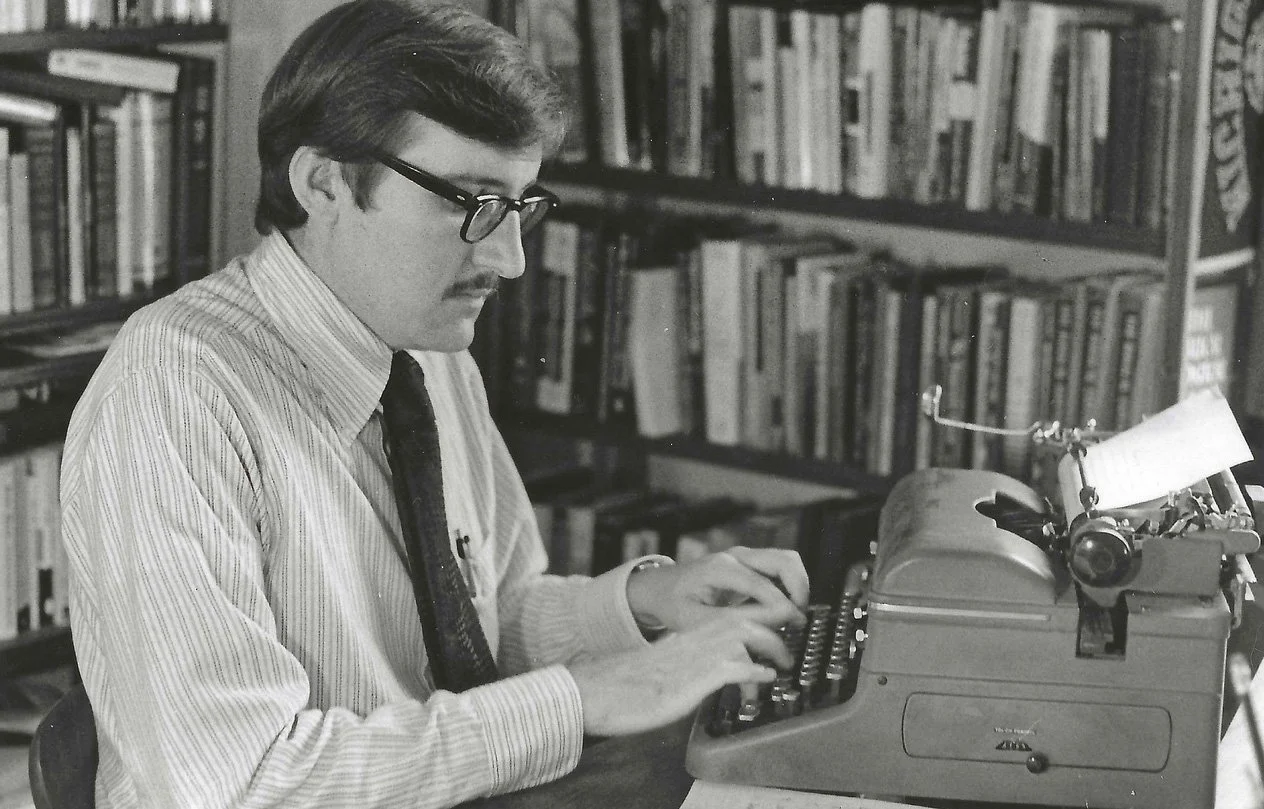
Richard Ostling works at a typewriter circa 1973. This was the “B.C. era (before computers),” as his late wife, Joan, described it on the back of the picture. (Photo provided by Elizabeth Ostling Klein)
“Experts tell us it’s healthy to be busy with activities that interest you,” he explained. “My retiree schedule is perfect.”
Clemente Lisi, Religion Unplugged’s executive editor, praises Ostling’s always stellar contributions.
“Dick Ostling’s columns have been a tremendous asset to Religion Unplugged,” Lisi said. “His experience, journalistic rigor and historical perspective have helped to elevate our coverage and give readers essential context on the importance of religion and public life. I have valued, and continue to value, his guidance, advice and friendship.”
I reflected last week on my 25th anniversary on the Godbeat.
RELATED: How A Career Choice By My Wife Led Me To The Godbeat 25 Years Ago
But I’m just a pup compared to Ostling, who got his start in 1965 — 61 years ago — with Christianity Today before a legendary career with Time magazine and later The Associated Press.
Among his professional highlights, Ostling interviewed the Rev. Billy Graham, the Dalai Lama, Mother Teresa and Joseph Cardinal Ratzinger (who later became Pope Benedict XVI) along with “ranking rabbis and Muslim leaders; and authorities on other faiths; as well as numerous ordinary believers,” according to his bio. He and his late wife, Joan, wrote the acclaimed 1999 book “Mormon America: The Power and the Promise.”
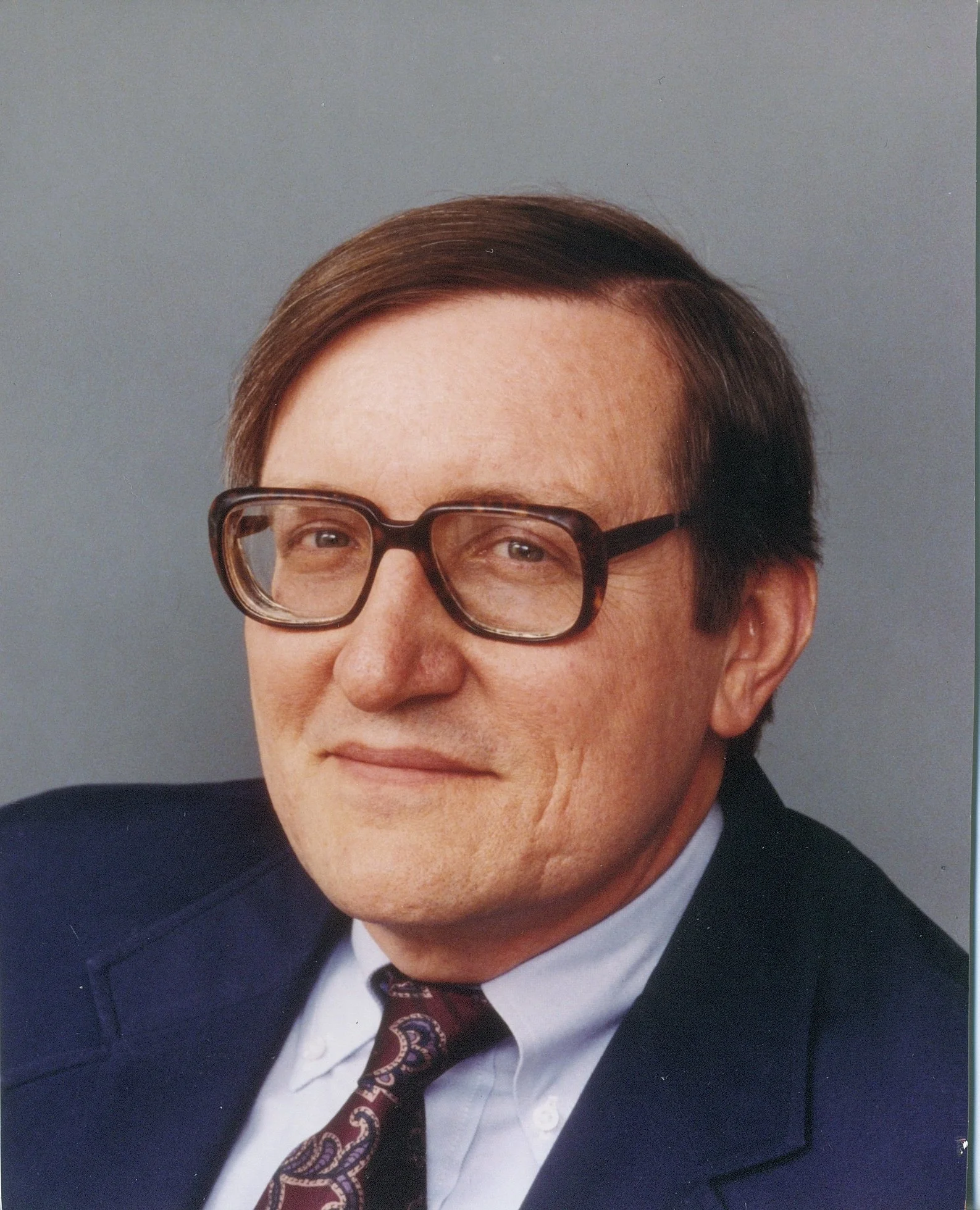
A publicity photo of Richard Ostling from his time with Time magazine. (Photo provided by Richard Ostling)
Ostling and the late, great Rachel Zoll formed AP’s national religion dream team for five years before his “retirement” in 2006. I was blessed to collaborate with both of them — and gain valuable insight on religion journalism — during my time with AP in Nashville, Tennessee, and Dallas, Texas, from 2003 to 2005.
I even got to cover a national meeting of conservative Episcopalians with Ostling in Dallas in October 2003. He wrote the stories for AP’s morning newspaper wire (the coverage most people were actually going to see!), and I did the afternoon wire versions. But despite my limited role, I cherished the opportunity to work alongside him.
A full two decades ago, Ostling earned the Religion News Association’s 2006 William A. Reed Lifetime Achievement Award. Ann Rodgers, then the Pittsburgh Post-Gazette’s religion writer and a future lifetime achievement award winner herself (she won it in 2018), wrote the tribute when Ostling was honored.
“When I was a journalism student at Northwestern University in the mid-1970s, Richard Ostling's work inspired me to go into religion news,” said Rodgers, who spent three decades on the Godbeat. “His reporting demonstrated that religion could be covered as a legitimate and highly compelling news beat, with as much claim to the front page as politics or economics. He was covering the Vatican, trends among evangelicals and much more that had often been sidelined by other reporters, but was necessary to understand our society then and now.
“In the early 1980s, when I was at my first newspaper, he was the person who first introduced me to what was then the Religion Newswriters Association,” added Rodgers, now the communications director for the Catholic Diocese of Pittsburgh. “He was always generous with his time to help young reporters navigate the shoals of religion reporting, and I believe he continues to do so. He has not only made great contributions to religion reporting but to journalism in general. We would all continue to benefit from following his example.”
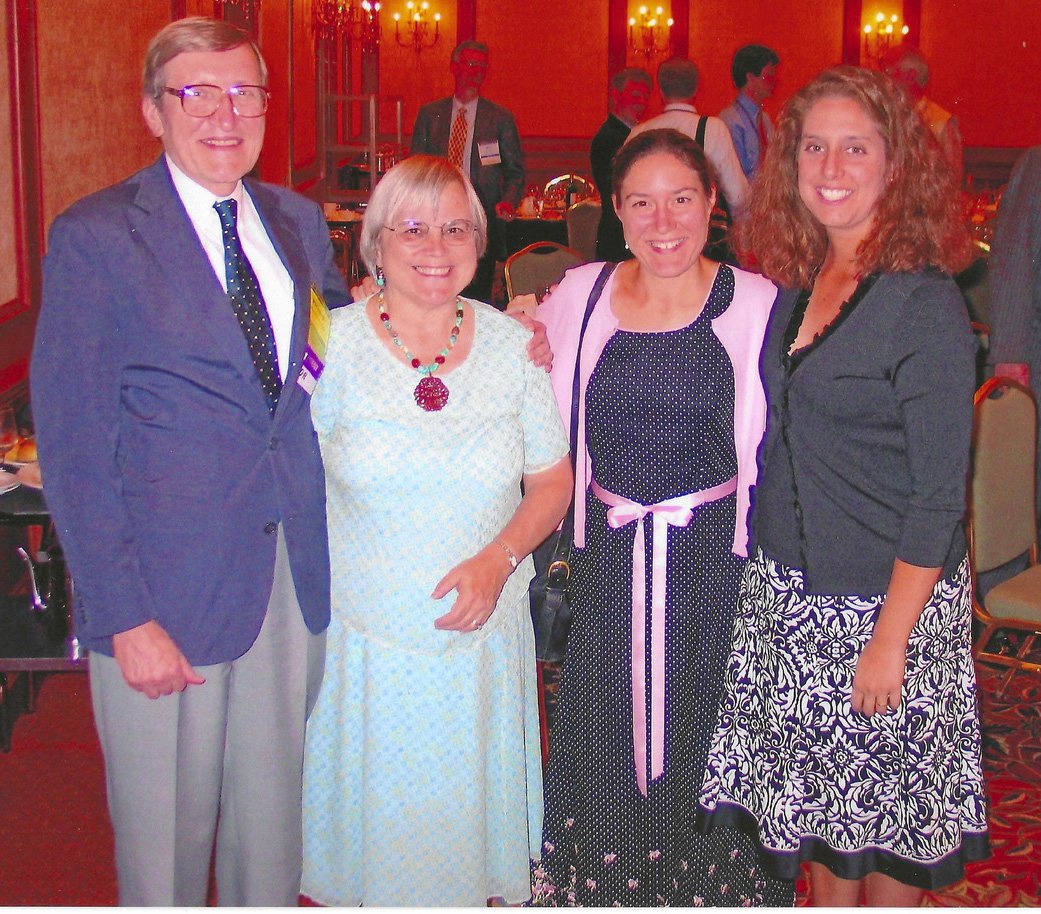
Richard Ostling with his late wife, Joan, and his daughters, Elizabeth and Maggie, when he received the Religion News Association’s lifetime achievement award at RNA’s 2006 annual meeting in Salt Lake City. (Photo provided by Elizabeth Ostling Klein)
Joan and their daughters, Elizabeth and Maggie, celebrated with him when he accepted the RNA award in Salt Lake City in September 2006.
“Dad never just worked as a journalist. He is a journalist, through and through,” said Elizabeth Ostling Klein, a professional musician who serves as the Boston Symphony Orchestra’s associate principal flute. “He’s not only highly informed in his specific area of expertise, with decades of research, interviewing and writing under his belt, but he’s also ardently committed to old-fashioned, journalistic objectivity.
“Level-headed by nature, Dad has always had a natural gift for drawing people out by asking probing questions and presenting opposing viewpoints accurately and respectfully,” she added. “I think that he’s maintained his career for so long partly because it’s so intellectually interesting, and he has so much to offer.
“Most of all, however, he’s drawn into his work by the reality that religion is one of the prime motivators in the human heart. That makes the religion beat fascinating — and constantly relevant to the news.”
These highlights from my email interview with Richard Ostling have been lightly edited for clarity and brevity:
On how he got his start in religion journalism
“Though a lifelong (Protestant) churchgoer, in my youth I did not particularly think of religion as news. After a stint with the Wilmington, Delaware, newspapers and active duty as a U.S. Army bandsman, I failed to land a Newsweek internship, turned down a Houston Chronicle offer and in 1965 became the assistant to Christianity Today News Editor David “Gene” Kucharsky, who became a valued mentor.
“Reasons? I enjoyed magazine writing, had done freelance articles for this evangelical magazine, joined its team to cover Dr. Martin Luther King Jr.’s historic March on Washington and appreciated the CT crew. The (then) D.C. location was more appealing than Texas, plus my brother was the band director at the nearby University of Maryland.
“I did not plan any long-term in religion reporting, but soon became entranced by the field. At a crucial moment, I happened to chat with Editor Newbold Noyes Jr. of the great Washington Evening Star (RIP), who encouraged me to consider beat specialization and recommended academic work to build competence. The result was hectic years earning a religion M.A. at The George Washington University while working full-time and eventually 30 fascinating years on the beat at Time magazine, eight at The AP and freelancing as a retiree.”
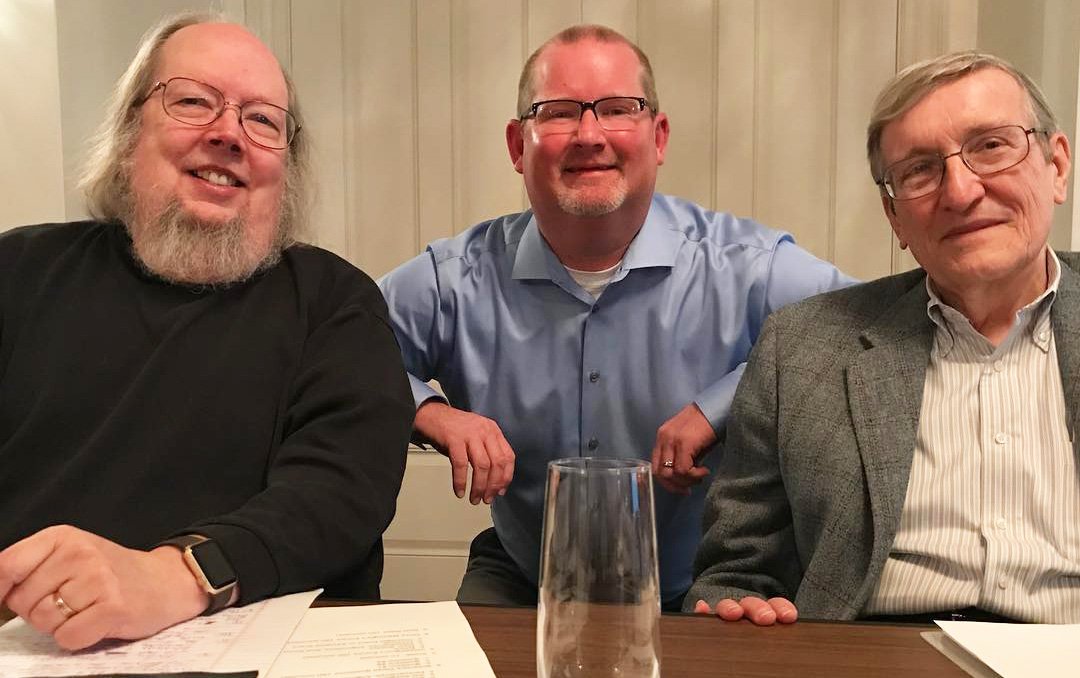
Religion writers Terry Mattingly, Bobby Ross Jr. and Richard Ostling at a meeting in New York City in 2017. (Photo provided by Bobby Ross Jr.)
On what stories and accomplishments made him the most proud
“Oh, dozens. Writing Time’s religion section was collaborative, and major credit goes to fine researchers (thank you, Dr. Michael Harris, RIP), editors (well, most of them) and splendid reportage from (the then) 100 staff correspondents plus bureau stringers.
“Highlights included loads of Vatican pieces and cover stories on the evangelical rise, Bible scholarship or offbeat topics such as missionaries and heaven. I’ve said my greatest achievement was cramming into a single column (with photo) the personal and canon law tangles when Catholic New York Gov. Hugh Carey wed a twice-divorced Greek Orthodox woman (we later learned of a third divorce).
“At The AP I easily found something newsworthy each week for a column about the Bible, and for example, managed heavy lifting on the existence of God for an Easter feature about world-class philosopher Alvin Plantinga. Cherished fellow AP religion writer Rachel Zoll (also RIP) made every day a delight.”
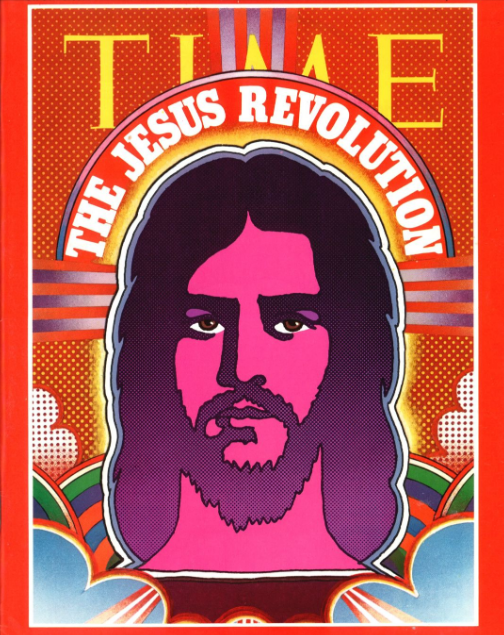
“The Jesus Revolution,” published in 1971, was one of nearly two dozen cover stories that Richard Ostling wrote or reported for Time magazine.
On the era in which he worked and the changes he has seen
“Those decades were a golden age not only for religion coverage but print journalism overall. In its heyday, Time had the money and staff to do most anything, as was generally true with the equally classy and more efficient AP. I’m grateful for both organizations and colleagues there.
“I was fortunate to know many of the great RNA pioneers on our beat. Fine work is still being done, but religion scrambles for space ever more as print media suffer a severe decline. Then there's erosion of the fairness and balance expected of professionals in my fading generation, as citizen trust in journalism continually erodes. A tragedy for America at its 250th anniversary.”
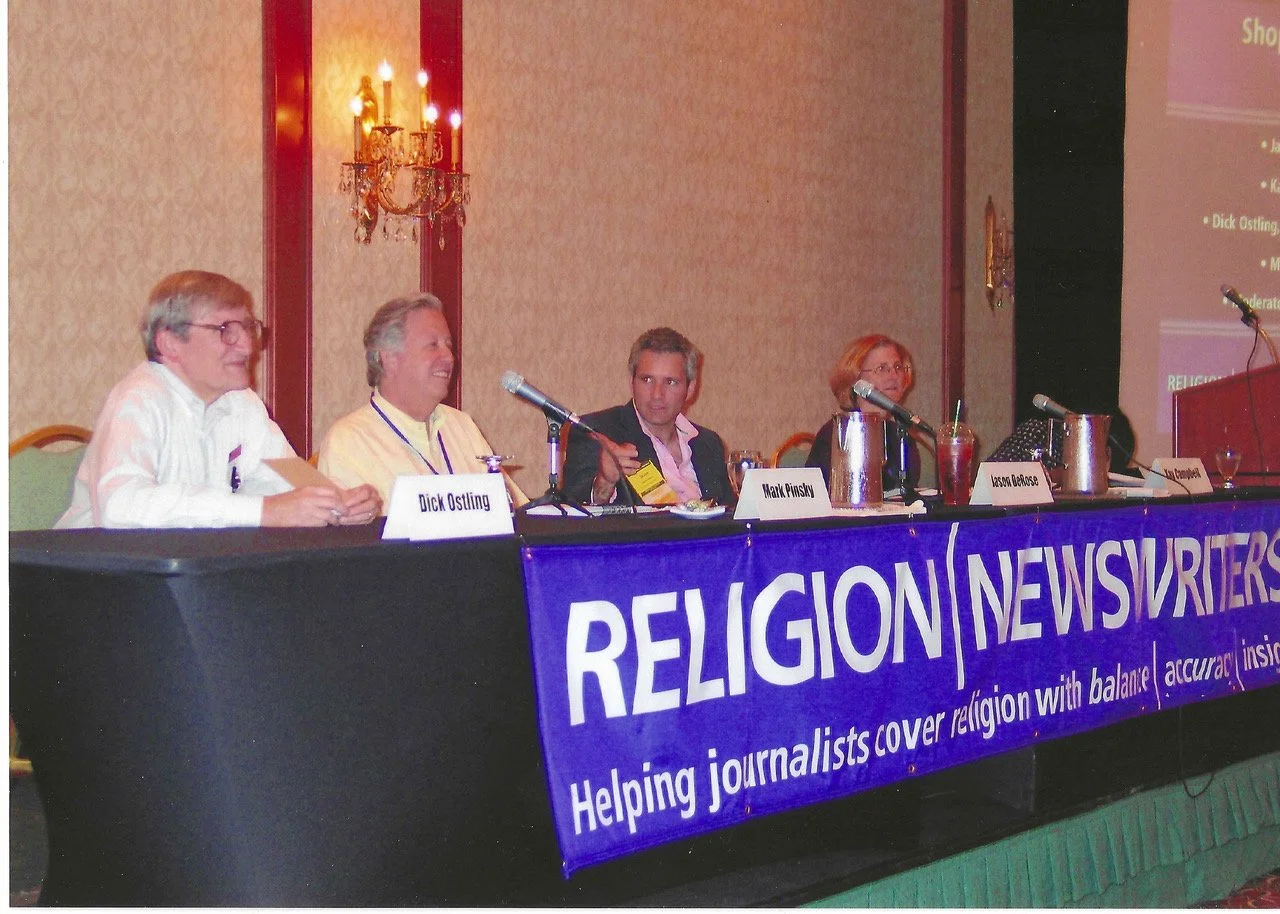
Richard Ostling, left, speaks on a panel at the 2006 annual meeting of the Religion News Association — then known as the Religion Newswriters Association — in Salt Lake City. (Photo provided by Elizabeth Ostling Klein)
On the advice he’d offer fellow journalists and religion writers
“Tips? Above all, be truthful, respectful, fair — but tough as warranted. Also curious, especially with faiths you’re less familiar with. Carefully prepare for each interview. Double-check everything. Be careful whenever a source shares your own faith.
“After that helpful M.A., over succeeding decades, I sought to read a book per week, skimming as warranted and marking up pages for fast review if needed (as happened just this week with a 1980 book for a piece on Iran).
“On the personal side, I benefited immensely from my lovely late wife, Joan, a fellow reporter. Raising kids for the sheer fun of it also keeps you humble and grounded in real life. Finally, I recommend weekly worship in a wholesome congregation, not only for depth and inspiration but perspective from everyday folks.”
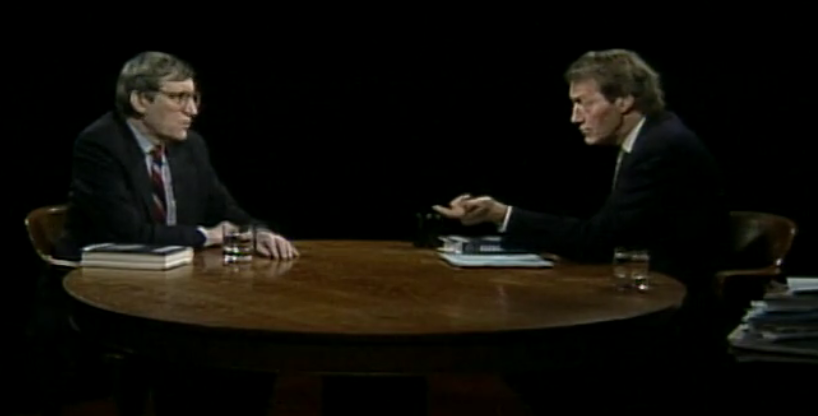
in 2000, Richard Ostling discusses his book “Mormon America: The Power and the Promise” with Charlie Rose. (Video screenshot)
Inside The Godbeat
Don’t miss Religion Unplugged executive editor Clemente Lisi’s tribute to John L. Allen Jr., the esteemed Rome correspondent and Vatican expert who died Thursday after a long battle with stomach cancer.
Of the 61-year-old Allen, Lisi writes:
In a world where reporters cover the Vatican more like a political state rather than a religious institution, John occupied a rare space, even rarer these days. The longtime Rome correspondent explained things — both fairly and with plenty of context — to a world largely unfamiliar with how the Vatican works.
When something happened behind Vatican walls, he was the journalist I went to for context. He was the one who could tell readers not only what was happening, but why it mattered and why people might disagree about it.
The Final Plug
I mentioned the late Rachel Zoll, the beloved former Associated Press national religion writer, up above.
This seems like an appropriate time to point out that the Religion News Association has created the Rachel Zoll Award for Excellence in Breaking News.
RNA’s contest website notes that Zoll “was beloved and respected by her fellow RNA members. RNA honored Zoll with a Special Recognition Award in 2018. She died in 2021 after a three-year bout with brain cancer.”
Happy Friday, everyone! Enjoy the weekend.
Bobby Ross Jr. writes the Weekend Plug-in column for Religion Unplugged and serves as editor-in-chief of The Christian Chronicle. A former religion writer for The Associated Press and The Oklahoman, Ross has reported from all 50 states and 20 nations. He has covered religion since 1999.