
Remembering John L. Allen Jr.: A Life Spent Making Sense Of Power And Faith
(ESSAY) I first came to know John L. Allen Jr. the way many people did — by trusting him.
In a world where reporters cover the Vatican more like a political state rather than a religious institution, John occupied a rare space, even rarer these days. The longtime Rome correspondent explained things — both fairly and with plenty of context — to a world largely unfamiliar with how the Vatican works.
When something happened behind Vatican walls, he was the journalist I went to for context. He was the one who could tell readers not only what was happening, but why it mattered and whypeople might disagree about it.
The news of John’s death on Thursday in Rome, his adopted hometown, at the age of 61 following a long battle with stomach cancer has us religion beat journalists mourning his loss and quantifying his immense legacy.
In recalling John’s life and career, Crux, the Catholic news website he relaunched in 2016, noted the following:
“Allen was a force of nature, certainly as a journalist who was not only our principal but also a model for us, whose counsel and whose company we already and forever shall sorely miss. Allen was a patient mentor, a generous colleague and the consummate newsman.”
He was all those things and much more. I last saw John at a Rome restaurant in September 2024, where he regaled a group of foreign journalists with stories about the Vatican and its inner workings. He was a master storyteller. I could have listened to him for hours.
I did regularly listen to him, each week, on his podcast and read his columns as part of my large news diet. He was an astute observer, in print, on TV and in my earbuds, on all things regarding the Catholic Church.
John’s wife, Elise Ann Allen, herself a Vatican correspondent, recalled her husband this way:
“In that sense, John’s greatest ‘heritage’ is not his legendary career, the prestige of the Crux website, or even the titanic impact he has had on journalism and the way the Catholic Church is understood and perceived in the world. It is the people he loved: it is me, our friends, our colleagues, and all of you. John’s greatest gift to the world was not his incredible and unparalleled mind, but it was his big and generous heart. Everyone who was blessed enough to call themselves John’s friend bore witness to his gift for friendship, his limitless self-giving, and his insatiable desire to help and empower others whenever and however he could. If he loved you, there were no lengths to which he wouldn’t go to help you or simply make your life easier. I hope that with his passing, the world will look back not just on his lifetime of impressive professional accomplishments, but more so, his personal ones.”
Born in Hays, Kansas, in 1965, Allen dedicated his life to journalism. After establishing himself in the Eternal City (he had spent 17 years as a reporter with the National Catholic Reporter), he joined the Boston Globe’s Crux team, where he served as associate editor.
Two years later, the newspaper spun Crux off, leaving Allen to spearhead the website as both CEO and editor-in-chief.
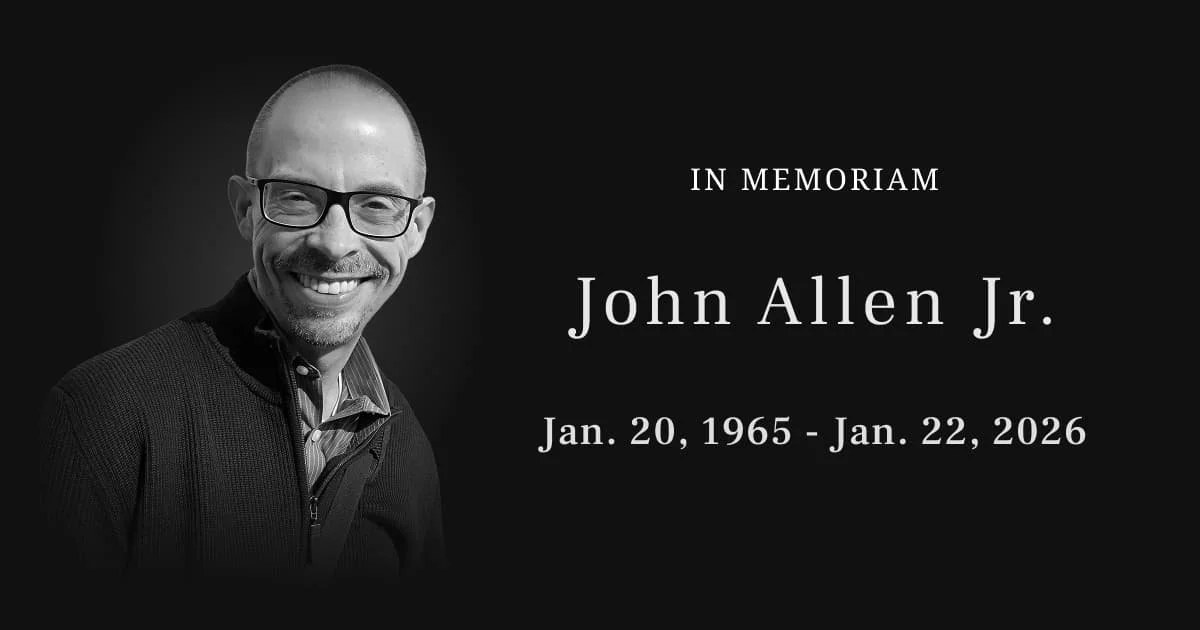
Image courtesy of Crux
Allen came to my attention in 2001 with the publication of his book titled, “Cardinal Ratzinger: The Vatican's Enforcer of the Faith.” The church — along with the news media — were different places at the start of the 21st century. The internet was new and papal conclaves were even more mysterious than they are today.
I met John for the first time in 2012 when I traveled to Rome, as a reporter for the New York Post, on assignment to cover the elevation to cardinal of then-New York Archbishop Timothy Dolan. He was very helpful to me and my fellow New York reporters throughout that week.
Allen’s 2003 landmark “Conclave” became a handbook for religion-beat journalists (I used it as a resource during last year’s process that led to the election of Pope Leo XIV) trying to understand how the Catholic Church chooses a pope. He didn’t just report on the Vatican, he helped demystify it.
TV audiences also got to know him. He appeared as an analyst on CNN and later CBS News, giving millions upon millions of viewers the same context I had come to appreciate from him in print. He was a walking encyclopedia on all things Catholic. Well versed in politics, theology and where cardinals liked to dine, he was the best Vaticanista not to be an Italian.
He was also a great mentor. He answered interview requests from reporters eager to quote him. He made time for young reporters. He celebrated others more enthusiastically than himself. He continued working almost until the end.
What remains now is not just a body of journalistic work, though that is formidable. What remains is a way of doing journalism — with curiosity instead of suspicion and ability over ego.
I’ll miss reading him. Rest in peace, John.
Clemente Lisi serves as executive editor at Religion Unplugged.