
2 Years Later, Opinions On Trans Rights Have Barely Budged
(ANALYSIS) If one were to ask 100 informed voters about the types of issues at the center of the Culture War debate, I think that 20 years ago two would clearly be the front runners: Gay marriage and abortion.
If I were to ask 100 informed voters that same question today, I’m pretty sure that abortion would come up a lot, but same-sex marriage would have probably faded quite a bit in the public’s consciousness.
Instead, I would argue that the rights of transgender Americans would be much more “top of mind” for folks who pay even a little attention to the political debates in this country.
READ: Hijab Disputes Expose Legal Gap In Faith-Based Schools
It’s hard to poll on trans issues because the debate takes on so many forms. There are battles over bills designed around bathroom access, legislation about whether high school students can compete in sports that don’t match their birth gender, and strong debate over whether teachers can use different pronouns with students without notifying their parents. In the previous dustup about homosexuality, the question really centered on one thing: Should a same-sex couple have the right to marry one another?
A couple of months ago, The Argument pulled together a really extensive poll about transgender rights. The title of the report tells the whole story: The trans rights backlash is real. A majority of voters would support a national law requiring people to use public restrooms that correspond with their birth sex. Sixty percent believed that high school athletes should be required to compete with people who share their birth sex. What was even more surprising was that the latter question almost evenly divided Kamala Harris voters: 38% were in favor and 41% were opposed.
One thing we don’t have a lot of in this arena is longitudinal data about how opinions have moved over time. Because of the newest release of the Cooperative Election Study, I can now compare answers to the same question from October 2023 to October 2025 — before election season had really heated up, and then a year after it was over.
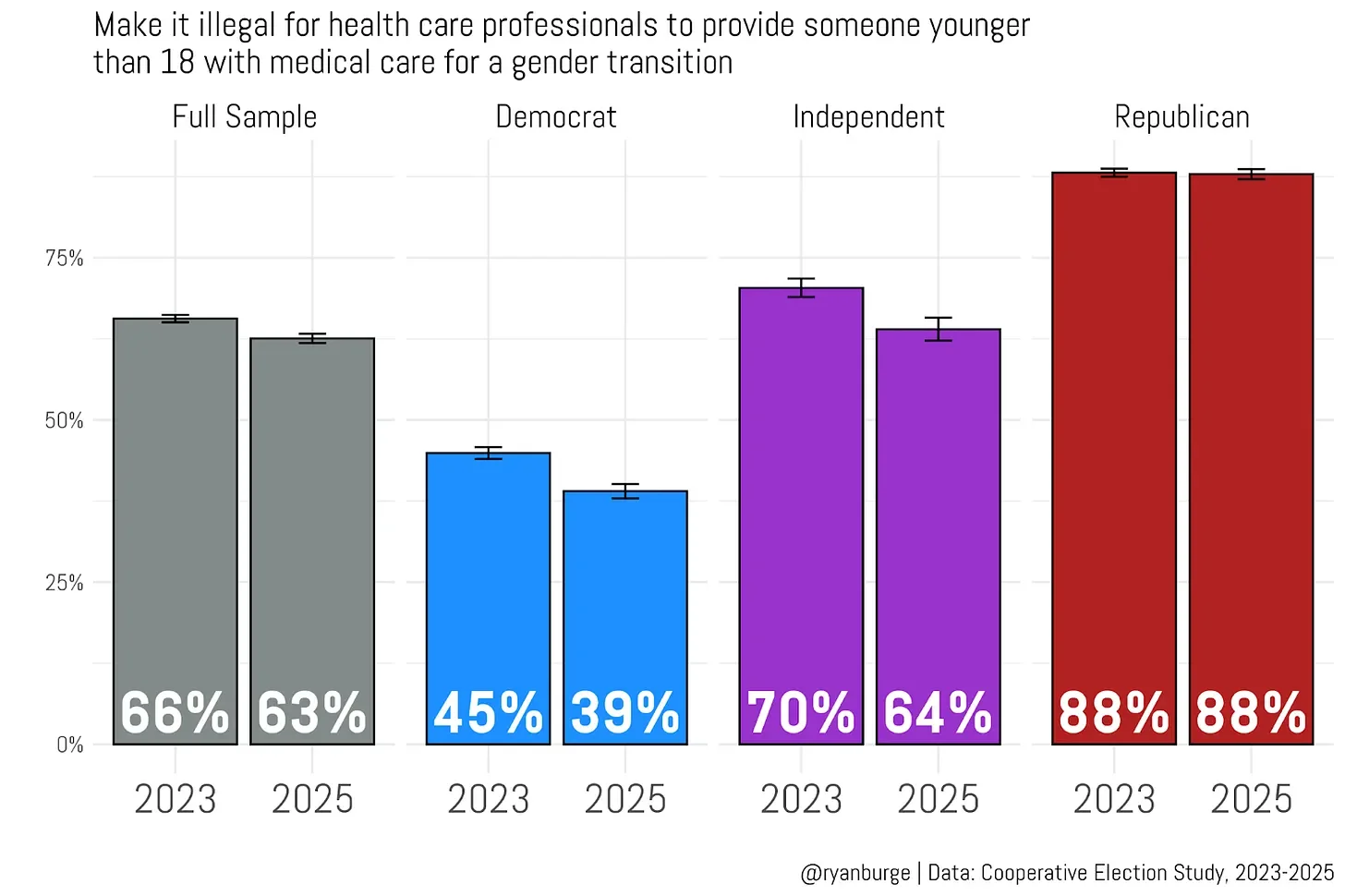
The question under scrutiny here is: “Make it illegal for health care professionals to provide someone younger than 18 with medical care for a gender transition.”
And I think we can see a bit of movement in the direction of permissiveness over the last few years. In the full sample, support for the ban went from 66% in 2023 to 63% in 2025. Obviously not a huge shift, but it is statistically significant.
The reason for that is a big movement among Democrats and Independents. For Democrats, opposition dropped from 45% to 39% in two years, but it declined even more among Independents — from 70% to 64%. It’s important to note, though, that even today almost two-thirds of Independents favor a ban on medical care for gender transition for minors.
Notice the opposition among Republicans, though. It’s rock solid and near unanimous. It’s basically orthodoxy in the GOP now. I can’t imagine a Republican running for office in 2026 who won’t make it a centerpiece of their campaign.
You can read the rest of this post on Substack.
Ryan Burge is an assistant professor of political science at Eastern Illinois University, a pastor in the American Baptist Church and the co-founder and frequent contributor to Religion in Public, a forum for scholars of religion and politics to make their work accessible to a more general audience. His research focuses on the intersection of religiosity and political behavior, especially in the U.S. Follow him on X at @ryanburge.