
Trump vs. Pope Leo: A Conflict Over Faith, War And Power
(ANALYSIS) The escalating clash between President Donald Trump and Pope Leo XIV is more than a war of words. It is a revealing confrontation between two fundamentally different kinds of power — moral authority and political force — and a window into how both are evolving in an era of polarization and conflict.
At the center of the dispute is the U.S. war with Iran, which the American pope has condemned in strikingly direct terms. His recent statements decry the “worship of mortals and money” and warn against arrogance. It denounced, in the pope’s words, the “absurd and inhuman violence” unleashed by war.
This confrontation is not just about a pope and a president. It is about the kind of leadership that resonates in a time of crisis. Leo represents a model grounded in moral persuasion and restraint, one that seeks to elevate the conversation above immediate political gains. Trump embodies a model centered on dominance and narrative control, where influence is measured by the ability to command attention and shape perception.
READ: Pope Leo Strikes A Diplomatic — And Distinctively American — Path For The Papacy
The pope’s critique becomes even sharper in his rejection of religious justifications for violence. When American officials invoked Christianity in support of the war effort, Pope Leo responded with a theological rebuke: Jesus does not sanction war or listen to prayers that seek victory through violence.
In doing so, Leo is not merely disagreeing with policy — he is challenging the moral framework being used to defend it. His message is clear: Faith cannot be conscripted into a military talking point without distorting its core teachings.
Trump’s response operates on a different plane. Rather than engaging Leo’s moral arguments, he recasts the pope as a political adversary —“weak” and “liberal” on foreign policy. His claim that Leo’s papacy is somehow a product of his own presidency — “If I wasn’t in the White House, Leo wouldn’t be in the Vatican” — is less a factual assertion than a reflection of how Trump understands power as personal and transactional.
This rhetorical move is significant. By framing the pope as just another politician, Trump collapses the traditional boundary between spiritual authority and partisan conflict. The leader of the world’s 1.4 billion Catholics becomes, in this view, no different from a domestic opponent to be criticized and delegitimized. It is an approach that leaves little room for independent moral voices, treating all criticism as inherently political and therefore suspect.
Following his attack on Pope Leo XIV, Trump posted an an AI-generated image on his Truth Social account — later deleted — depicting himself as Jesus. Trump, questioned later by reporters, called it “fake news.”
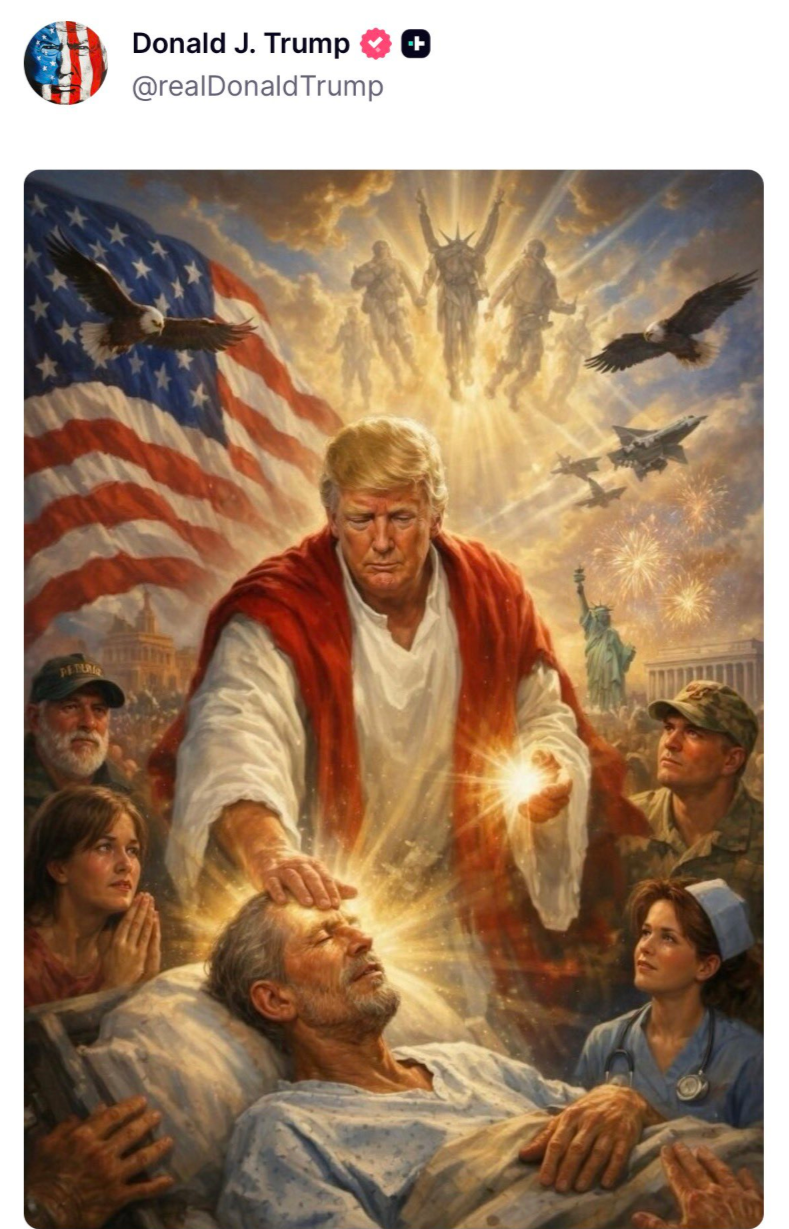
An AI-generated image via Truth Social
Trump said it was supposed to be him as a doctor.
Social media posts aside, the contrast between the two men is stark. Pope Leo’s leadership style is rooted in universalism. He speaks in the language of human dignity and restraint, emphasizing the broader consequences of war beyond national interests. Papal authority derives not from coercion but from persuasion.
Speaking to reporters on Monday aboard the papal plane as he began his trip to Africa, the pope declined to directly address the president's comments.
“I am not a politician,” he said. “I will leave that to the politicians.”
The pope added, “Too many people are suffering in the world today. Too many innocent people are being killed. And I think someone has to stand up and say, ‘There’s a better way to do this.’”
Criticism of Trump came from a variety of Catholics, including Archbishop Paul Coakley, head of the U.S. Conference of Catholic Bishops, and from Bishop Robert Barron, who, a few days ago, was applauding Trump as an Easter guest at the White House. CatholicVote, a politically conservative group, voiced concerns about the growing rift.
“There is no reason this disagreement should become a larger rupture,” CatholicVote President and CEO Kelsey Reinhardt. “But it will if reckless voices keep treating every papal statement as a partisan attack and every political disagreement as proof of betrayal. Once again, we must delineate between moral principles and the realm of politics.”
Trump’s approach to taking on the pope is grounded in confrontation and personalization. Disagreement is met with escalation, and critics are reframed as adversaries. Where Pope Leo seeks to lower the temperature, the president seems to raise it, turning even a critique into an opportunity for political combat.
This isn’t the first time Trump has taken on the papacy. In February 2016, Pope Francis blasted Trump’s campaign pledge of building a wall on the U.S.-Mexico border. At the time, Trump attacked Pope Francis for acting like a “very political person.”
For Trump and some of his political allies, religion can function as a source of legitimacy for state action. Invoking faith in support of military objectives blurs the line between spiritual conviction and political messaging, transforming religion into a tool of mobilization.
The resulting tension is not just about Iran. It’s about who gets to define the moral meaning of the conflict — and whether that meaning is independent of political interests.
Clemente Lisi serves as executive editor at Religion Unplugged.