
Singapore Tops World Rankings For Most Religious Diversity
NEW YORK — Singapore is the world’s most religiously diverse nation, according to a new study by the Pew Research Center that examines how evenly major religious groups are represented across national populations.
Using data from 2020, Pew found that no single religious group dominates Singapore’s population. Buddhists make up the largest share at 31%, followed by religiously unaffiliated people (20%), Christians (19%), Muslims (16%), Hindus (5%) and adherents of other religions (9%).
That balance, Pew said, gives Singapore a score of 9.3 on Pew’s Religious Diversity Index, the highest among the 201 countries and territories analyzed.
READ: Hong Kong Catholic Activist Jimmy Lai Sentenced To 20 Years In Prison
The index measures diversity by dividing the global population into seven categories — Christians, Muslims, Hindus, Buddhists, Jews, followers of other religions and people with no religious affiliation — and assessing how evenly those groups are distributed within each country.
Scores range from zero, which indicate a population made up almost entirely of one religious group, to 10, which would reflect a perfectly even distribution. No country achieved a perfect score.
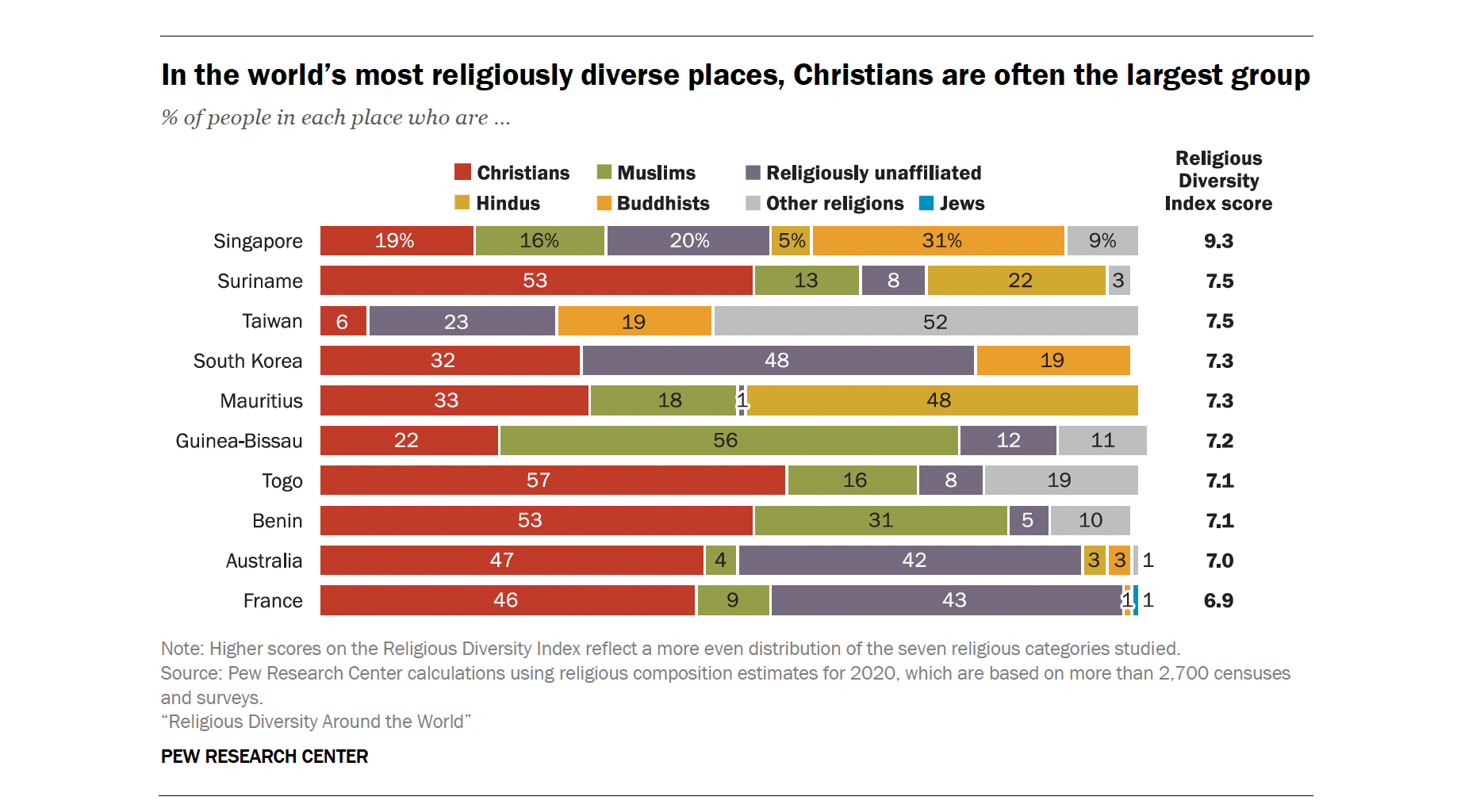
The South American nation of Suriname, meanwhile, ranks second on the list and is the only Latin American country in the global top 10. About 53% of Suriname’s population is Christian, while Hindus account for 22%, Muslims 13% and religiously unaffiliated people 8%.
Most of the remaining countries in the top 10 are located in the Asia-Pacific region — including Taiwan, South Korea and Australia — or in sub-Saharan Africa, including Mauritius, Guinea-Bissau, Togo and Benin.
France is the only European country to make the list, with a population that is largely Christian (46%) or religiously unaffiliated (43%), alongside a significant Muslim minority (9%). France’s RDI score is 6.9.
While historically Catholic, France is religiously diverse primarily due to post-World War II immigration from former colonies (mostly from Africa), which introduced significant Muslim populations to the country.
The United States, however, may be a nation of immigrants, but it does not rank among the world’s 10 most religiously diverse countries overall. Pew said the data places the United States 32nd with an RDI score of 5.8.
However, when the analysis focuses only on the world’s 10 most populous countries — each with at least 120 million residents — the U.S. does ranks No. 1.
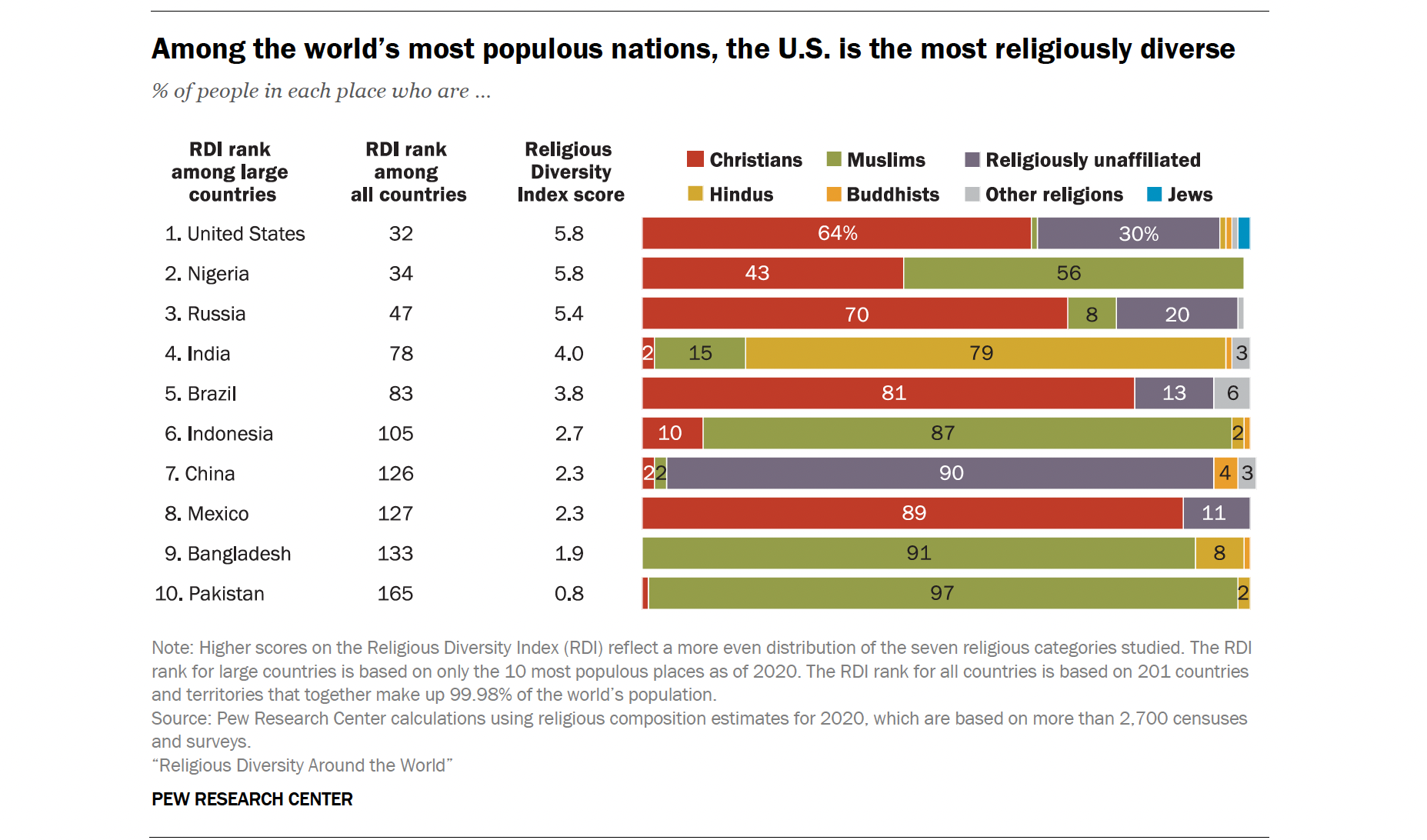
As of 2020, Pew said Christians made up about 64% of the U.S. population, religiously unaffiliated people accounted for roughly 30%, and the remaining 6% consisted of Muslims, Hindus, Buddhists, Jews and followers of other faith traditions.
Nigeria, a nation where religious freedom has been a major issue in recent years, ranks second among the most populous nations, with Muslims and Christians each representing more than 40% of its population.
The African nation is equally split between Christianity and Islam, driven by historical, geographical and colonial factors that established these faiths in different regions. The north was heavily influenced by Islamic traders starting in the 11th century, while the south underwent conversion led by Christian missionaries starting in the 19th-century.
At the other end of the worldwide spectrum, Pakistan is the least religiously diverse of the world’s 10 most populous countries, where Muslims account for about 97% of residents. Pew reported that Yemen, Afghanistan and Somalia as the least religiously diverse countries in the world — each with Muslim populations of 99.8% or higher.
Overall, Muslims make up at least 99% of the population in eight of the 10 least diverse countries. The remaining two (Timor-Leste and Moldova) are instead overwhelmingly Christian.
The study also found that religious homogeneity remains common worldwide. In 194 countries and territories, at least half of the population belongs to a single religious category.
Only 49 countries, Pew said, have three or more religious groups that each make up at least 5% of the population, and just seven — including Singapore and Suriname — have four or more religious groups at that level.
Clemente Lisi is executive editor at Religion Unplugged.