
No Revival, Just a Rift: Young Men And Women Split On Religion
(ANALYSIS) Two important religion surveys dropped recently.
Last Wednesday, the Public Religion Research Institute, PRRI, released its Census of American Religion, with a banner headline: “New PRRI Data Rebuts ‘Religious Revival’ Claim.” While the overall withdrawal from religious affiliation in America seems to have hit a pause, PRRI reported no indication of an increase either.
However, according to PRRI’s findings, young women, especially young women of color, are still disaffiliating, despite already record disinterest in the church.
The Associated Press published a story about “young men’s religious revival” based on newly released religion data from Gallup. Within Gallup’s data, there is a three-point decrease among young women saying religion is very important in their lives, which followed the trend of the past decade.
The news of “revival” is largely supported by survey results showing a dramatic 14-point bump in young men saying religion is very important in their lives, with modest increases in attendance.
If you go with Gallup’s assessment, over the last two years, young men have taken an interest in voicing the importance of religion in their lives, but without an equivalent change in their identity or habits.
And according to PRRI’s religious affiliation numbers, young women are still withdrawing.
A sweeping spirit of the age, it ain’t.
After years of religious decline in America, it’s understandable that faith leaders—especially from Christian traditions who have witnessed the steepest decline — would celebrate any indication of renewal.
Yet the eagerness to tout young men’s religious interest and relatively muted discussion of young women’s decreased attachment mirrors a current that has washed through many American churches for over a generation. It also reflects some of the issues that got us here.
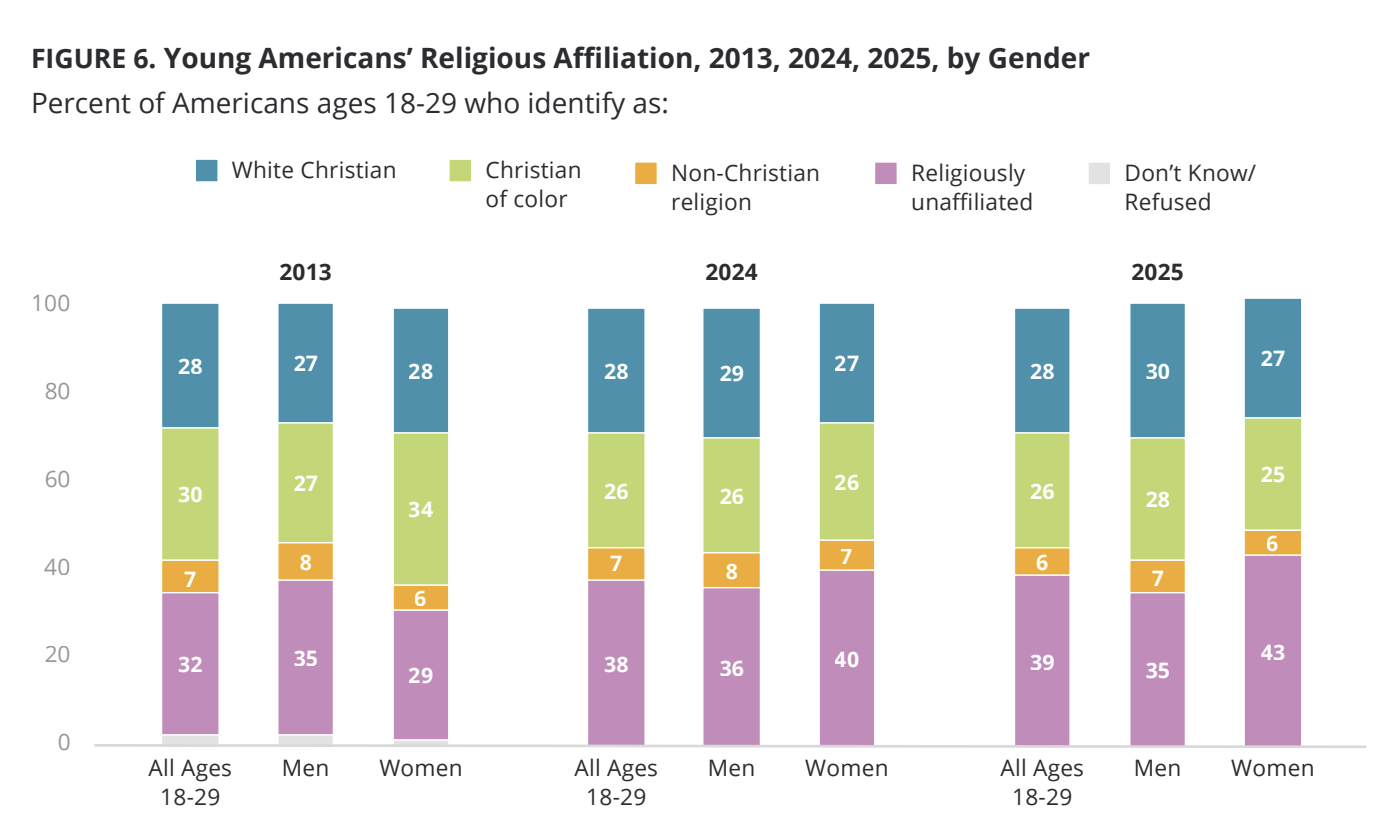
Source: PRII Census of American Religion.
Data scientists have some reason to be skeptical of recent claims of religious revival, particularly after what happened in the U.K.: a splashy Bible Society announcement of revival there wound up roundly criticized and discredited for poor methodology.
In the case of American pollsters, the differences in PRRI and Gallup’s results are generally accounted for by differences in survey periods, how questions are asked by the groups, and their methods (phone for Gallup; online for PRRI).
There are also some differences in scale. In its 2025 annual census, which reflected trends similar to prior years, PRRI surveyed 3,342 young adults age 18-29. According to Gallup’s survey methods breakdown, the headline-grabbing question of religious importance (upon which “revival” claims rely) was posed to 295 men and 145 women, ages 18-29.
The magnitude of change over two years in the Gallup religious importance answers, noted social scientist Ryan Burge, is suggestive, but “should give us caution.” Trends don’t typically shift 14 points in two years.
Between these surveys, two contrary-seeming groups emerge as possible signifiers: Republican young men for Gallup and young women of color for PRRI.
Gallup’s data shows increases in attendance among men of all parties (but much larger among Republican/Republican-leaning men, who made up the majority of the young men’s sample. While Republican/Republican-leaning women did show about the same uptick in attendance as Republican men, these women represented a smaller portion of Gallup’s poll (a little more than a quarter of young women surveyed).
This segment is murkier still, because in PRRI’s findings, there was a decline in attendance among Republican young women. In Gallup’s poll, 60% of young women were Democrats or leaned Democratic and showed little change in attendance.
In PRRI’s data, young Republicans attend church at higher rates than Democrats, but PRRI has witnessed no increase in attendance among young, Republican men. In PRRI’s census, 68% of Republicans are white Christians. Democrats, on the other hand, were far more likely (34%) than Republicans (13%) to identify as religiously unaffiliated.
For PRRI, the variable to watch is not young men. “Looking at young adults, there is a shift happening – but it’s not Gen Z men becoming more religious, as some suggest,” notes PRRI’s CEO, Melissa Deckman. “Instead, young women’s declining religiosity has brought them on par with their male counterparts for the first time.”
PRRI finds that young women’s growing disaffiliation from religious identity is led by young women of color.
There’s a certain eagerness, especially among American evangelicals, to latch onto any good news about young men’s church attendance. In part, this is because the church has been able to take women in the pews for granted for so long. Historically, in most religions around the world and in Christianity in particular, women have long outnumbered men.
In the U.S., as evangelical churches pursued growth, they sought that more elusive target: young men. From the 1960s, homeschool and political influencer Bill Gothard promised men they would be the patriarchs and authorities in their homes.
In the 1990s, men filled arena-sized Promise Keepers events, which made way for Wild at Heart-themed retreats and cussing pastor Mark Driscoll and a class of Theobros. Today, Douglas Wilson, Defense Secretary Pete Hegseth’s spiritual mentor, encourages women’s submission to their husbands and supports a repeal of women’s right to vote.
Tucked alongside this form of conservative, patriarchal religion, Christian nationalism rose.
Recent decades’ political advocacy by the Christian Right has done a lot to position the church, generally, within the American imagination as a conservative refuge. Young men who want to find a home in conservative spaces are hungrily welcomed there.
Young Christian men have stronger Christian nationalist worldviews, higher rates of apocalypticism (a belief the world, currently dominated by evil forces, will soon end through divine intervention, ushering in a utopian new era) and are most likely to have heard arguments about appealing the 19th Amendment, according to survey analysis by political researchers Paul A. Djupe from Denison University and Brooklyn Walker at the University of Tennessee-Knoxville. Those who believe “the system works against people like me” and “I rarely get what I deserve in life,” are most likely to be young, male and evangelical.
In PRRI’s tracking, young women have shed religious labels steadily since 2013, growing from 29% religiously unaffiliated in 2013 to 43% in 2025. This is a seismic change.
Not only are a lot of young women of color, especially Black young women, withdrawing from religion, but they are also abandoning the Democratic party, too, notes Melissa Deckman, CEO of PRRI. They are not becoming Republicans either. They appear to be “detaching from organizations in general.”
Depending on your survey of choice and how you group people politically, young men’s religious affiliation has either remained flat or climbed most among conservatives, while progressives tended to opt out. Women, who used to be the lifeblood of the American church, in Gen Z, are increasingly absent.
Cumulatively, this is hardly a recipe for widescale return to religious institutions.
This gender gap flip among young Americans corresponds with widening political polarization. Even in considering who they might date or marry, according to an NPR/PBS/Marist poll, 60% of people under 30 say it’s important their mate shares their political views.
It’s doubtful, without a major cultural shift or efforts from churches to depolarize, that we’ll see these groups drawing together eagerly in social or spiritual environments.
As social scientist Burge details in his book, The Missing Middle, a vital place where people of various political and economic stripes used to mix—mainline Protestant churches—is dying away. The churches that are stable and sometimes growing are ever more conservative evangelical and Catholic churches.
The emerging portrait of Christianity and conservatism becoming even more fused in the future is dangerous for the sustainability of American churches. It is unlikely to make the church more attractive to a rising generation of progressives, deepening a chasm between American Christianity and the vast majority of young women.
Young adults carry indicators for the future, but they are not the entire landscape. There are long, sloping trend lines that lead up to this fresh data.
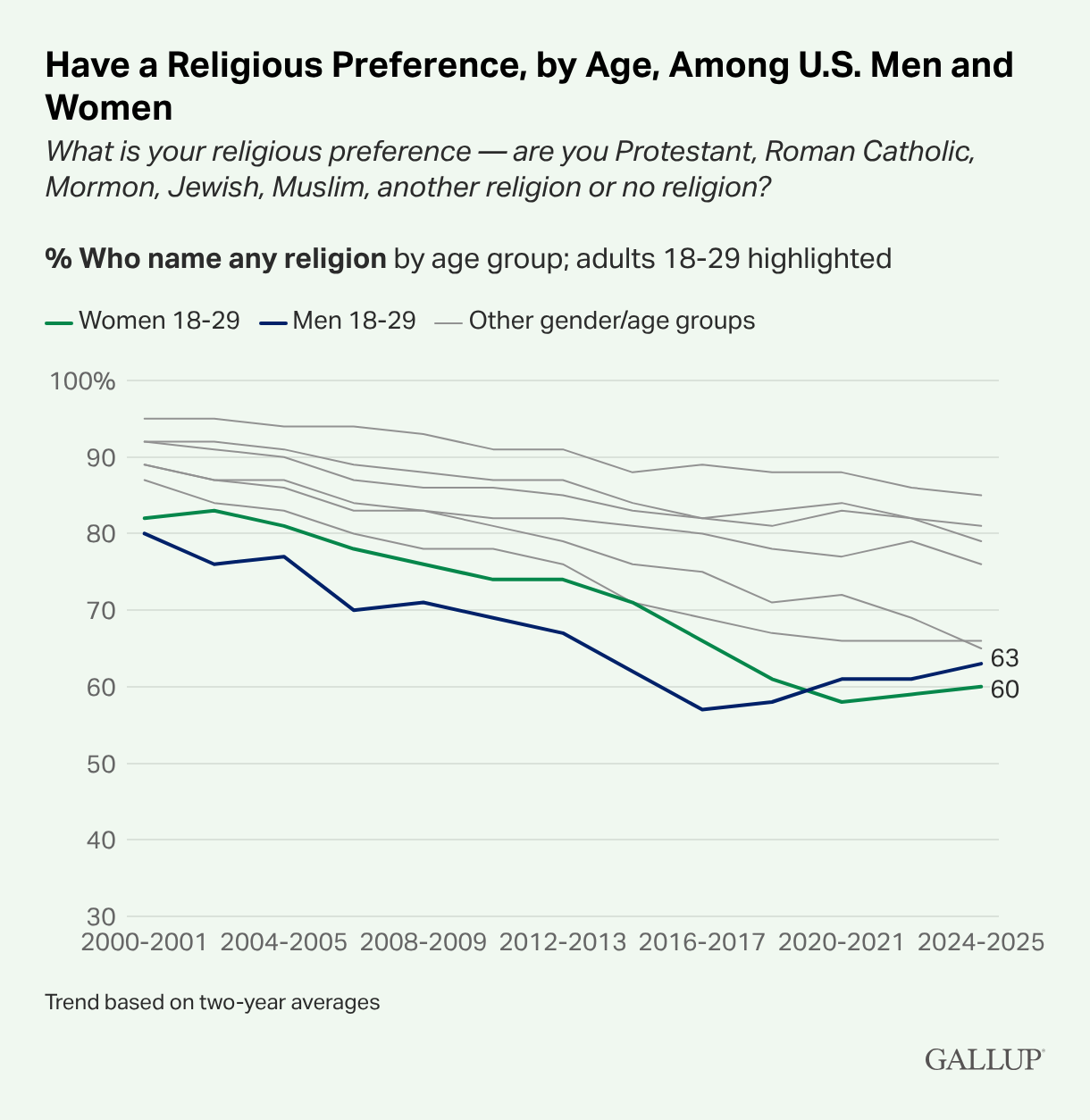
Source: Gallup
In Gallup’s most recent rendering, the religious identity of men and women between ages 30-64 is at or remains near trend lows. The gender gap between men and women in these age groups is shrinking too.
Older women (65+) remain most active in religious life. But as they age, they will not be replaced by Gen Z women in anywhere near the same numbers.
We tend to inherit religion from our mothers. As Gen Zers start to form families, it’s pretty unlikely progressive young women who are already opting out of the church will choose to join (perhaps increasingly) conservative churches or raise their children there. Many of their Millennial mothers opted out.
As a religion reporter, I have spent years interviewing women who have left the church, culminating in my forthcoming book, “Damned If She Does.” I know that the choice to leave a faith community is a deeply personal, major life decision. Millions of women have already made this (often painful) choice in the past decade. A true revival would have to win great waves of them back.
I suspect, as the next generation comes of age, broader shifts toward disaffiliation may begin again. Millennial deconstruction groups are already filled with exvangelicals and others who left churches that were patriarchal or did not align with their social justice values or that covered up abuse. How will Zoomers who grew up with today’s divisive religious and political polarization view the church?
Sarah Stankorb is a journalist and author of “Damned If She Does” and the national best-seller “Disobedient Women.” Her work has appeared in publications including Elle, The New York Times, The Washington Post, Cosmopolitan, O Magazine, Marie Claire, Vogue, Longreads, Glamour, Catapult, Slate, The Guardian, The Atlantic, Newsweek, and others. She writes about religion, politics, feminism, health, technology and the public good.