
Spirits On Display: Faith And The Supernatural Highlight ‘Art of Manga’
(REVIEW) Manga has always been a medium in which the ordinary and the extraordinary coexist. A playground can become a site of spiritual encounter, a forest can conceal ancient powers and a familiar creature can reveal a universe of supernatural possibilities.
The Brooklyn Museum’s new exhibit “Art of Manga” offers the chance to explore this imaginative territory through more than 600 original drawings from many celebrated anime franchises, including “One Piece,” “Inuyasha” and JoJo’s Bizarre Adventure. The popularity — both in print and on TV — is easy to understand. The stories address universal human themes.
Beyond the exhibit’s celebration of manga’s visual artistry and massive global popularity, areas such as religion and supernatural belief opens a compelling window onto the cultural traditions that have shaped Japanese storytelling over the last 1,000 years. Superstition and the supernatural in manga is not simply an escape from everyday life. It is often a way of interpreting reality, giving visual form to questions about mortality, moral responsibility and the relationship between humans and the unseen world.
READ: Lucio Fontana Exhibit Cuts Between The Infinite And The Divine
By drawing on Shinto traditions, Buddhist ideas, regional legends and the popularity of supernatural folklore, manga artists have taken these inherited beliefs and turned them into contemporary stories. The result is a visual culture in which spiritual questions remain remarkably flexible: Ancient gods, restless spirits and demons can become objects of reverence and even sources of terror.
Manga is without a doubt stories that are widely considered secular fictional narratives rather than religious allegories. Nevertheless, an important foundation for this imaginative landscape is Japan’s rich tradition of folklore, particularly stories involving yōkai, a broad category of supernatural entities that includes monsters and spirits.
Medieval Japan was a time period where several publications and other visual depictions of yōkai started to appear. While there were religious publications like the “Jisha Engi,” this started a trend where yōkai became increasingly seen as subjects of entertainment.
In manga art, such figures are often complex and not easily placed in categories of good and evil. Some are mischievous and others dangerous. These shifting identities make them especially suitable for manga, a medium that communicates character and atmosphere through expressive linework.
Faith can add another dimension to this imaginative world. Shinto, with its diverse traditions of kami (sacred deities) associated with places, natural phenomena and other parts of existence, offers a framework for imagining a world animated by spiritual presence. Nature can become a sacred space can have significance beyond their physical appearances. Buddhist traditions also have an influence on manga, providing stories and concepts that deal with suffering, death, rebirth and the consequences of human actions.
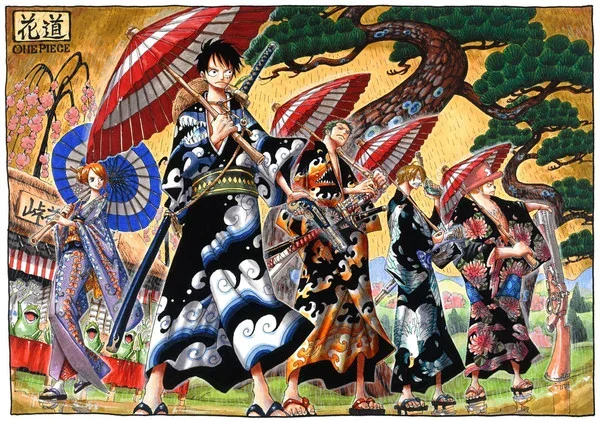
An illustration from Eiichiro Oda’s “One Piece” series on display at the Brooklyn Museum. (Image courtesy of Eiichiro Oda/Shueisha/Brooklyn Museum)
In “One Piece,” some readers (such as discussions on websites such as Love Thy Nerd) draw parallels between Monkey D. Luffy’s leadership style — bringing freedom, joy and hope to oppressed people and themes of liberation found throughout faith traditions. In the same series, the character Bartholomew Kuma carries a Bible with him at all times, injecting Christian symbolism into the storyline.
The supernatural also creates a powerful visual in this art form, making the artwork valuable to an exhibition of this kind. In manga, the unexpected must be made visible without losing its mystery.
For example, a sharply defined silhouette can make a spirit threatening, but an exaggerated expression can also transform fear into comedy. As a result, manga artists are capable of a special aesthetic achievement produced through the deliberate manipulation of what readers see and what they are left to imagine.
“Art of Manga” promises the chance to enjoy artwork while also considering how faith and fantasy inform one another in Japanese visual culture. Its supernatural dimension reveals a medium capable of holding both reverence and irreverence as well as tradition and reinvention in the same frame.
The spirits inhabiting these stories may be ancient, but what matters today is their continuing power to and remind viewers that storytelling can give visible form to the mysteries through which people try to understand the world.
“Art of Manga” is currently on display at The Brooklyn Museum now through Jan.31, 2027.
Clemente Lisi serves as executive editor at Religion Unplugged.