
New Lucio Fontana Exhibit Cuts Between The Infinite And The Divine
(REVIEW) When Argentine-Italian artist Lucio Fontana began slashing and piercing his canvases, it wasn’t an act of destruction but of liberation — an attempt to free painting from the constraints of two dimensions by redefining the concept of space in art.
But a desire to expand the possibilities of painting is only part of the story. Inspired by his engagement with religion, Fontana also sought to transcend earthly limitations by having his works point toward an infinite, immaterial and spiritual plane.
As the founder of the Spatialism art movement in 1947, he wanted to introduce actual space, time, light and movement into art. The puncture marks and gashes that characterize his famous concetto spaziale (“spatial concept”) series (1949-1968) draw attention to the space behind the picture plane, making the void beyond the flat surface as much a part of the work as the canvas itself.
READ: 800 Years After St. Francis Of Assisi’s Death, His Story Gets A Vivid New Restoration
These works were partly inspired by his fascination with the vastness of the cosmos and the latest developments in space exploration. Yet Fontana also sought to convey his conception of the divine as a universal, generative void that was ultimately unfathomable. As he said, “My cuts are a philosophical expression, an act of faith in the infinite, an affirmation of spirituality.”
For Fontana, these works allude to the unknowability of God, echoing ancient mystics and theologians such as Pseudo-Dionysius and Thomas Aquinas, who emphasized that we can know that God exists but not the nature of his essence.
The artist’s lifelong interest in the nature of spiritual reality was informed by his Catholic upbringing, and he accepted several commissions from the Church throughout his career. Yet despite consistently engaging with spiritual and religious themes, his personal beliefs were complex and apparently not tied to any conventional dogma.
The major exhibition “Lucio Fontana: Spatialism. Pioneering the Contemporary,” currently on view at Hauser & Wirth Hong Kong, introduces the artist’s practice to an Asian audience, providing a compelling overview of his Spatialist works. Curated by art historian Luca Massimo Barbero in collaboration with the Fondazione Lucio Fontana, it is the final installment in a three-part series that began at the global gallery’s Los Angeles and New York locations in 2020 and 2022-23, respectively.
The Los Angeles exhibition reconstructed Fontana’s immersive Ambienti Spaziali (“Spatial Environments”), in which dark corridors and rooms illuminated by ultraviolet lights and neon tubes placed viewers directly within the artwork, as if transporting them to another dimension.
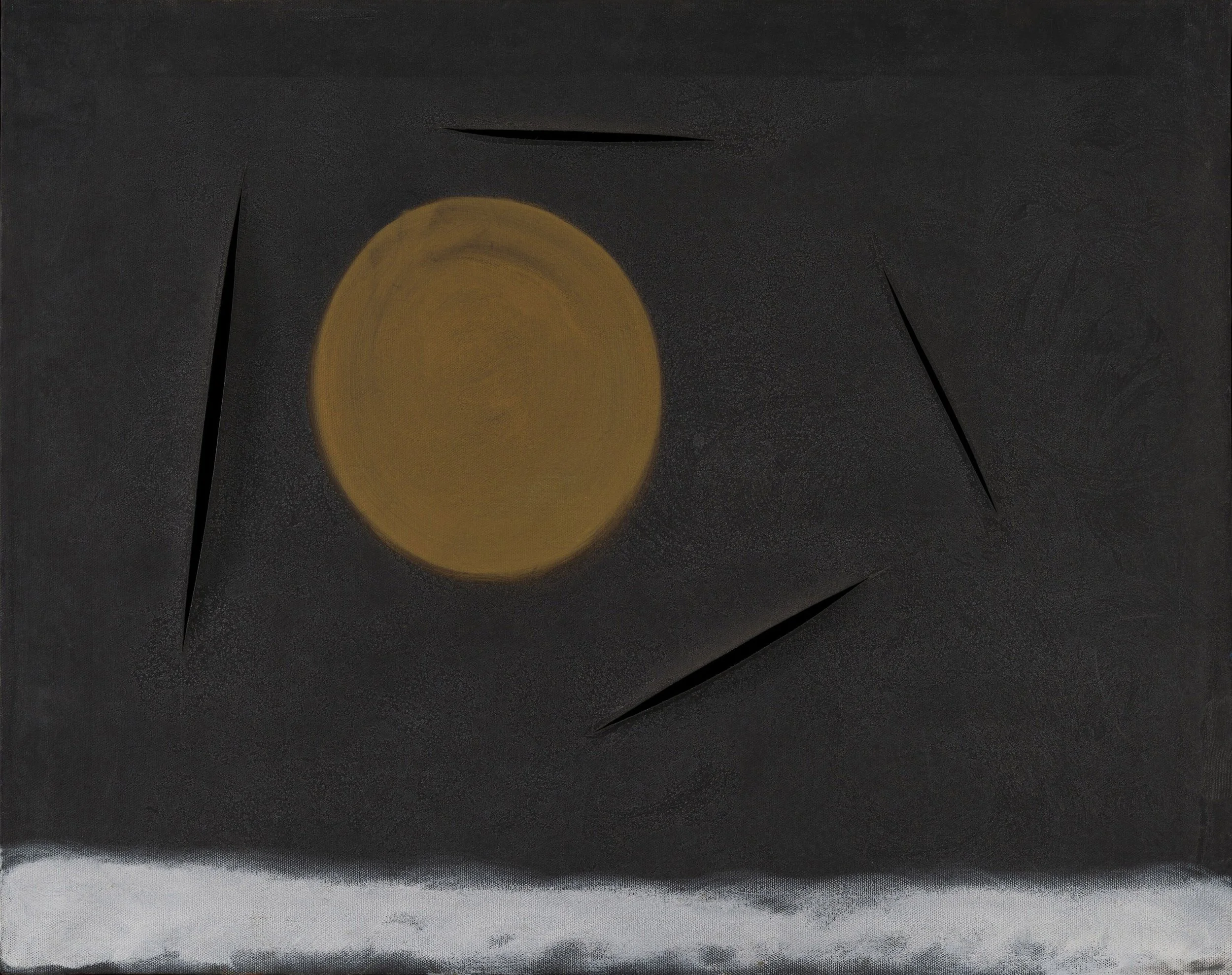
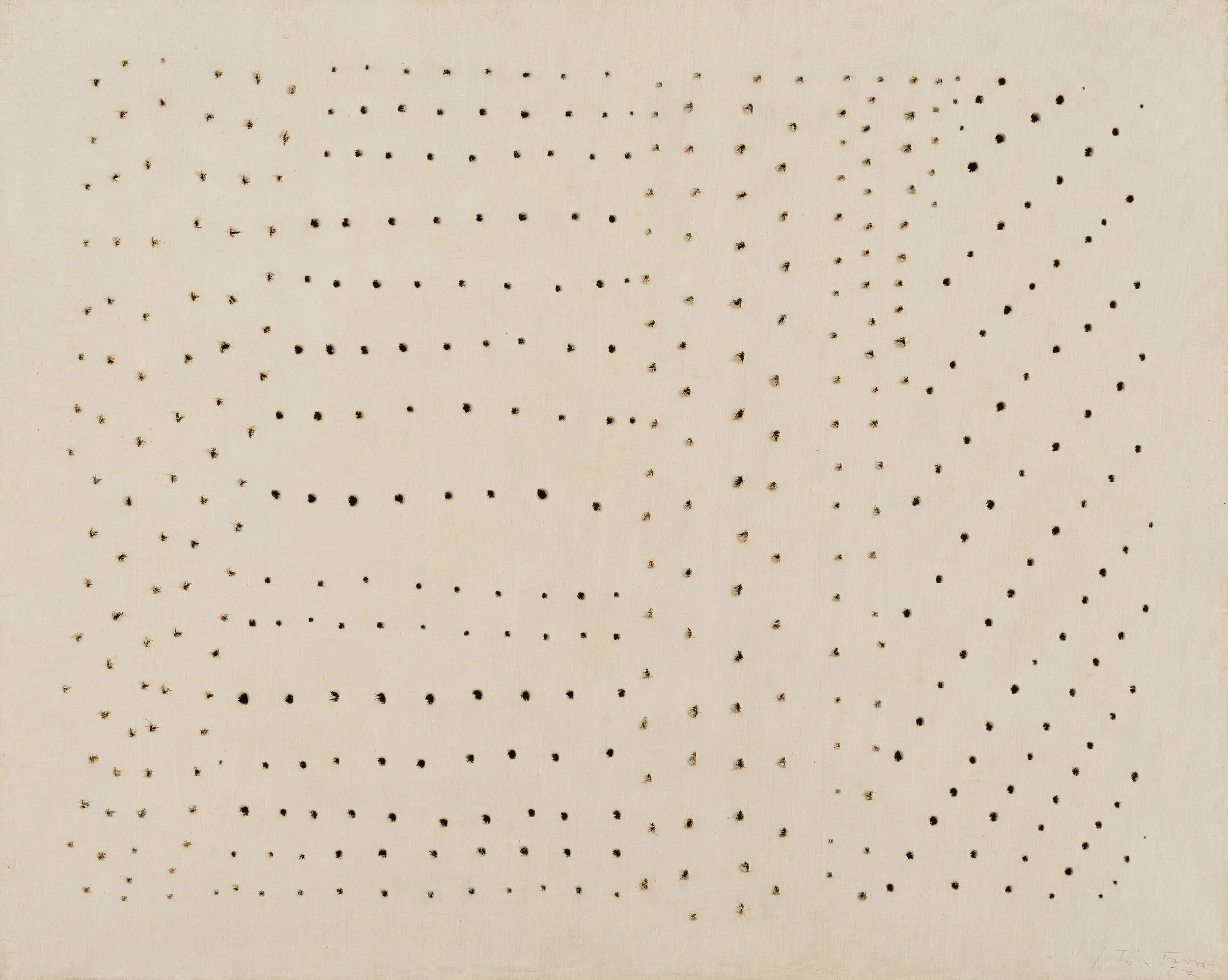
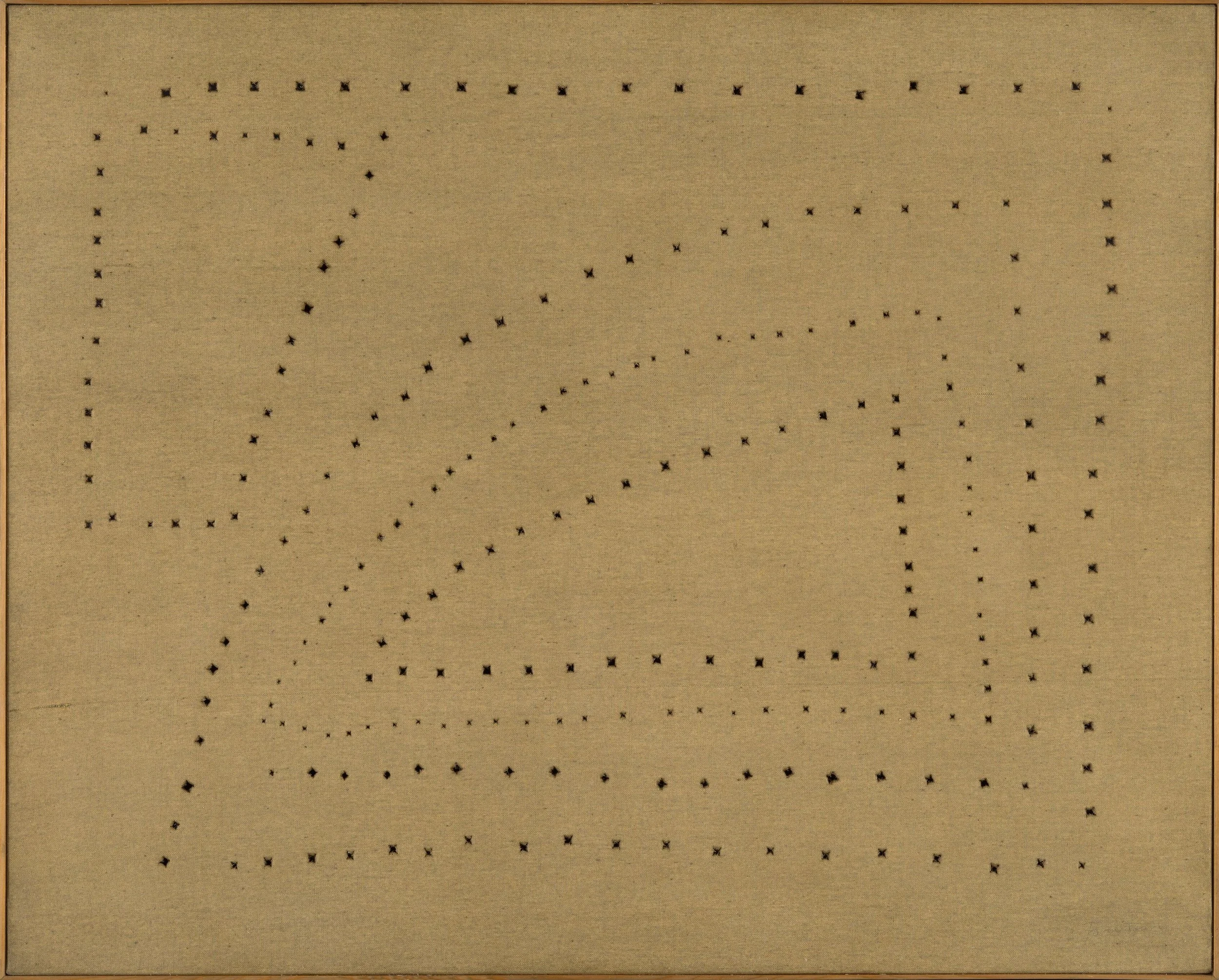
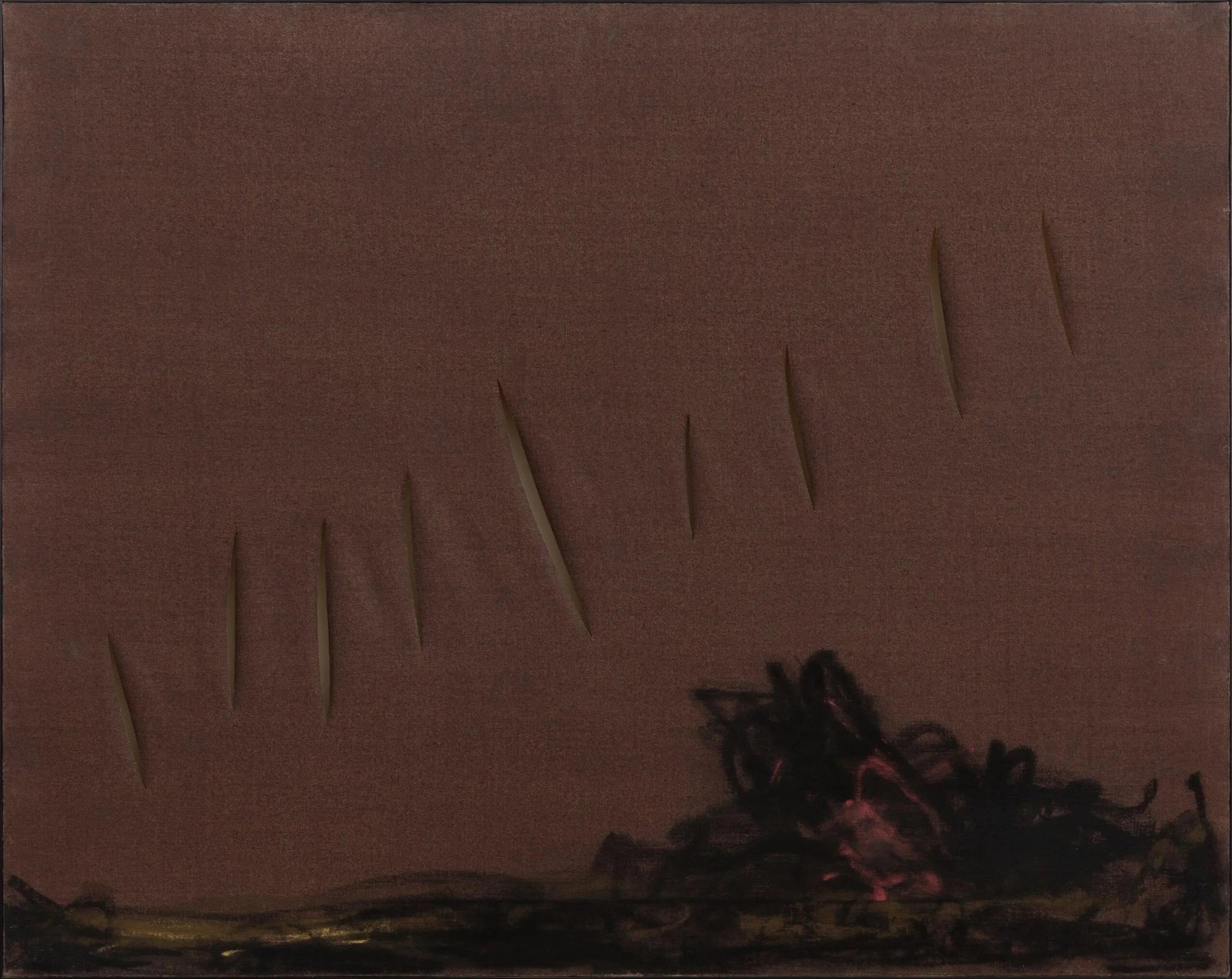
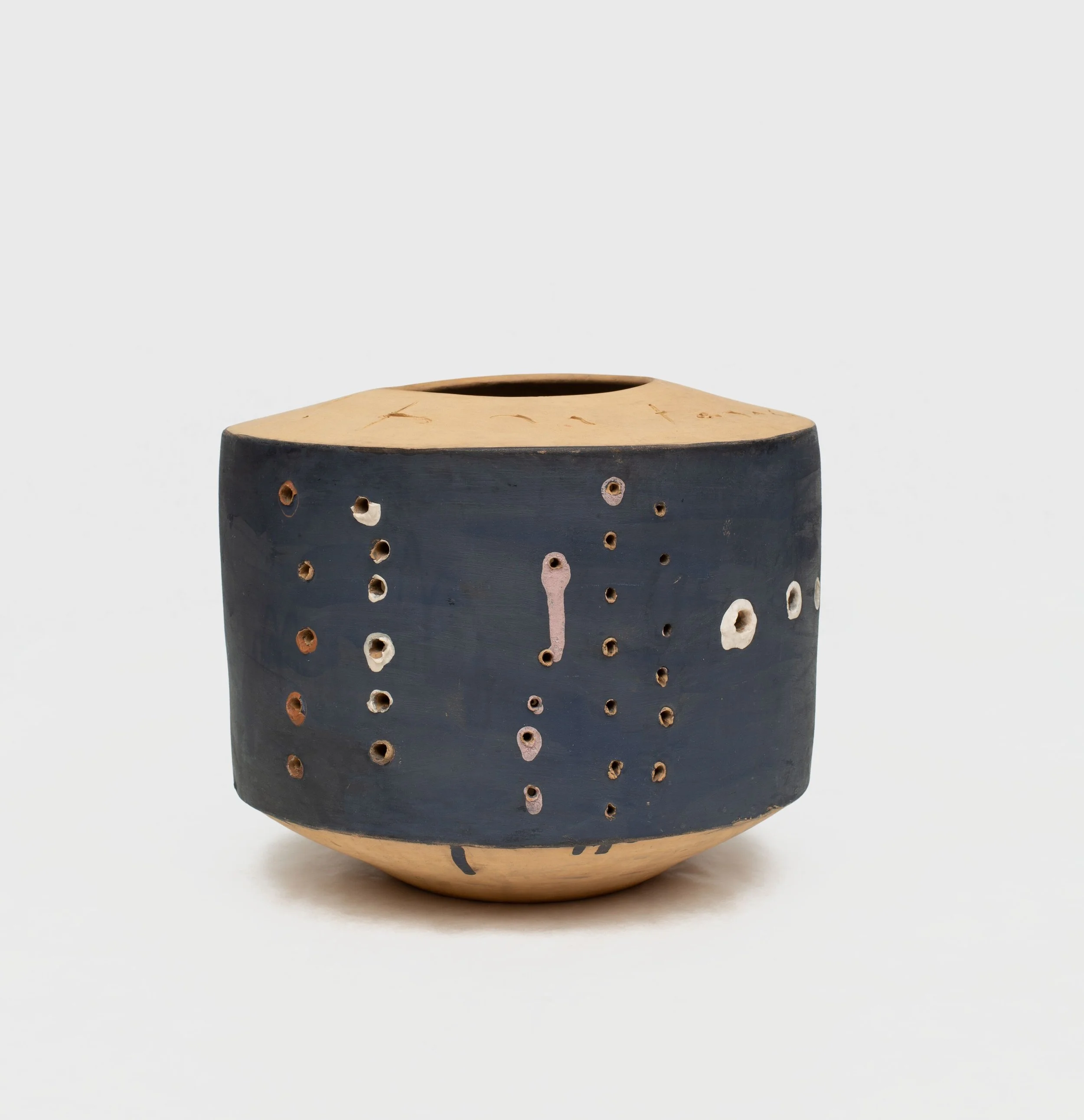
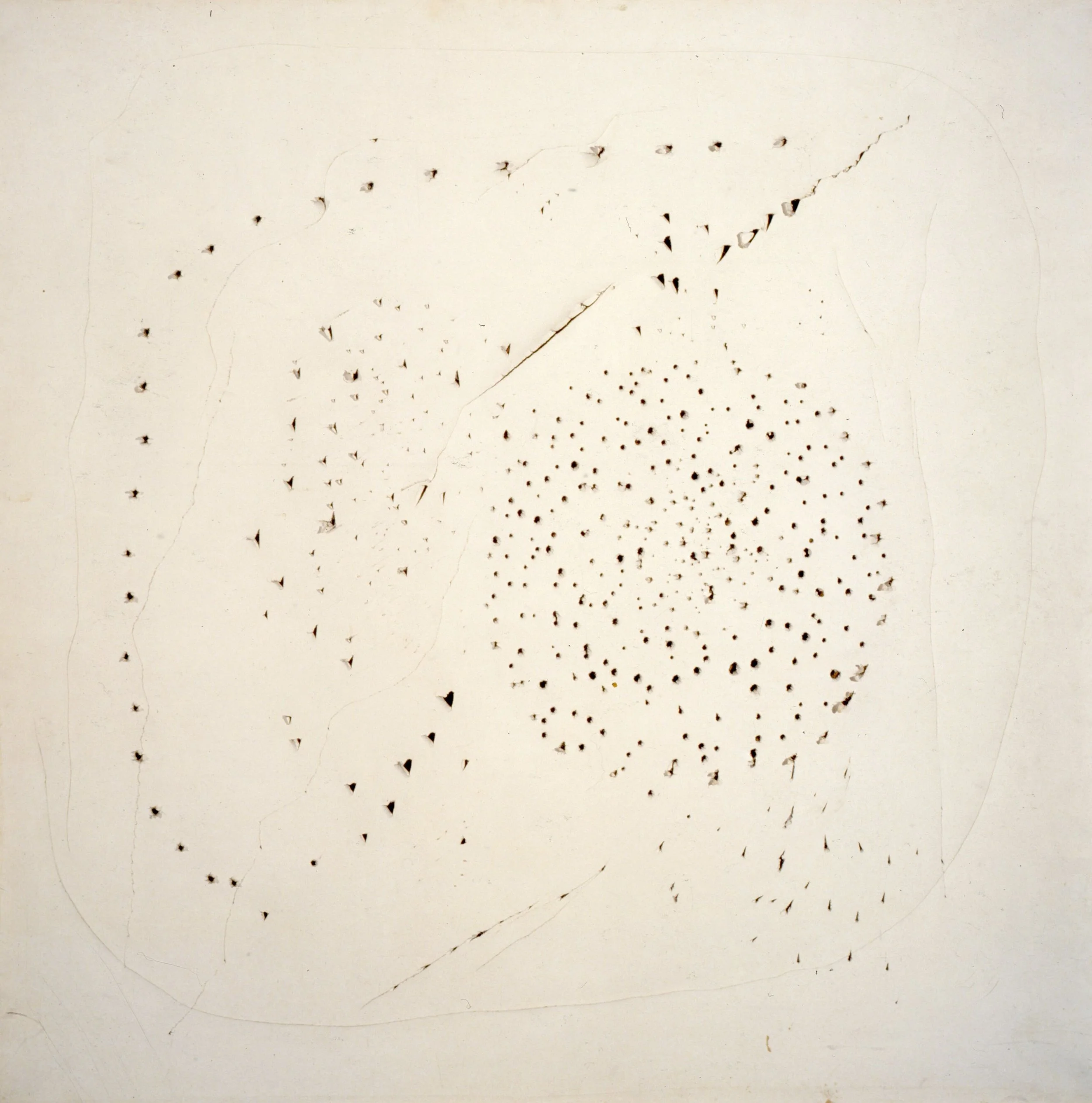
Images courtesy of Hauser & Wirth Hong Kong
In New York, the spotlight fell on Fontana’s ceramics, paintings and sculptural experiments from the 1920s through the late 1960s. In Hong Kong, the focus is on the artist’s radical Buchi (“Holes”) and Tagli (“Cuts”) works, tracing the evolution of Spatialism from 1949 onward.
The exhibition takes visitors from one of the artist’s earliest perforated papers on canvas to rare terracotta spatial constructions that combine painting and sculpture, and then to late pierced works and the internationally acclaimed series Concetti Spaziali, Attese (“Spatial Concepts, Expectations”), characterized by their precise, elegant slits. As visitors will see, these pieces originated in experimental gestures and rough incisions before evolving into the carefully slashed monochromatic canvases for which Fontana is best known.
Also on view are works from his “Quanta” series (1959-60) — multipart, shaped canvases with slashes and perforations designed to hang freely across a wall like a spatial constellation — and the “Nature” series (1959-60), in which bronze sculptures of organic forms resemble extraterrestrial spheres. Modeled and punctured through immense physical effort to represent the unknown, these sculptures embody what Fontana described as “still forms with a dream of bringing inert matter to life.”
What visitors won’t see in Hong Kong is Fontana’s explicit engagement with Christian iconography. Alongside his concetto spaziale works, for example, he produced a series of glazed ceramic crucifixes. Made between 1948 and 1961, these radically modern interpretations of a sacred subject blend the abstract and the figurative, exemplifying the artist’s experimental approach to sculpture. In these pieces, Christ’s body appears elongated, twisted and fragmented, while Fontana’s highly tactile handling of clay introduces swirling movement into the drama of the Savior’s suffering.
Fontana’s use of ceramics has its roots in the time he spent working in his father’s workshop, which produced funerary monuments. But it was under the tutelage of influential sculptor Adolfo Wildt at the Accademia di Belle Arti di Brera in Milan that Fontana was encouraged to experiment with the medium. With subjects ranging from battle scenes and flowers to human figures and sacred imagery, his direct, forceful manipulation of clay was radical and innovative.
In addition to his crucifixes, Fontana created three different terracotta versions of the Stations of the Cross (Via Crucis). The first was made soon after he published the first Manifesto of Spatialism in 1947, while the second and third were produced in 1955 and 1957, respectively, as he experimented intensively with his Spatialist works. Like the crucifixes, the stations are rendered in a dynamic, semiabstract style with thick, undulating textures. The first two are glazed, while the third has been left unglazed, with touches of color sparingly applied by brush. Art critic Giorgio Mascherpa praised them for their “incredible plasticity.”
In 1986, the Stations of the Cross were acquired by the Church of San Fedele in Milan, which also houses “The Sacred Heart of Jesus,” a prominent altarpiece Fontana created in 1957. Made of glazed, polished ceramic and installed in the church’s Guastalla Chapel, the work was commissioned by Fontana’s close friend Father Arcangelo Favaro and comprises 28 individual ceramic tiles fused together.
The design, which depicts Jesus in vibrant red robes, is based on the mystical visions of French saint Margaret Mary Alacoque (1647-1690), who claimed that Christ appeared to her on several occasions, revealing the love of his Sacred Heart for humanity. As she wrote in her autobiography: “The Divine Heart was presented to me in a throne of flames, more resplendent than a sun, transparent as crystal, with this adorable wound. And it was surrounded with a crown of thorns, and a cross above.” Fontana placed the saint in the lower-left corner of the composition, gazing up at Christ and his radiant heart.
How, though, do Fontana’s overtly religious works relate to his abstract pieces and, in particular, the slits in his Concetti Spaziali, Attese series? The distinguished art critic Donald Kuspit has suggested that the artist’s famous slashes allude, “however obliquely, to the Lance of Longinus, to the Spear of Destiny, the Holy Spear” — the weapon that pierced Jesus’ side after his death on the cross (John 19:32-35). For Kuspit, these works point to Christ.
Although Fontana never spoke of his Tagli in these terms, the connection becomes apparent when they are considered alongside his religious works. His elegant slits across monochromatic surfaces can be understood as gateways to the infinite void, but they also evoke Christ’s side wound, a subject depicted throughout art history, from medieval prayer books to paintings by Giacomo Galli and Caravaggio.
Kuspit describes these works as “Christian abstractions” made by an artist who, he argues, “became a serious Christian at the end of his life.” Whether or not Fontana fully embraced Christianity, his slashes speak compellingly to a central paradox of Christian theology: God is incomprehensible and transcendent in his infinite essence yet truly knowable through the incarnation, death and resurrection of Jesus Christ.
“Lucio Fontana: Spatialism. Pioneering the Contemporary” is on view at Hauser & Wirth Hong Kong through Dec. 19.
David Trigg is a writer and art historian based in the U.K. He hosts the “Exhibiting Faith” podcast and can be found on Instagram at @davidtriggwriter.