
The Fox News Edge: How Cable News Divides Along Religious Lines
(ANALYSIS) I think that I’m a lot like the folks who read this newsletter — I don’t actually watch the news that much anymore. I used to be a regular viewer of our local news station that is based close to Carbondale and covers our county, but then they literally fired all of their meteorologists and outsourced that part of the broadcast to some command center in Atlanta or some such place. That annoyed me to no end. So, I stopped watching it altogether now.
Yes, you can conjure the Grandpa Simpson meme “Old Man Yells at Cloud“ right now.
But I rarely watch the nightly news on a major broadcast network and I bet I may consume an hour of the 24-hour news channels (CNN, Fox, MSNBC) in an average month. I just don’t feel the need to watch the news anymore. Sometimes when there’s a breaking news story, I will throw it on while I doom scroll social media, but that doesn’t happen too much. I do watch 60 Minutes and CBS Sunday Morning (which is probably my favorite journalistic program). However, that’s the extent of my viewership habits.
What prompted that little discourse about my media consumption habits is a series of questions that the Cooperative Election Study began asking in 2020 about television network news.
It’s a pretty simple setup: in the past 24 hours, which of these networks did you watch? And it’s got all the major broadcast news stations (ABC, CBS, NBC) but then it has the three 24-hour news channels along with PBS and then an “other” option. People can check all that apply.
This is the share who checked the box for each of those news outlets in the 2020, 2022, and 2024 datasets.
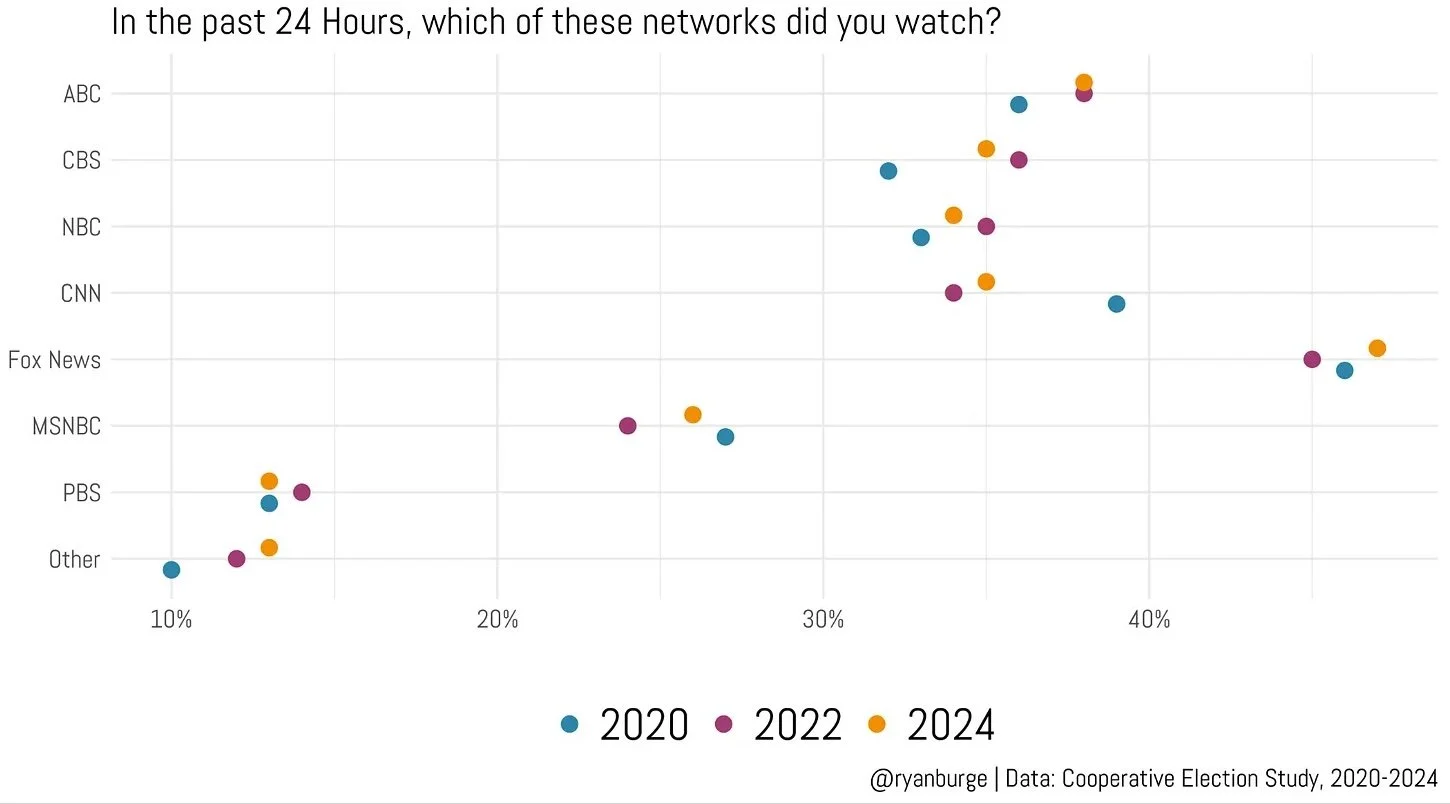
I wanted to start with this analysis to see how much “bounciness” there is in these numbers. When I first looked at these questions, I really thought that answers would be all over the board and there wouldn’t be a whole lot of reliability to be had, but after looking at the graph I think that this data is actually pretty trustworthy, really. The variations from year to year are basically what one would expect — no big shifts, but a little bit of movement here and there.
For instance, the share of folks who are watching NBC News is basically 33-35% of the country. That passes the sniff test, I suppose. The numbers for ABC are just a bit higher but don’t change that much either (36-38%).
There’s just not much numeric change from one survey to another and there’s really no rhyme or reason to any change. It’s not like viewership consistently slid between 2020 and 2024.
You can read the rest of this post on Substack.
Ryan Burge is an assistant professor of political science at Eastern Illinois University, a pastor in the American Baptist Church and the co-founder and frequent contributor to Religion in Public, a forum for scholars of religion and politics to make their work accessible to a more general audience. His research focuses on the intersection of religiosity and political behavior, especially in the U.S. Follow him on X at @ryanburge.