
Where Evangelicals Live (And Where They Don’t)
(ANALYSIS) Where are there lots of evangelical Christians in the United States, and where is it hard to find one?
That’s actually a really difficult question to answer from a methodological perspective. Very few surveys offer enough granularity to provide rigorous state-level estimates, let alone data at the county level. But because of the rapid acceleration of Artificial Intelligence, I can actually provide you all with a really good answer now.
The 2020 Religion Census lists over 400 traditions of all kinds. I wanted to aggregate them into their larger religious families. For instance, Reform, Orthodox, and Conservative Jews need to be placed in a larger “Jewish” category. That didn’t take much work. That’s not so easy for Protestant Christianity. In fact, there were about 350 groups listed that needed to be sorted.
Here’s how I solved that: Artificial Intelligence. I fed the list into both ChatGPT and Gemini and had them iterate over all those denominations to sort them into three categories: Evangelical, Mainline and Black Protestant.
Even with the help of AI, I had to do this exercise a bunch of times just to get to a list that I felt pretty good about. I would run my classifier, check the top 50 largest evangelical denominations, and inevitably find one that was not supposed to be there.
Right now, I’m about 98% confident that this list is as good as it’s going to get. There are certainly no large Protestant denominations that are misclassified. You can check my work:
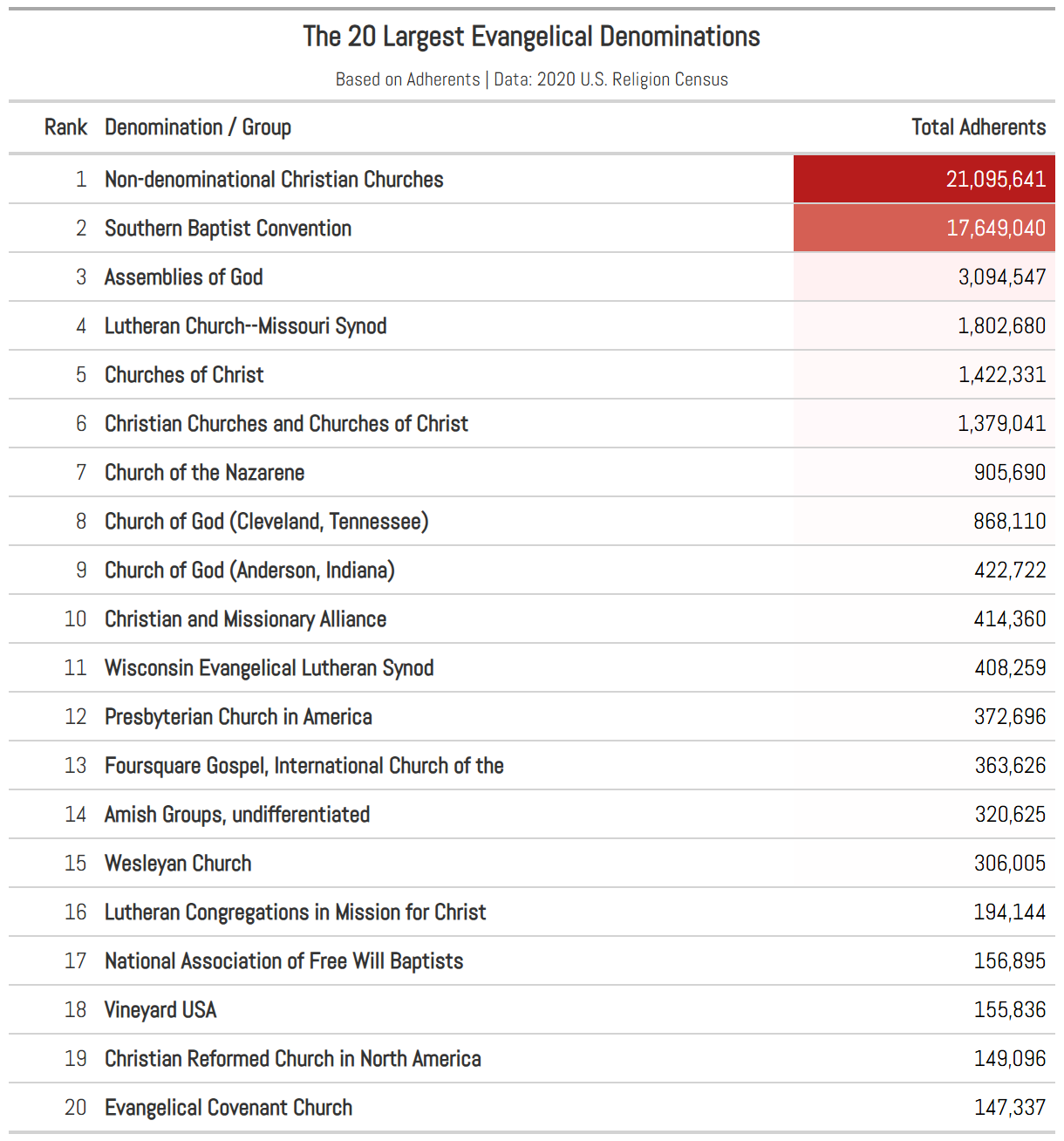
I don’t think anyone could look at this list and have any major gripes about these groups being classified as evangelical. Maybe the Amish? But if they aren’t evangelical, then what are they? They certainly aren’t Mainline Protestants or part of the Black Church. But here’s a point I want to make clear: The Religion Census identified just over 53 million evangelicals in the country. If you add up the membership of just the first three traditions listed (Southern Baptists, Non-denominational, and the Assemblies of God), that’s nearly 80% of all evangelicals right there.
I tell you that to make this point clear — while I’m not completely confident in these results due to the subjective nature of doing something like this, I do feel sure about this point: It almost certainly won’t make a material difference in any of the analyses that you see here.
Missing a denomination of 80,000 folks just doesn’t move the needle at the macro level, because that group makes up about 0.1% of evangelicalism.
You can read the rest of this post on Substack.
Ryan Burge is an assistant professor of political science at Eastern Illinois University, a pastor in the American Baptist Church and the co-founder and frequent contributor to Religion in Public, a forum for scholars of religion and politics to make their work accessible to a more general audience. His research focuses on the intersection of religiosity and political behavior, especially in the U.S. Follow him on X at @ryanburge.