
Christians Return To War-Torn Sudan, But Danger Isn’t Gone
KHARTOUM, Sudan — For the first time in two years, Emelda Vonve entered her church in the capital city of Khartoum.
A few months earlier, the Sudanese army reclaimed the city from paramilitary groups that had held it for years. She saw the priest. She saw faces she hadn’t seen since before the war. They prayed together, aloud, as a congregation, as they used to.
Outside, 15 police cars were waiting.
The officers had come to arrest them and deport them from the city where Vonve had spent her entire life. The charge: That they were foreigners.

Vonve, 53, is South Sudanese and a Catholic. An alto singer at the historic St. Matthew’s Cathedral on Nile Street, she’s one of the few Christians who had not left Khartoum throughout the two years of the paramilitary Rapid Support Forces’ control. She had sent her children and family to South Sudan and remained at home with her sister and brother. She says she does not know how to live in any city other than Khartoum.
That morning at Al-Amaraat Church, amid the faces she had missed and the police cars surrounding her, Vonve realized something she may have known deep down all along: the army’s recapture of Khartoum in March 2025 had not restored the city to its Christians. It had merely changed the nature of the threat.
While the Sudanese Armed Forces’ recapture of the city in March 2025 and the reopening of some churches represented a symbolic moment that seemed to mark the beginning of a return to normal religious life, the following months saw worrying developments that reflected the fragility of this hope. A Pentecostal church was demolished in the East Nile District under the pretense that it was an “unregulated” building.
Christians in Sudan are a minority, accounting for 5.5 percent of the population of 49.2 million. Muslims make up 91 percent and indigenous religions 2.8 percent.
Sudan’s civil war that broke out in April 2023 and the resulting humanitarian crisis displaced nearly 14 million Sudanese people — many of them Christians originating from the Nuba Mountains in South Kordofan, Blue Nile State — and destroyed more than 100 churches across the country.
Father Jackson Yokusok, a Catholic priest currently serving in southern Khartoum at the Catholic Church of the Virgin Mary in the Al-Kalakla district, experiences the impact of the war in his daily life.
“The reopening of churches and the return of some Christians to the capital does not mean that life has returned to normal; the war is still present in the details of daily life and in the collective memory of the faithful who have lost their homes, family members and church communities,” Yokusok said.
He added that many families have been scattered across Sudan’s various states and neighboring countries, noting that rebuilding the church community is far more difficult than reopening the physical buildings themselves.
Yokusok notes that the return to Khartoum is proceeding very slowly, not only because of the destruction left by the war, but also because of a persistent sense of uncertainty.
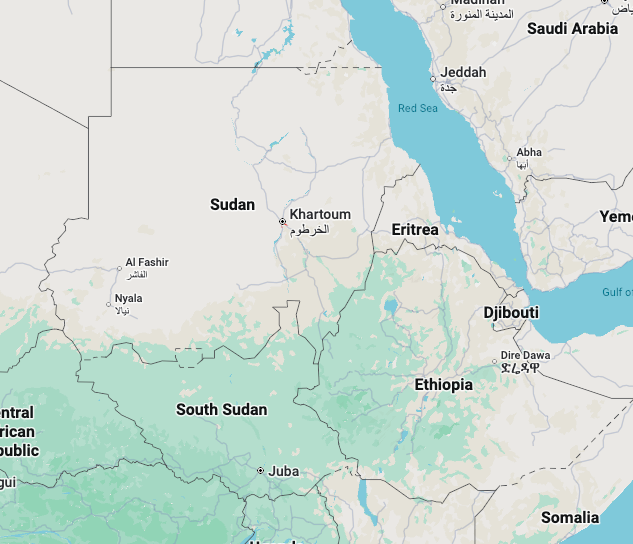
Sudan and South Sudan. (Google Maps)
“Families considering a return first ask about security, schools, job opportunities and the possibility of living a normal life without fear,” he said. “Alongside prayers and Masses, the church is balancing its spiritual mission with the need for psychological and social support for families who have lost their livelihoods.”
He said he believes that the fact that some Christians have remained in Khartoum and others have returned to it carries a meaning that goes beyond mere physical presence.
“When people come to church today, they do not come merely to pray, but to affirm that they are still part of this city and that they have a place in it,” he said. “Their very presence has become a message.”
Yokusok said the number of families who have returned to the city and are attending services regularly represents less than a quarter of those who attended before the war.
During the Rapid Support Forces’ control, Vonve continued to attend three churches with the few Christians who remained: The Wad al-Bashir Church, the Khartoum Barona Church and the Uganda Martyrs Church. The group was well aware of the constant danger, as a stray bullet or shell could strike them at any moment, but their faith was stronger than their fear.
Vonve describes how one of the worshippers was hit by a stray bullet and died instantly inside the church one day, but this sight did not stop them from continuing to come and pray. The three churches were destroyed during the war, as Rapid Support Forces militants used them as storage sites for heavy weapons, leading to their looting and demolition. During that period, Vonve lost her uncle and her nephew, who were killed by Rapid Support Forces gunfire.
Leaving not a choice
Not everyone managed to stay, and leaving wasn’t always a choice. Khaled Rudryrude was on the verge of starting university when the war broke out, shattering his plans overnight.
“I was working to save up for my registration fees,” Rudryrude said. “The war broke out, and I lost all my papers. I dropped out of school, fled, and life became a day-to-day struggle. The whole family had to work, and my brothers couldn’t continue their studies in Port Sudan. Everything changed overnight.”
Before the war, the church was the center of his life. He was a cantor, active in every activity, and part of a community that knew his face and the names of his family. It was not merely a place of worship, but his identity and sense of belonging. After displacement, all this began to slowly unravel.
“After the war, everything stopped. I was a cantor and took part in all the activities, but with displacement, work and responsibility, everything fell apart. The bishop was displaced after the first month of the war, and we were left without a priest,” he recalled. “The missionaries led us in prayer and did not stop even when the Rapid Support Forces entered the area, tightened the noose around us and subjected us to many abuses, but they did not have the leadership ability of priests. The church community gradually fell apart”.
Nevertheless, Rudryrude stressed that faith did not cease entirely, even in the darkest of moments.
“People prayed every day for the war to stop. Every day, they implored the Virgin Mary. Some died whilst praying inside the church. Others fled and never returned; we don’t know where they are now, or if they are all right,” he added.
On every visit to Khartoum from the Blue Nile state where he lives now, Rudryrude stood in front of his church, but he no longer finds what he once knew. Fewer people, missing faces, and walls that bear silent witness to everything that has happened. The place still stands, but the community that once filled it has scattered to the four winds, and some will never return.
‘We didn’t know to be happy or afraid’
Atouk Maren, 43, chose to return. She is from Southern Sudan but was born and raised in Khartoum, and is the mother of three sons and a daughter aged between 17 and five.
She said that returning to Khartoum was not so much a moment of decision as a long period of despair that ended in acceptance.
“We left for Juba, in South Sudan, at the start of the war — my husband, my children, and I. We didn’t know if we’d ever come back,” she said. “We were packing up our lives in a hurry, as if we were leaving them behind with no promise of return.”
Maren pauses briefly before continuing: “In Juba, we were living, yes, but we weren’t ourselves. The children were growing up at a strange pace, far from their school, their church, and their home. Everything was new, and everything was temporary. Even laughter was temporary. Khartoum never left our thoughts.”
When she returned, the homecoming was not as she had imagined.
“I walked into the house and found it miraculously just as I had left it, but I was not the same. Even the children stood in silence, as if they didn’t know whether to be happy or afraid,” she said. “We went to the Al-Kalakla Al-Qubba Church in southern Khartoum, near where we lived, the same church we used to belong to. I sat there and cried. Not just because I had returned, but because I realized that many would not return and that some of us had returned incomplete.”
Maren said the hardest thing about returning is the feeling that life is no longer whole.
“We’ve come back, but there are people missing in every sentence. In every prayer, in every empty seat. Sometimes, I feel we’ve returned to a weaker version of our old life, a life we’re trying to believe is still possible,” she added.
Despite this, she clings to a fragile hope: “We live our day, we try to protect our children, and we go to church. I don’t know if this is enough to call it a life, but it’s all we have right now.”
She sad the war has “stopped in Khartoum, which is a good thing, but the end of the war hasn’t made our situation any better.”
This article was published in collaboration with Egab.
Aunnab Alman is a writer and journalist from Sudan.