
Inside Bangalore: India’s City Of Churches Etched In Faith And Memory
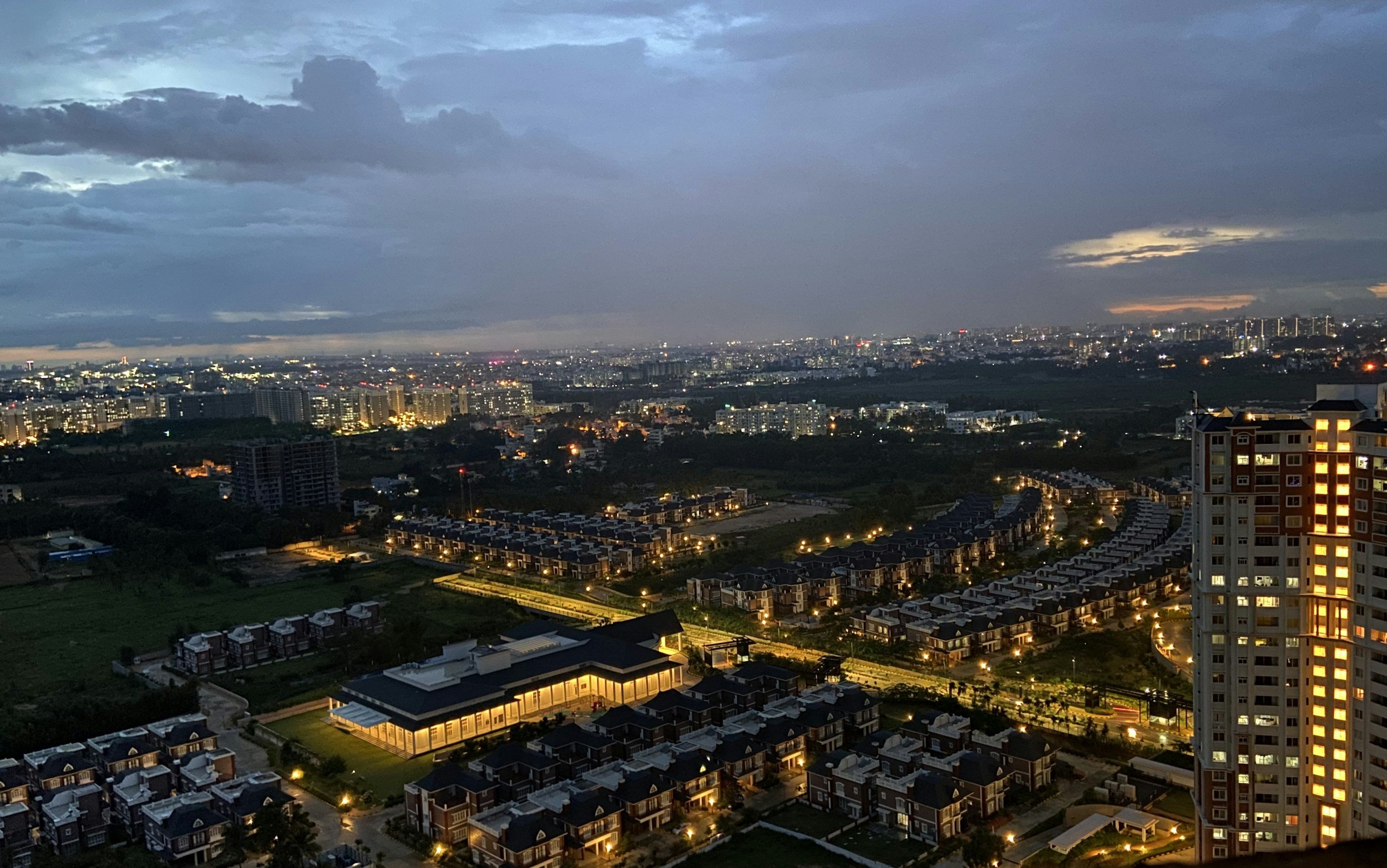
An ariel view of the Indian city of Bangalore at night. (Unsplash photo)
BANGALORE, India — Bangalore, located in the southern Indian state of Karnataka, was once called “The Garden City of India” and “Pensioner’s Paradise.” During the tech boom of the 1990s, it became known as “The Silicon Valley of India” and “Pub City.”
Today, Bangalore is known for its “traffic nightmare,” the result of exponential growth, as well as its status as an economic hub offering numerous businesses and job opportunities. But somewhere along the way, there was a lack of proper planning.
In its colonial days, Bangalore was famous for its magnificent architecture, historic landmarks and peaceful, tranquil surroundings. Beautiful structures stood tall and continue to stand strong today.
READ: Pope Leo’s Adopted Hometown To Take Center Stage During Tour
Each brick, stone, granite slab, bell, pipe organ, altar, pillar, steeple, cross, construction and design has its own charm, intrigue and unique, interesting story — stories deeply engraved in the city’s colonial past. The rich religious, spiritual and cultural heritage of Bangalore’s iconic churches, basilicas and cathedrals has stood the test of time.
Bangalore has always remained tolerant and accommodating of other faiths, beliefs and cultures. From the early morning adhan recited by a muezzin at a mosque to the chime of church bells, the divine ghanta resonating with the sound of “Om” at a temple or bells ringing at neighbors’ houses as they prepare for puja, the sounds of worship are woven into the fabric of the city.
The Indian Social Institute in Bangalore has stated that there are 500 churches of various denominations in the cantonment area. Besides churches, temples, mosques, Jain derasars, Sikh gurdwaras, Buddhist viharas, a Parsi fire temple, a Jewish community Chabad and a Baha’i center are all found in the city. There are close to another 500 churches on the periphery of the city and in the surrounding areas.
I set out early one morning with a professional photographer friend, Supriya Namrata, and another friend, Alvin Santosh, who drove us. I wanted to go beyond the obvious and dig deep into the little things we take for granted as we pass churches during our daily routines or visit them frequently.
Having been an altar boy, receiving my first Communion and Confirmation and even getting married at Holy Ghost Church, we decided to drive down to Richards Town. Supriya suggested that we go up to the terrace of an adjacent building to get a panoramic view of the beautiful stone church, shaped like a dove with two wings on either side. It was breathtaking.
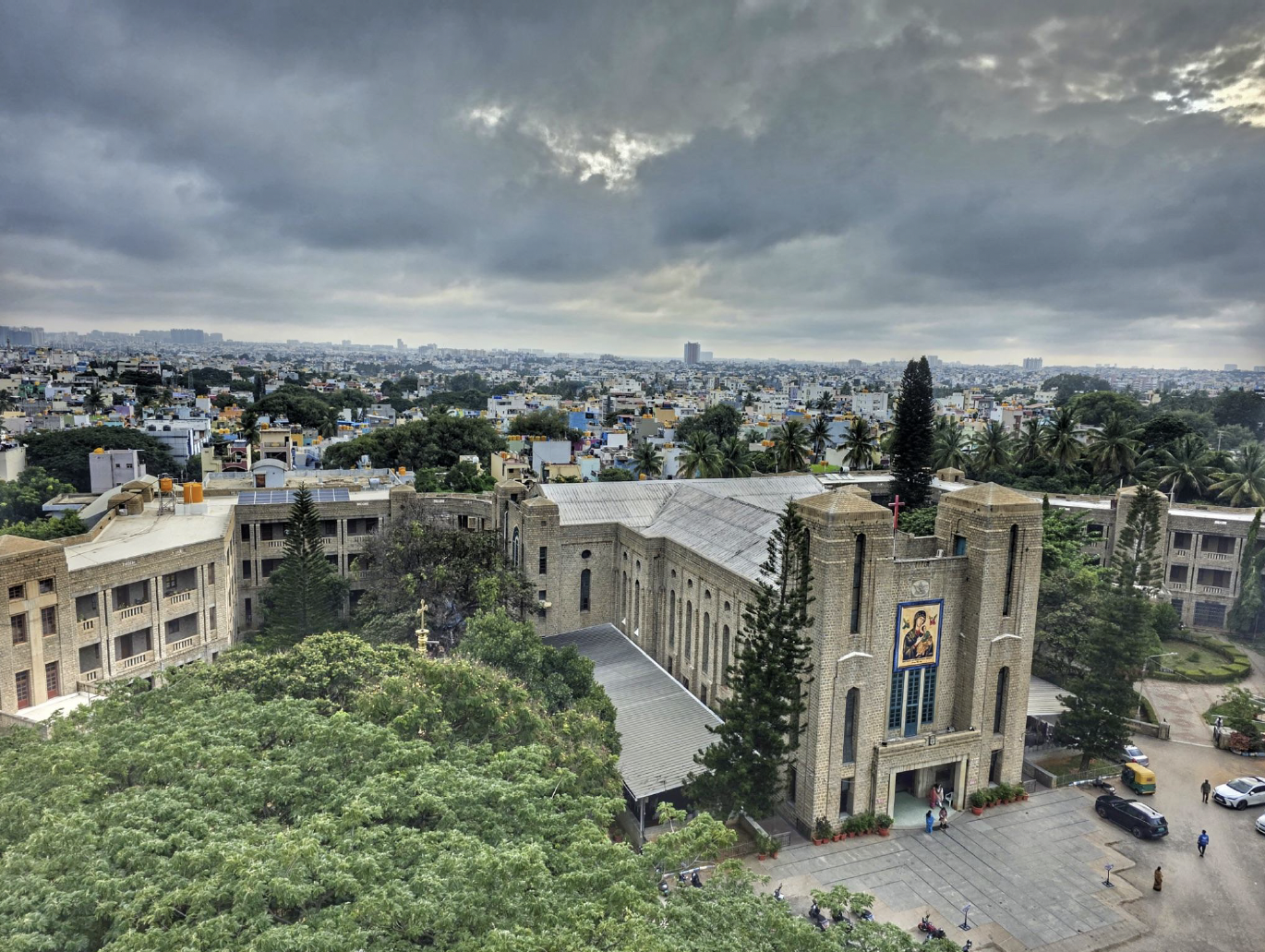
Holy Ghost Church, located in the Richards Town neighborhood of Bangalore, India. (Photo by Supriya Namrata)
Irish Redemptorist priests erected the church on May 24, 1953, and dedicated it to Our Lady of Perpetual Help. The novenas every Saturday and the feast in January attract thousands of devotees.
The Irish Redemptorists later built a huge church with plenty of space around it, envisioning a place that could accommodate a growing number of parishioners with each passing year.
Our next stop was St. Francis Xavier’s Cathedral nearby in Fraser Town. As a schoolboy at St. Germain’s, next to the church, we were brought there for Mass on the first Friday of every month. The church was built by French missionary priests in the 1850s, who also ran the school.
As Supriya mounted her camera, we were warmly welcomed by two curious dogs that came sniffing around for goodies.
Three large domes on the Neo-Romanesque stone edifice are strikingly appealing. The stained-glass windows around the central dome were also worth looking up at. Like most Catholic churches, there is an adoration chapel on the premises.
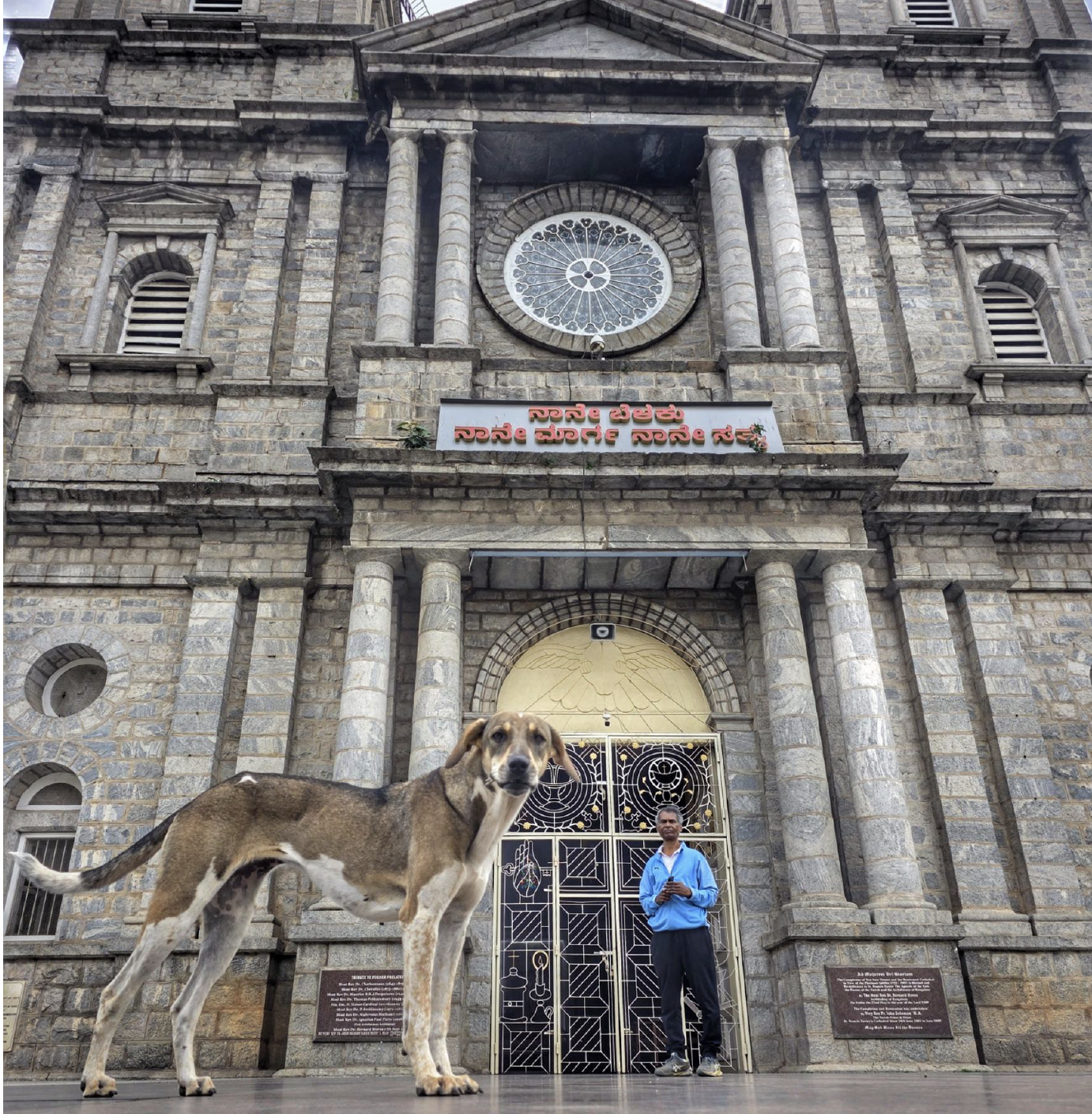
St. Francis Xavier Cathedral in Bangalore, India. (Photo by Supriya Namrata)
After two Catholic churches, we stopped at the adjacent compound of St. John’s Church. School was about to begin, and students arrived for classes opposite the church, while some entered the church hurriedly to pray. The strikingly beautiful red-brick building, constructed in the English Gothic style and dedicated to St. John the Evangelist, opened in 1858.
The lovely floor was sparkling, and the pipe organ is among the oldest and rarest. This Anglican church is part of the Church of South India.
St. Mary’s Basilica, built in 1882 in the crowded Shivajinagar area, is one of the oldest churches in the city. Its majestic Gothic style was designed by the Rev. L.E. Kleiner. In 1898, the great plague struck the Blackpally area, where the church was located, and people sought the mercy and protection of Mother Mary. It is now famous among Tamil parishioners as the Mother of Good Health, or Annai Arokyamary.
Devotees throng to the basilica from far and wide every year in late August, culminating in the nine-day novena on Sept. 8. The white icon of Our Lady is taken around the church in procession.
Close to St. Mary’s, near Bowring Hospital and at the corner of Old Poor House Road, is St. Paul’s Church, the first Tamil Anglican church in the erstwhile Mysore state. Native Tamil Anglicans, mainly converted “sepoys,” or soldiers of the Madras Army, wanted a Tamil Anglican church where they could worship in their native language. It is a small, quaint, red-colored church.

St. John’s Church in Bangalore, India. (Photo by Supriya Namrata)
Up the road from St. Paul’s was our next stop, St. Andrew’s Church on Cubbon Road.
The former Presbyterian Scottish church, built in 1864-66 in the Gothic style, is famous for its stained-glass windows at the altar.
Named after St. Andrew, the patron saint of Scotland, St. Andrew’s, with its red exterior, 90-foot-tall tower and chimney clock at the apex, was completed in 1866. It is also famous for its old pipe organ.
From St. Andrew’s, we went to St. Mark’s Cathedral, located one street away at the west end of Mahatma Gandhi Road. Dedicated to St. Mark the Evangelist, the cathedral is noted for its English Baroque architecture, inspired by St. Paul’s Cathedral in London. It was founded in 1808.
The cathedral is famous for its centuries-old pipe organ, exquisite ceiling with graceful domes, marble altar, stained-glass work, well-maintained exterior bell and elaborate woodwork at the entrance.

St. Paul's Church, located in the bustling area of Shivajinagar (historically known as Blackpally) in Bangalore, India. (Photo by Supriya Namrata)
It was destroyed by fire and rebuilt. A stone inscription at the entrance tells the story: On the night of Feb. 17, 1923, it was seriously damaged by fire. The following year, while it was being restored, the nave collapsed, and the building remained in ruins until October 1926, when the nave was entirely rebuilt and parts of the choir were replaced. The church reopened for services on Aug. 7, 1927.
We stopped for lunch at Airlines Hotel Garden and headed to St. Patrick’s Church, located between Brigade and Museum roads. The foundation stone was laid in 1841, and the church was completed and consecrated in 1844.
The Bangalore Cantonment was developed in 1809, and a good number of British soldiers settled there. Most of the Irish soldiers were Catholic, and they contributed substantially to the construction of the church. St. Patrick’s has a small adoration chapel and St. Anthony’s Shrine beside it, which is frequented by devotees on Tuesdays.
We drove to other churches, shrines and little places of worship.
Tamil Wesley Church in Ashok Nagar was a poorer church where the drivers and servants of the British sahibs attended services while their employers attended Anglican services at St. Mark’s Cathedral on St. Mark’s Road.
Holy Trinity Church, built in the English Renaissance style with Corinthian columns, was once visited by distinguished personalities such as Lord Cornwallis and Winston Churchill. Established in 1852, it has a rich military history.
It is traditionally believed that St. Thomas, a disciple of Jesus Christ, visited India in A.D. 52 and established seven churches on the Malabar Coast. Mar Thoma Syrian Church on Primrose Road, off MG Road, was one of the churches subsequently established in Bangalore as an offshoot of that tradition.
As we drove to Viveknagar to visit Infant Jesus Catholic Church, we were struck by the vastness and enormity of the church’s interior. It is one of the largest churches in the city.
East Parade Church, built in 1865 on what is now MG Road, was established by Wesleyan Methodist missionaries in the Mysore state. The eight massive Corinthian columns are striking sentinels at the entrance. Today, it is home to the East Parade Malayalam and Tamil pastorates.
I’ve been to All Saints’ Church a few times but never realized that its low ceiling, tiled roof and winding staircase made it resemble a cute little cottage, complete with well-tended gardens.
St. Mary’s Jacobite Syrian Cathedral on Queen’s Road was the first Syrian Orthodox church. The Knanaya Jacobites and Knanaya Catholics have three churches. The KJCF, or Khasi Jaintia Christian Fellowship from Meghalaya, worships at Revival Centre Church on Hutchins Road.
Many devotees and worshippers from different states practice their faith in rented halls throughout Bangalore. The same is true of international faith communities. Such is the secular nature of Bangalore’s tolerance and acceptance of other faiths.
We Bangaloreans are just a stone’s throw away from a place of worship. And if one threw a stone, chances are it would probably land on one of the beautiful, iconic places of worship in Bangalore. Or perhaps the stone might get stuck in one of the many traffic jams.
There are many other notable churches — including Apostolic Christ Assembly, Don Bosco Church and Christian Fellowship Church — just to name a few. It’s a place of 1,000 churches and counting.
Leslie Carvalho is a writer and filmmaker based in India.
Supriya Namrata works in communications and photography. She is based in India.