
❤️ We Will Always Love Her: How Dolly Parton Lived Out Her Personal Faith 🔌

Weekend Plug-in 🔌
Editor’s note: Every Friday, “Weekend Plug-in” meets readers at the intersection of faith and news. Click to join nearly 10,000 subscribers who get this column delivered straight to their inbox. Got feedback or ideas? Email Bobby Ross Jr.
• • •
Like Jesus taught his followers to do, Dolly Parton loved her neighbors.
But what about loving her enemies, another biblical commandment?
I’m guessing the entertainment icon, whose death Tuesday at age 80 sent shockwaves around the world, found that more difficult to do.
“The thing about Dolly was that she seemed to have no enemies,” The Dispatch’s Michael Reneau wrote in a tribute titled “Dolly Was a Real One.” “Even if you didn’t quite get her, it was impossible not to like her.”
In his New York Times obituary of Parton, Bill Friskics-Warren described the country music queen as “quintessentially, a uniter of people.” The writer referenced a 2019 Times story that featured this headline: “Is There Anything We Can All Agree On? Yes: Dolly Parton.”
Since Bryan Seaver, Parton’s nephew and head of security, revealed the news that she “is in the arms of Jesus,” I’ve joined countless millions of fans in reflecting on her life, her legacy — and yes, her faith.
I’ve found myself listening to songs such as “You Can’t Make Old Friends,” which Parton performed with her old friend Kenny Rogers, who died in 2020 at 81.
In the wake of Parton’s passing, these lyrics require a tissue:
When Saint Peter opens the gate
And you come walking in
I'll be there just waiting for you
'Cause you can't make old friends
Equally poignant is “When I Get Where I’m Going,” Parton’s duet with Brad Paisley:
Yeah, when I get where I'm goin'
There'll be only happy tears
I'll shed the sins and struggles
I have carried all these years
And I'll leave my heart wide open
I will love and have no fear
Yeah when I get where I'm goin'
Don't cry for me down here
We’ll try not to cry, Dolly.
Well, not too much anyway.
My favorite Parton song ranks as one of her biggest hits — along with classics such as “I Will Always Love You” and “Jolene.” Brought up “dirt poor” in a large Tennessee family, she based “Coat of Many Colors” on the Bible story her mother, Avie Lee Parton, told about Joseph:
My coat of many colors
That my momma made for me
Made only from rags
But I wore it so proudly
Although we had no money
I was rich as I could be
In my coat of many colors
My momma made for me
• • •
PARTON’S MATERNAL GRANDFATHER, the Rev. Jake Owens, was a Pentecostal preacher. Her “daddy’s people” were Baptists. Her husband grew up in the Church of Christ.
Parton herself?
“Dolly’s faith never fit neatly into any standard denominational framework, but she talked often about God, Jesus, scripture, and prayer,” a Missouri pastor named Jason G. Edwards wrote in The Christian Century. “Some of what she said would’ve been difficult to reconcile with the theology of churches she knew, but that didn’t seem to trouble her too much. When once asked how she practiced her faith, she resisted the verb: ‘I don’t practice it. I live it.’”
The Tennessean’s Keith Sharon pointed out:
At age 6, Parton was singing in the Church of God choir at her grandfather's church, the House of Prayer.
"Gospel was an important part of life in the Smoky Mountains where I grew up," she told Country Weekly in a 1999 interview, "and religion was a part of everyday life."
Religion Unplugged’s own Clemente Lisi noted after her passing:
Parton’s Christianity was rooted in the evangelical culture of her Appalachian childhood, but she rarely presented herself as a model of doctrinal perfection.
Instead, she emphasized love, humility, forgiveness and service.
In interviews, she repeatedly returned to the Bible and its command to love one's neighbor. She once told Vogue magazine: “I really do ask God every single day to let me do something, say something, be something that matters to somebody else. To make somebody feel good. To let people see a spark of love. God is love, that’s the Scripture.”
More from Lisi’s analysis:
Parton’s religious identity also helps explain her unusual ability to appeal across cultural boundaries. She was unmistakably Christian and spoke openly about God, Jesus and prayer. Nonetheless, she was also wary of judgment and repeatedly emphasized acceptance and kindness. She could be embraced by conservative Christians while also maintaining relationships with audiences who did not share her faith.
Parton did not believe that Christianity required her to become less welcoming. Instead, she treated faith as a reason to enlarge the circle of people deserving compassion. Fellow country music star Reba McEntire captured the religious dimension of that legacy in her farewell: “Thank you, Lord, for Dolly.”
The Knoxville News Sentinel’s Tyler Whetstone offered this insight:
Dolly Parton famously grew up singing in church, her first stage inside a Pentecostal church her grandfather pastored.
Homage to this place is incorporated into the fabric of Dollywood, Parton's family-friendly theme park in Pigeon Forge, with the Robert F. Thomas Chapel, which hosts worship services for guests.
As a business owner and a country music legend, Parton's own faith journey was the subject of written pieces and speculation. She gave hours of interviews on the topic, and yet, as anyone would tell you, someone's faith is personal. She was a public person, but private where she needed to be. Like on the subject of her husband of nearly 60 years, Carl Dean, she kept many memories to herself.
More from Whetstone:
Parton’s faith wasn’t a plaything, a way of getting attention or a way to sell albums. It was real and personal. She prayed. She read daily devotions. She tithed. She tried to live a life worthy of the platform she was given.
“I pray every day that God will lead me, guide me and direct me and he’ll bring all the right things and all the right people into my life, take all the wrong things out,” she told the “Jesus Calling” podcast in 2018.
In a 2018 visit, Parton showed actress Reese Witherspoon the personal chapel at her home.
“This is where I have to come when I get overwhelmed with everything else,” Parton told Witherspoon, “or if I just want to pray.”
In a 2014 Entertainment Weekly interview, Parton indicated that she’d like the hymn “If We Never Meet Again” sung at her funeral.
“It’s an old country-gospel church song that talks about if we never meet again this side of heaven, I will meet you on that beautiful shore,” she said. “That was my daddy’s favorite. We did sing it at his funeral, and I would like it to be sung at mine.”
READ: Country Star Ella Langley: Brought Up Baptist, Saved (Again) At Judgement House
Speaking of her father, Robert Lee Parton, Dolly started the Imagination Library — which has given away millions of books to children — in his honor.
The Los Angeles Times’ Emily St. Martin explained:
Parton understood the novelty of owning your very own book. Growing up in the Great Smoky Mountains town of Sevierville in east Tennessee, Parton was the fourth of 12 kids. Her father, a tobacco sharecropper, couldn’t read or write, and the family lived in a one-room cabin with no electricity. There were no books in the home, aside from the Bible.
• • •
MY CURIOSITY was piqued several years ago when I came across a black-and-white picture of “Mr. and Mrs. Carl Dean” in the 1966 directory of the Radnor Church of Christ in Nashville, Tennessee.
Mrs. Carl Dean was, of course, better known as Dolly Parton.
In the story that I wrote for The Christian Chronicle, I provided this context:
The 75-year-old entertainment icon talked about her little-known — and apparently brief — connection to Churches of Christ in her 2020 book “Dolly Parton, Songteller: My Life in Lyrics.”
“I loved my husband’s mother. She was very sweet, and we were like best friends. Her name was Virginia, but everybody called her Ginny,” Parton wrote concerning her mother-in-law, who died from cancer at age 71 in 1991. “Carl’s mother was very religious. She was in church every Wednesday and every Sunday morning.
“The Deans were Church of Christ people. They don’t believe in having any instruments in their church; they just use their voices,” added Parton, who wrote her 1971 song “Lord Hold My Hand” with Ginny Dean. “Ginny had this big, beautiful, ‘church’ kind of voice. Very proper. It sounded totally different from our ‘Holy Roller’ church back home.”
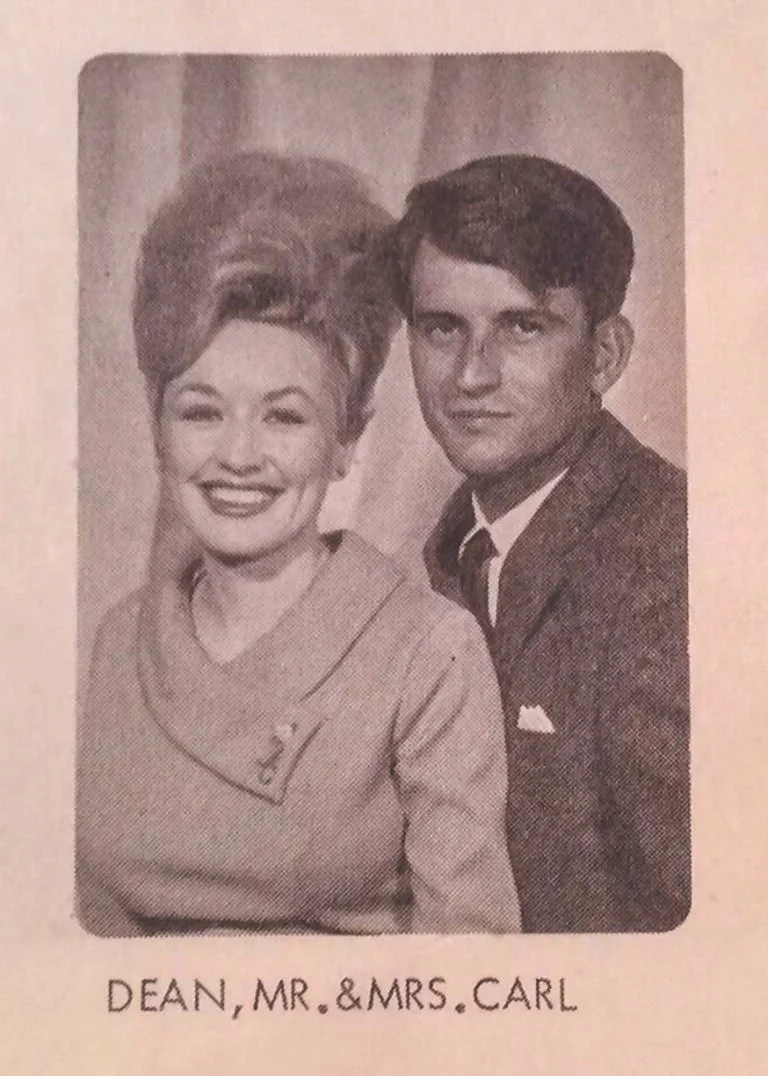
Newlyweds Carl Dean and his wife, Dolly Parton, in a 1966 church directory photo. (Photo provided by Annelle Gaddes Tubb)
After Carl Dean’s death last year, Parton talked to The Associated Press about relying on her faith:
“I am a person of faith, and I truly believe that I’m going to see him again someday. And I see him every day in my memories and in my heart, and in all the things that we used to do and all the things that we’ve built together,” said Parton. “You just kind of have to learn to kind of make new plans — but that’s the hardest part.”
While I tried, I never got to interview Parton myself.
But Greg Garrison, the longtime religion writer for Alabama Media Group, did.
READ: Top 10 Faith-Infused Country Songs: The ACM’s All-Time Best Honorees
Garrison reflected on what Parton taught him about faith. He asked her about her Christian faith and whether being a celebrity changed it:
“Well, that faith I had when I was a child has helped me right through everything right now,” Dolly said.
“My grandpa was a preacher, a Pentecostal preacher. My daddy’s people were Baptist. So I’ll have a little chapel in all my places. I have a place where I grew up and I call it the Bapticostal chapel. I just believe that there’s a God. I believe that God helps me, leads me.
“I talk to Him everyday. I’d prefer to believe in God if there wasn’t one, I’d still believe in God, because I believe we need to believe in something bigger and better than ourselves.
“It gives us hope. It gives us strength. I know it does me. My faith is very important.
“I do believe that through God all things are possible. I do believe that Jesus loves me. And I just use that. I’m never ashamed of my family. I’m never ashamed of my religion. I’m not trying to cram it down anyone else’s throat. I just think that everybody’s got to have something to believe in.”
• • •
I OPENED WITH a reference to Parton loving her neighbors.
After her death, I became aware of a specific example involving a couple I know.
In recent years, I’ve written multiple stories — for The Christian Chronicle and Religion Unplugged — about Matt and Macy Collins, whose 4-year-old daughter, Hattie Jo, died in a 2020 tornado that battered Cookeville, Tennessee.
In 2024, I did an in-depth feature on Matt and Macy launching the Magnolia Foundation, a ministry to honor their oldest daughter’s memory and support other parents who lose a child.
Here’s what I didn’t know: Parton helped the Magnolia Foundation — as she did countless other causes.
Matt Collins, a former Church of Christ youth minister, shared the details on Facebook:
The Magnolia Foundation was less than a year old when, on a Friday afternoon in August, I got a knock on the door. I was getting some mail — the kind you have to sign for. When I opened the envelope up, I was blown away. I was holding a check from Dolly Parton in support of Magnolia.
Magnolia was new, and I was still wondering if it was a good idea to quit the real job I had and start this foundation. Dolly’s support wasn’t just financial — it was validation and encouragement to keep going. Dolly, without ever meeting us in person, has proven to be uniquely important to our family. Dollywood has been a place where we celebrate and grieve our daughter, Hattie. We will be there in 2 weeks for Hattie’s 11th birthday. Her support on that August afternoon meant more than the amount on the check. Dolly considered Magnolia a worthy cause to invest in — she cared about us and the people that we have the opportunity to serve.
If Magnolia has ever impacted your life or the life of a loved one, I want you to know that, directly or indirectly, Dolly was behind it. If you’ve ever supported Magnolia as we serve families, I want you to know that Dolly stood beside you in that effort.
A remarkable life. Thank you, Dolly.
Yes, thank you, Dolly.
For everything.
Inside The Godbeat
The same day the world lost Dolly Parton, a 17-year-old Tennessee boy named Mitchell Boles succumbed to cancer.
International media didn’t cover Boles’ death, but he made a big difference in his community — and Clay County schools will close Friday for his memorial services.
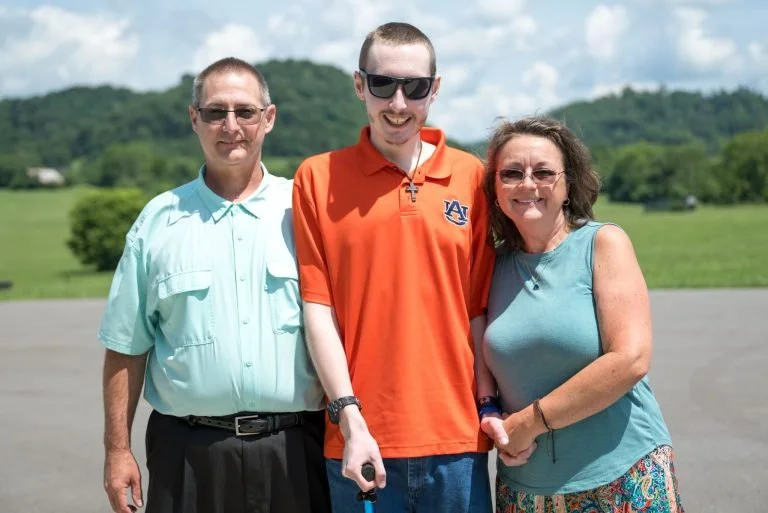
Mitchell Boles poses for a picture with his father, Ray, and mother, Hanna, outside the Beech Bethany Church of Christ in Celina, Tennessee. (Photo by Ephraim Rodenbach)
“I don’t care if I die — I know I’ll be in heaven,” Boles told Christian Chronicle intern Ephraim Rodenbach this summer. “I got baptized, and my name is written in the Book of Life.”
May God bless Boles’ family, his church and all those who loved him.
The Final Plug
The Arizona Diamondbacks hosted their annual Faith and Family Night this past Friday night — the latest MLB team to do so.
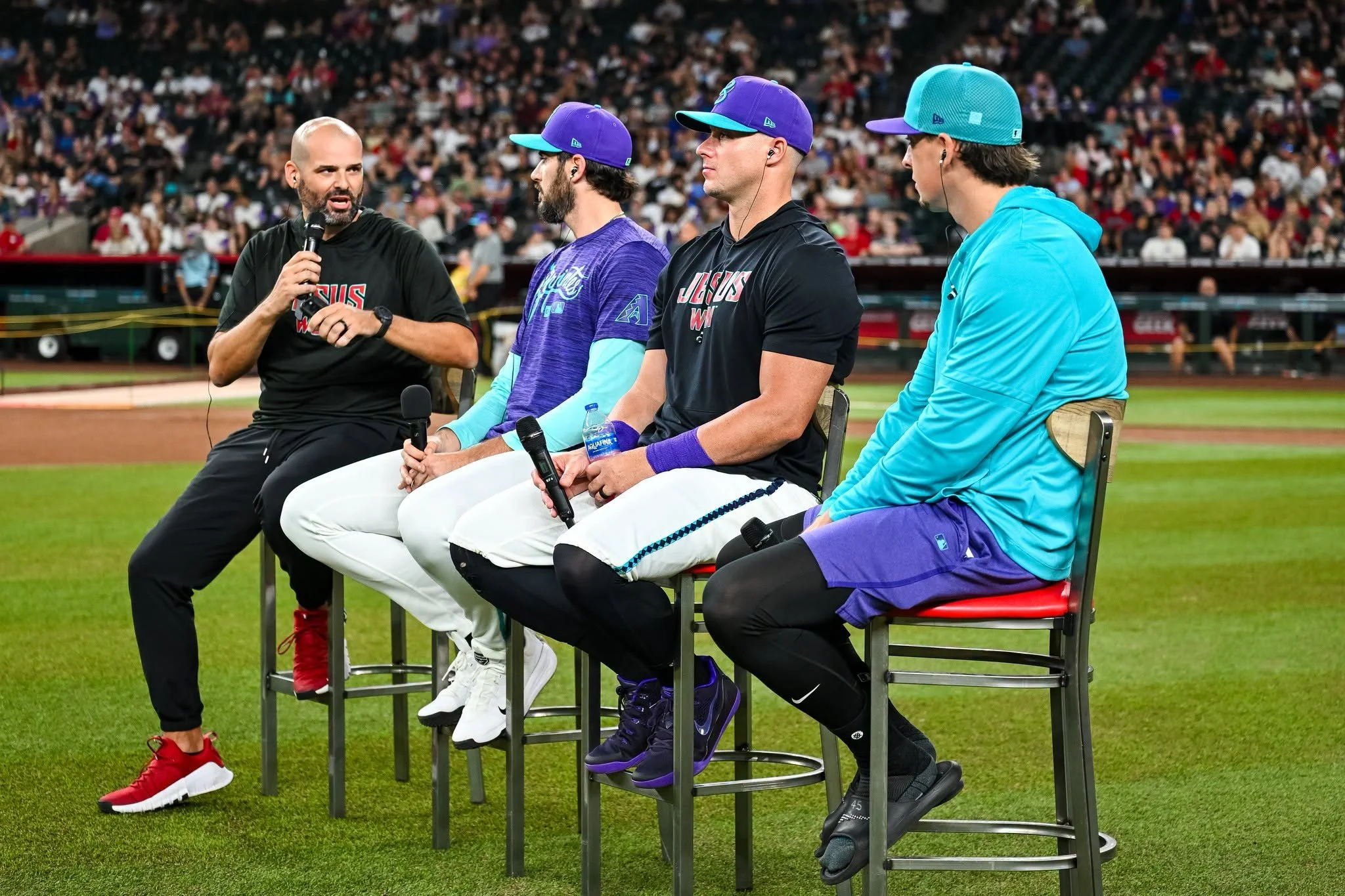
Arizona Diamondbacks players speak during the team’s annual Faith and Family Night. (Photo provided by Arizona Diamondbacks, via Facebook)
As Weekend Plug-in readers know, faith days have become a popular annual themed event for a majority of MLB’s 30 franchises. Just last week, we mentioned the Baltimore Orioles’ Christian Faith Night.
Happy Friday, everyone! Enjoy the weekend.
Bobby Ross Jr. writes the Weekend Plug-in column for Religion Unplugged and serves as editor-in-chief of The Christian Chronicle. A former religion writer for The Associated Press and The Oklahoman, Ross has reported from all 50 states and 20 nations. He has covered religion since 1999.