
‘Show Us!’: The Myth Of The ‘Real Catholic’ Voter
(ANALYSIS) Here’s a common occurrence for me on social media. I post a graph that’s really basic: How a bunch of religious traditions feel about a controversial political issue. Could be a pathway to citizenship for folks who came here illegally, could be access to an abortion, or maybe a question about gender identity.
I have all the traditions listed: White and non-white evangelicals and Catholics, mainline Protestants, Jews, Muslims, atheists, etc. What the data consistently shows — across a wide variety of dependent variables — is that white Catholics are not as socially conservative as white evangelicals.
This makes a lot of anonymous people on Twitter very angry, of course. I’m guessing that many of them are Catholics who believe that Catholicism, correctly measured, will exhibit results similar to their evangelical cousins.
The replies are always something like, “No, show us what REAL Catholics believe on this issue.” Which I think is shorthand for: I want you to only compare weekly attending Catholics to weekly attending evangelicals. Their assumption is that if I do that, the statistical differences will disappear.
Well, let’s just put that to the test today, shall we?
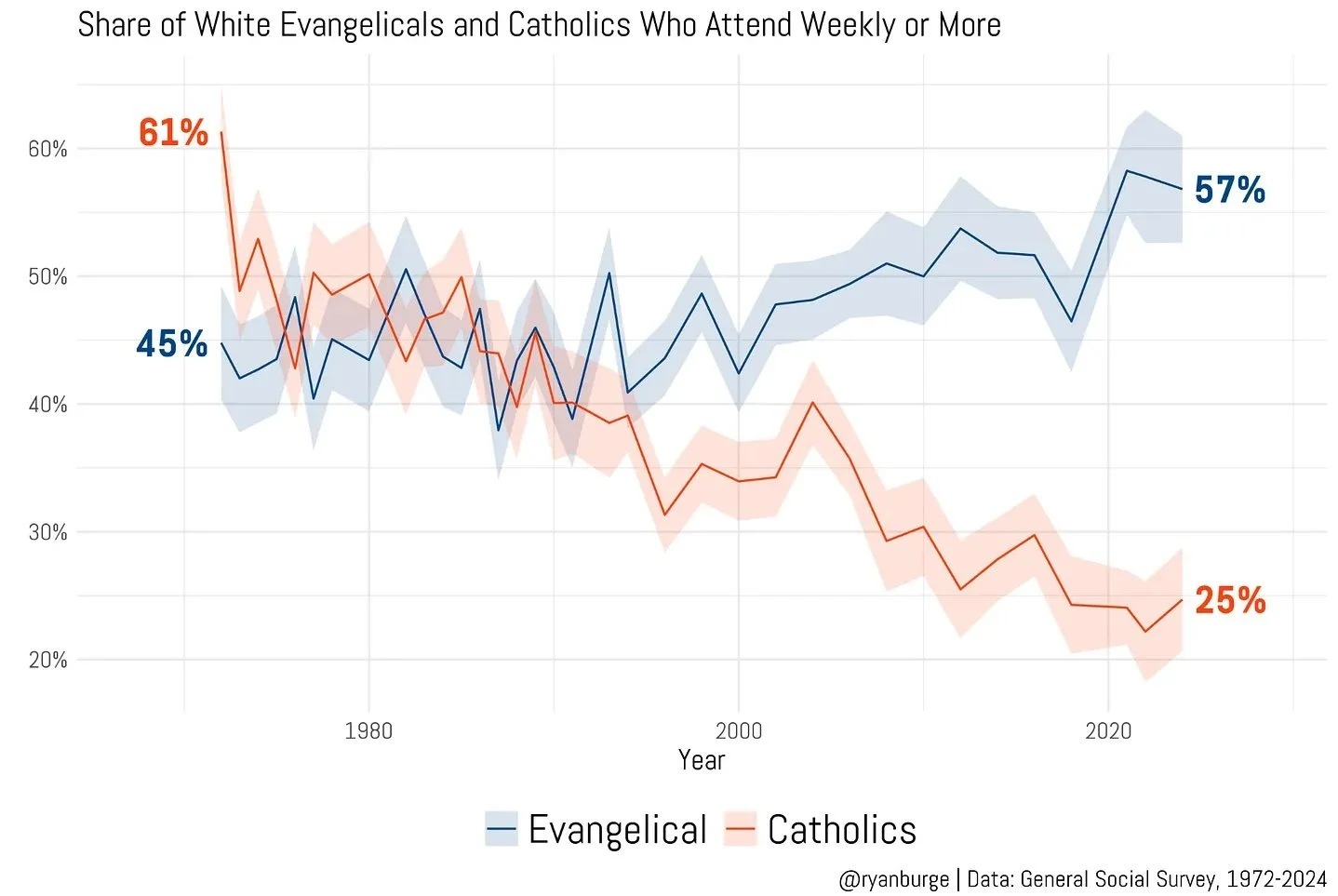
The first thing we need to establish is that the reply guys are kind of right in one way: The average white Catholic doesn’t go to church with nearly the same regularity as the average white evangelical.
Back in the halcyon days of the early 1970s, Catholics were more devout than evangelicals — and by a fair amount. About 60% of white Catholics were going to Mass every week in 1972 compared to only 45% of white evangelicals. That’s not a small difference. But it didn’t last long.
By 1980, the two lines had clearly crossed around 45%. But then the Catholic line continued to move downward while evangelical attendance rates held steady. By the late 1990s, evangelicals were more likely to be weekly attenders than their Catholic counterparts.
From there, the gap only widened. It was about ten percentage points by 2000 (45% vs. 35%), and the chasm has only increased in the last twenty years. By the 2010s, over half of white evangelicals went to church nearly every week compared to less than 30% of Catholics.
In the data from 2024, 57% of white evangelicals were weekly attenders compared to 25% of white Catholics. So not controlling for attendance gives us a much different sample when analyzing evangelicals and Catholics. Keep that in your back pocket for now.
You can read the rest of this post on Substack.
Ryan Burge is an assistant professor of political science at Eastern Illinois University, a pastor in the American Baptist Church and the co-founder and frequent contributor to Religion in Public, a forum for scholars of religion and politics to make their work accessible to a more general audience. His research focuses on the intersection of religiosity and political behavior, especially in the U.S. Follow him on X at @ryanburge.