
New Study Shows Christians Trust AI For Their Spiritual Growth
Move over, pastors. New research shows your counseling and pastoral care may no longer be needed. Congregations are increasingly turning to AI to deal with their spiritual questions and help regarding personal growth.
New research from Barna Group, in partnership with Gloo, reveals a somewhat contradictory picture: 1 in 3 adults now believes AI’s spiritual guidance is just as trustworthy as that of a pastor. Nonetheless, a majority of practicing Christians expressed concern about people losing their religious faith because of artificial intelligence.
“Christians say they trust AI with spiritual growth, and a meaningful share say its spiritual guidance is as trustworthy as a pastor's,” said Daniel Copeland, Barna's vice president of research. “Yet, large majorities are simultaneously concerned about AI misinterpreting scripture, replacing God, or undermining the role of spiritual leaders. The use case and the underlying fear are both present, and they're pointing in different directions.”
READ: Can Artificial Intelligence Predict — And Even Stop — Sin?
In spite of Christians increasingly relying upon AI as a spiritual tool, 65% expressed concern about it beginning to act as a substitute for God, while 72% were concerned about AI replacing the role of pastors or spiritual leaders.
The research comes after large language models, like ChatGPT, became widely accessible to the public in 2022. Since then, several Christian-based AI apps have been launched, aiming to provide spiritual guidance and theological answers.
LogosPath, marketed to Christian schools and churches, says it pulls its references from the NASB and the HCSB versions of the Bible, and “does not present all religions as equal or suggest faith is a personal preference. Salvation through Christ alone … is the foundation,” according to its website.
AskPillar.ai appears to be under development, but once launched, it promises to provide “private, Scripture-grounded guidance for faith, decisions, prayer, doubt, relationships, suffering, and the questions you would otherwise take to generic AI.”
Some come with disclaimers. Cross And Faith says it exists “to complement, not replace, pastoral care and human spiritual leadership,” and to “always verify AI responses with scripture and seek guidance from your spiritual community.”
Religion Unplugged decided to take this AI model for a spin — and discovered it must still be in beta. The question was one many believers dread answering: “Why does God let bad things happen to good people?”
The ai bot’s answer? A 404 error.
Source: Barna
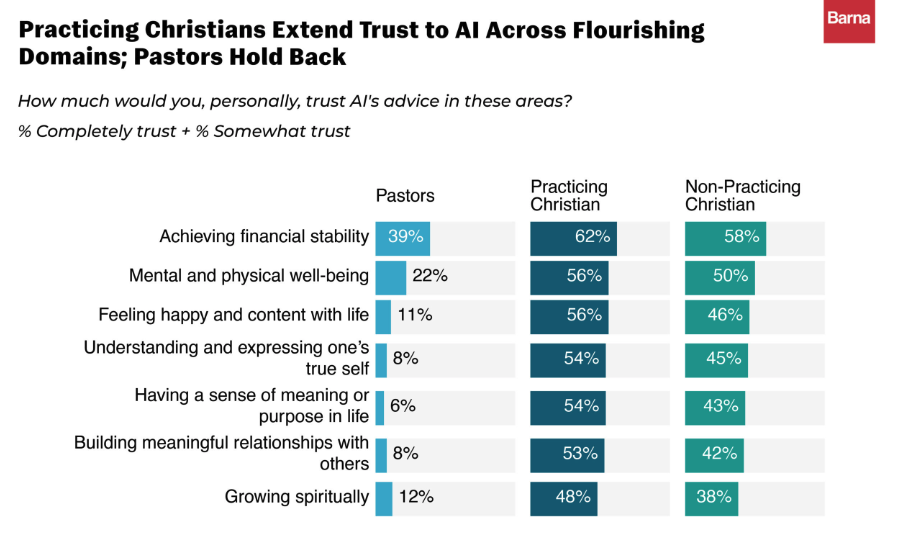
Despite such technical glitches, even practicing Christians report a “noteworthy openness” to letting AI into their personal lives, according to the new Barna study. Fifty-four percent of Christians surveyed would trust AI’s advice on having a sense of meaning or purpose, with nearly half (48%) saying they would trust its advice for growing spiritually.
Yet, the study found that trust has a ceiling: Nearly 3 in 4 Americans express concern that AI misinterprets Scripture — among Protestant pastors that figure rises to 94%.
It’s well known that many publicly available LLMs exhibit a “fawning” bias, meaning they tell users what they want to hear based on users’ implied viewpoints. Theoretically, this could mean LLMs may cherry-pick theological arguments that align with the users’ viewpoints rather than challenging their personal beliefs as a human offering spiritual guidance might. (This is dependent, of course, on which AI chatbot is being used, the user’s settings and the user’s previous conversations with the bots).
While regular church-goers might be chatting with AI from the comfort of their home, artificial intelligence is increasingly being integrated into the operations of their local churches.
Gloo, the tech company partnering with Barna to publish a series of research findings about Christians’ and churches’ use of artificial intelligence, is itself partially an AI company. It offers business solutions for churches and organizations to handle tasks such as email automation, membership management and generating social media content. (Barna says its research and findings are independent of fiscal sponsors, and it’s long been held in high regard for its data-driven insights into people of faith in America).
While this study focuses on protestant AI use, other denominations and religions are incorporating the new technology, too.
Some Jewish synagogues are turning to ShulCloud to handle scheduling and donation tracking or the online Sefaria library’s new AI assistant to explore torah translations or other sacred texts.
Muslims, meanwhile, are likely to use MuslimPro to track daily prayer times and get Quran-based answers to their questions. And many Catholics are turning to Magisterium AI for their theological and church doctrine questions.
Cassidy Grom is the managing editor of Religion Unplugged. Her award-winning reporting and digital design work have appeared in numerous publications.