
How White Christianity Shifted From New Deal Democrats To The GOP
(ANALYSIS) I don’t try to use this newsletter to just market my stuff to all you wonderful readers, but for those who don’t know — I published a book a couple of months ago called “The Vanishing Church,” which focuses on the role that politics has played in American religion over the last fifty years.
One of the central stories of that work is that white Christianity has become noticeably more conservative. That’s not just the case in white evangelicalism (which most people know about), but it’s also true among white Catholics. It has become increasingly the case that to be white and Christian is to support the Republican Party.
That simply wasn’t the case not too terribly long ago. As I’ve become accustomed to saying when talking about the book: “It’s not always been this way.” For younger adults, they just don’t know a religious world that is not dominated by the Religious Right. However, if you take a peek at the partisan composition of white Christians as far back as we can (1972), you see a much more complete portrait.
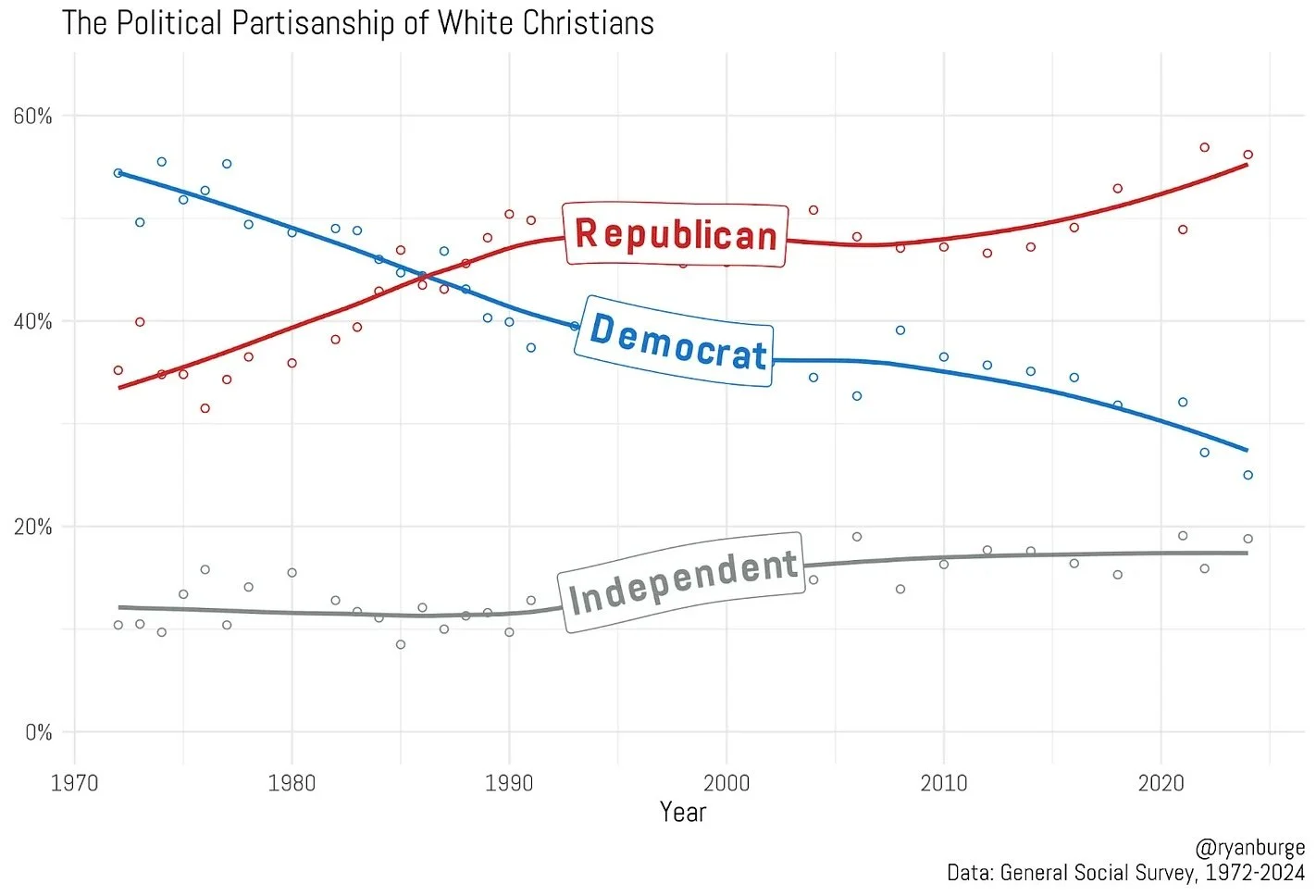
In 1972, a clear majority of white Christians (regardless of their denominational affiliation) were Democrats. That, by itself, is downright shocking to many audiences when I show a version of this graph. It is important to note here that these weren’t the types of Democrats that we know in modern political discourse. These were Southern Democrats (often called Dixiecrats) who felt a sense of alliance to the party because of FDR’s New Deal policies but held incredibly regressive views on racial issues. However, I do want to point out that by 1980, the share of white Christians who were Democrats had dropped below 50%.
By the late 1980s, white Christianity was essentially perfectly politically divided between Democrats and Republicans, but that didn’t last very long. As we moved into the 2000s, the Republican ascendance was already visible — hovering around 50%. There was a bit of a lull in the trend lines through 2010 or so, but from that point forward, the two trajectories headed in opposite directions. In the last few years, white Christians have become more politically unified around the GOP.
From a social science standpoint, there are only two ways for this to really happen. One is called generational replacement. Remember those Dixiecrats I mentioned above? Well, if they were dying off in large numbers in the 1980s and 1990s and their children were coming into adulthood as more Republican-leaning, that would easily explain the overall shift.
But there’s another possibility — white Christians simply began to change their minds about politics as each year passed. Those Dixiecrats realized that they could no longer support the Democratic Party, were won over by politicians like Ronald Reagan, and then started voting for the GOP.
Teasing that apart is going to be the point of this post: was it generational replacement that made white Christianity so Republican? Or was it just millions of Protestants and Catholics changing their minds?
You can read the rest of this post on Substack.
Ryan Burge is an assistant professor of political science at Eastern Illinois University, a pastor in the American Baptist Church and the co-founder and frequent contributor to Religion in Public, a forum for scholars of religion and politics to make their work accessible to a more general audience. His research focuses on the intersection of religiosity and political behavior, especially in the U.S. Follow him on X at @ryanburge.