
Crossroads Podcast: When A Religion Story Turns Into A Botched News Brief
One of the saddest, or most frustrating, things an editor can say to a reporter is this: “We don’t have much room in the paper today, so turn that story you’re working on into a brief.”
What’s a “brief”? The News Manual website offers this definition for the term and for a related page-layout feature:
news in brief (NIB): Also punctuated as news-in-brief, a collection of short stories or a single story presented in one or two short paragraphs. In print or on a web page, NIBs may appear in a small box or a specific column at the side or bottom of a page. …
While most “Crossroads” podcasts focus on religion angles in major news stories, this week’s episode focused, you guessed it, on a short news “brief.” The problem is that we are talking about a brief about a Lutheran Church-Missouri Synod story that, if the details had been accurate, was worthy of an A1 feature.
Unfortunately, a crucial fact in this “brief” published by the St. Louis Post-Dispatch was totally wrong or, at the very least, fatally incomplete.
The result was a one-paragraph train wreck.
This led to a discussion in which host Todd Wilken, an LC-MS pastor, and I discussed strategies that leaders of religious organizations should use when responding to news disasters of this kind.
I also offered some tips on how religious leaders can, in advance, work to prevent errors of this kind — by making sure that editors and reporters have solid information about how to get in contact, even on quick deadlines, with articulate clergy, academic experts, press aides, etc.
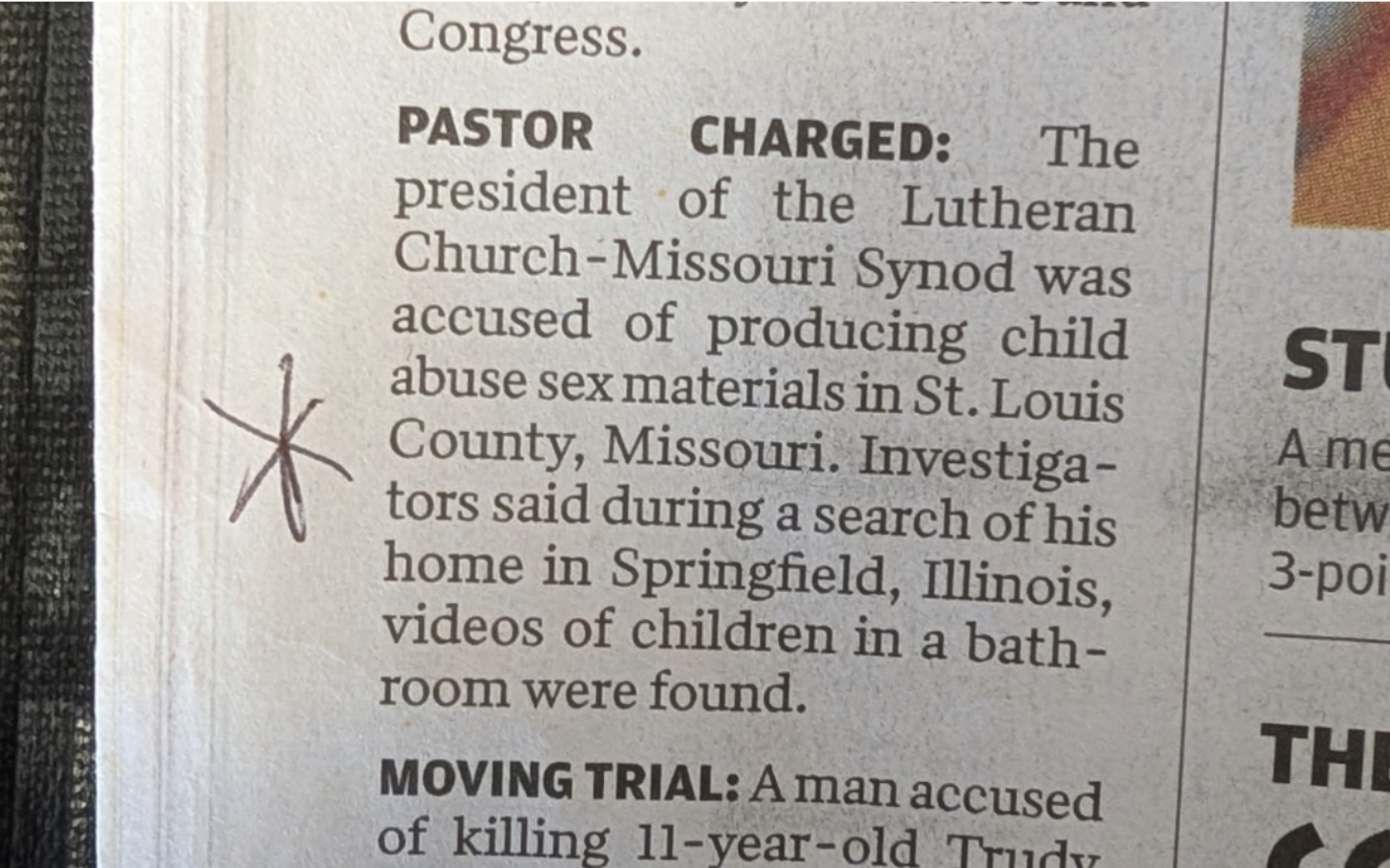
Image via the St. Louis Post-Dispatch
First, here is the news “brief” at the center of this discussion:
PASTOR CHARGED — The president of the Lutheran Church-Missouri Synod was accused of producing child abuse sex materials in St. Louis County, Missouri. Investigators said during a search of his home in Springfield, Illinois, videos of children in a bathroom were found.
Now, it helps to know that the LC-MS is, with nearly 2 million baptized members, is America’s second largest Lutheran denomination. It is also crucial, in this case study, that this large denomination is based in St. Louis.
In other words, this scandal is both a local and national story. Think, “location, location, location.”
The problem, for Post-Dispatch editors, is that there have been no charges made against the denomination’s president, Pastor Matthew C. Harrison. When the material — probably from a police document — was reduced to a brief, the job title of the person accused was chopped short in such a way that the newspaper, to be blunt, printed a story about the wrong man.
Thus, the denomination quickly released this online statement to leaders at the Post-Dispatch, other news organizations and the people in its own congregations.
St. Louis Post-Dispatch readers: The Sunday paper (Feb. 8, 2026) incorrectly reported that The Lutheran Church—Missouri Synod (LCMS) president was accused of producing child sex abuse materials. This is FALSE. The only accusations continue to be those previously reported regarding LCMS Central Illinois District President Michael Mohr, who was arrested and accused. We have reached out to the Post-Dispatch to get this corrected.
Obviously, the the leader of the nearby “Central Illinois District” is not the president of the entire LC-MS denomination. This is the equivalent of confusing a nearby member of Congress with the president of the United States, or confusing a regional Catholic bishop with the pope. It’s a major-league error.
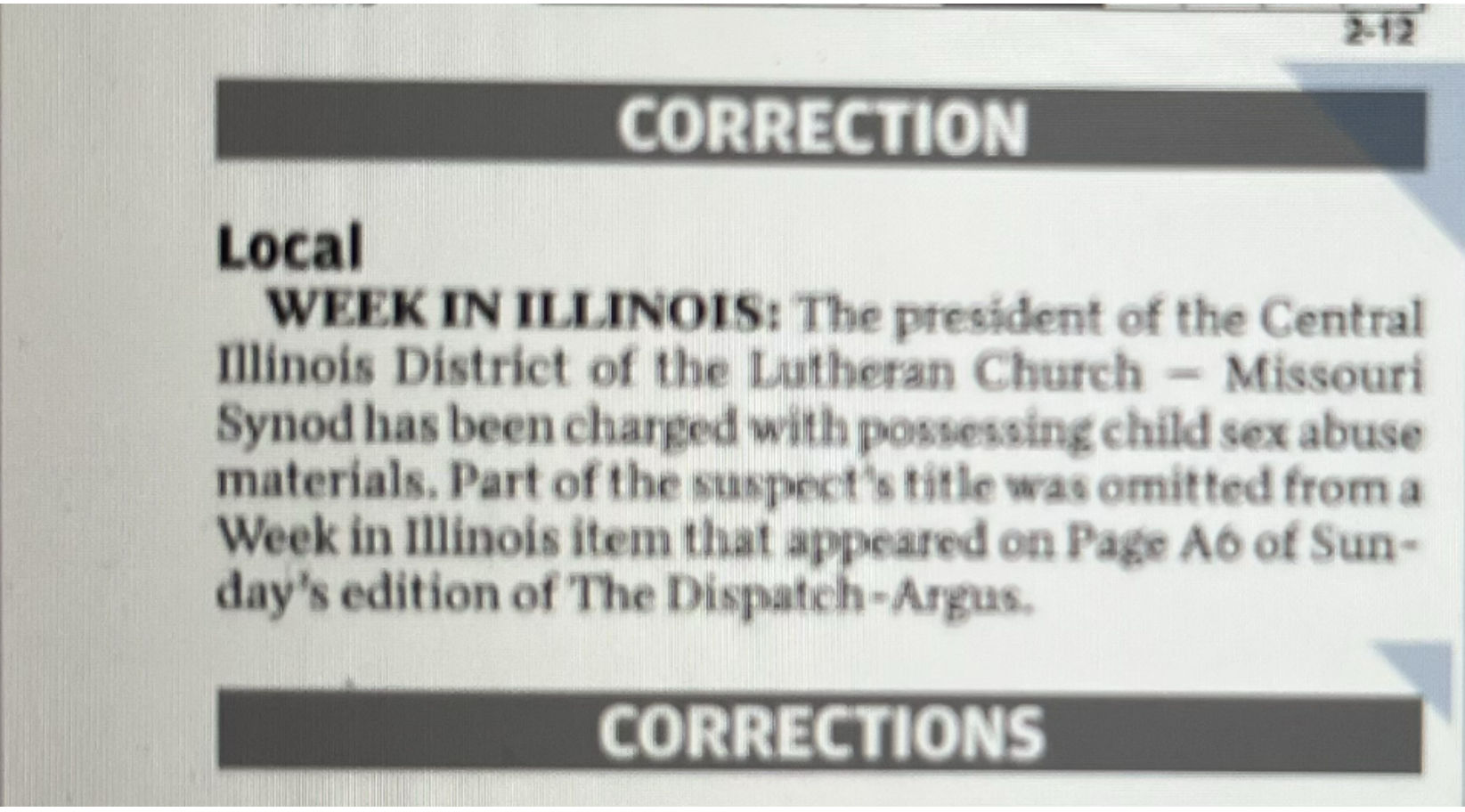
Image via the St. Louis Post-Dispatch
How did this happen?
So far, the newspaper has run a correction stating:
WEEK IN ILLINOIS: The president of the Central Illinois District of the Lutheran Church-Missouri Synod has been charged with possessing child sex abuse materials. Part of the suspect’s title was omitted from a Week in Illinois item that appeared on Page A6 of Sunday’s edition of The Dispatch-Argus.
That’s a very mild statement about the error, but let’s move on.
Lutherans in pulpits and pews have every right to ask: How in God’s name did this happen? Is this a classic case of media bias?
When I heard about this amazing error, I assumed that we were talking about a page-one news report or a prominent story in the newspaper’s state-and-local news section. After all, we are talking about — in the contents of the brief, as it was published — a felony sex crime accusation against the leader of a major Christian denomination that is based in St. Louis.
That’s a big story, not “brief” material.
I think it’s safe to assume that this item was written, in a rush, by an entry-level reporter or even an intern. In other words, the person who wrote this item, and the editor who approved it, did not know the ABCs of American religion at the local, regional and national level.
Is it possible that this “brief” was produced, in this age of cost-cutting, by an AI program? I have my doubts about that. In my experience, AI programs tend to be rather accurate when handling specific names and titles (search engines love those kinds of details). Note that the name of the accused clergyman is totally missing, even in the correction!
One thing is certain: This “brief” was not written by an experienced religion reporter. Does the Post-Dispatch even have a religion-beat professional? It would appear not. An AI search on this topic found the names of several reporters — all in the past.
Obviously, religion is a complex subject and anyone who has studied national and global news trends in recent decades knows that religion news overlaps with all kinds of important topics in the “real” news — sports, the arts, business, education and, yes, POLITICS.
Back in 1981, the legendary Associated Press religion-beat reporter George Cornell put it this way in an interview for my graduate-school project at the University of Illinois in Urbana-Champaign:
“You know, usually, where people put their time and money, that's where their interests are," Cornell said. "Newspapers give a great deal of space to professional sports ... [Americans] put into the local and national churches much greater amounts of money than they do into professional sports. And that money is their work. That's them. That's a projection of their own lives. "They are putting much more time and money into religion than they are into sports-and sports are getting the vast displays on television and in the newspapers. Whole sections of the newspaper. ... Newspapers' attention and space are supposed to be geared to people's interest. Right?”
OK, so the Post-Dispatch no longer has a religion-beat scribe.
What now? Yes, I have some thoughts on that subject.
— At the very least, newsroom managers should select a specific professional — a copy editor, perhaps — to serve as the in-house expert on religion news, someone who, at the very least, manages an up-to-date computer file containing local religion facts, names, email addresses, telephone numbers, URLs for relevant websites, etc. Local religious leaders need to know how to contact this journalist.
By the way, there are organizations, such as the Poynter Institute and The Media Project (the publisher of Religion Unplugged) that offer continuing-education seminars and events about religion-news basics.
— Religious organizations need to grasp the importance of selecting several “experts” from their ranks — clergy, academics, laypeople — who are willing (even on short notice, with deadlines approaching) to help journalists answer basic questions and get essential facts right. This includes knowing how to respond to accusations that, in the past, most religious leaders simply hoped would fade into the shadows. Newsroom leaders need accurate contact information about who to contact.
— When important errors occur, I believe that it isn’t enough to send editors an email or post an item online. That isn’t how serious leaders — in sports, business, politics and hot-button social causes — handle these things. They ring personal cell-phone numbers, over and over. They show up at the front desk of the newsroom. They want to discuss the error over coffee — right now. Yes, they make it clear that someone is going to stand in the newsroom until an editor is willing to talk.
— Religious leaders also need to offer praise when they see accurate, balanced news coverage of important topics and events in religion news — local, regional or national. This is especially important when this coverage is in their own backyard, including news about their own flock. Serious leaders — in sports, business, politics and hot-button social causes — do things like this on a regular basis and, trust me, editors notice.
There is much more information in the podcast! Please give it a listen and send the URL to editors and religious leaders that you know. Some readers may even want to “gift” a paid Relevant Sheep subscription to editors and religious leaders who need one, whether they know it or not.
Enjoy the podcast and, please, pass it along to others.