
Crossroads Podcast: Why This Heisman Trophy Winner’s Faith Isn’t News
A recent New York Times feature noted that quarterback Fernando Mendoza, before helping change University of Indiana football history, excelled at Belen Jesuit, an all-boys Catholic school in Miami, and then Miami Columbus High, another all-boys Catholic school. Oh, and his mother was a star athlete at Lourdes Academy, an all-girls Catholic school.
It’s possible that his strong Catholic background had something to do with the opening of that story: “Fernando Mendoza, Heisman winner, started his football career as QB4. Look at him now.” This piece served as the hook for this week’s “Crossroads” podcast. Here’s the glowing Times lede:
Fernando Mendoza was destined to make tears tumble down cheeks. After he posed behind the most prestigious individual award in college football and grabbed hold of the Heisman Trophy with each hand and flashed his wide grin, the Indiana quarterback delivered another of his patented, impassioned speeches filled with authenticity, love and, above all else, humility.
It was not that surprising that Mendoza began his Heisman acceptance remarks the same way he starts almost every post-game interview: “First, I want to thank God for giving me an opportunity that once felt a world away.”
It’s easy to find — in Catholic and conservative publications — commentary about the quarterback’s faith from Dominican Father Patrick Hyde, pastor of the St. Paul Catholic Center next to the Indiana campus. That’s where Mendoza rarely misses Mass and his enthusiasm has led to a sharp uptick in students taking part in activities at the center.
That’s the same parish where Mendoza showed up on Christmas Eve — with his Heisman Trophy statue — to share his excitement with the priests who serve as his mentors and who often travel to Hoosier games. The quarterback’s pre-game rituals include, without fail, saying the Rosary and listening to recordings of the Mass.
The Catholic faith shared by Mendoza and others around him certainly has something to do with another pre-game ritual in recent weeks, which drew attention from the Indianapolis Star (“Indiana football end zone sprinkled with holy water before Peach Bowl”). That report opens like this:
Before Indiana football took on Oregon in the Peach Bowl, led by their Catholic quarterback Fernando Mendoza whose priest has been traveling with the team, IU’s end zone at Mercedes-Benz Stadium was sprinkled with two small bottles of holy water.
It’s the third time in Indiana’s championship run that IU grad and professional photographer Garrett Ewald has poured holy water on the team’s end zone. It started at IU’s win over Ohio State in the Big Ten Football Championship, then at the Hoosiers’ victory over Alabama in the Rose Bowl. …
When photographer Garrett Ewald flew in from New York for the Big Ten Football championship at Lucas Oil Stadium, he had no plans of pouring an 8-ounce bottle of holy water onto the Indiana end zone, water pumped from a well at a Catholic retreat center in Bloomington where the liquid has long been touted as having spiritual and healing properties.
There are plenty of other faith-packed details in that story — including the fact that Ewald plans to have holy water on hand when Mendoza and the Hoosiers take the field at Hard Rock Stadium in Miami for the college national championship game.
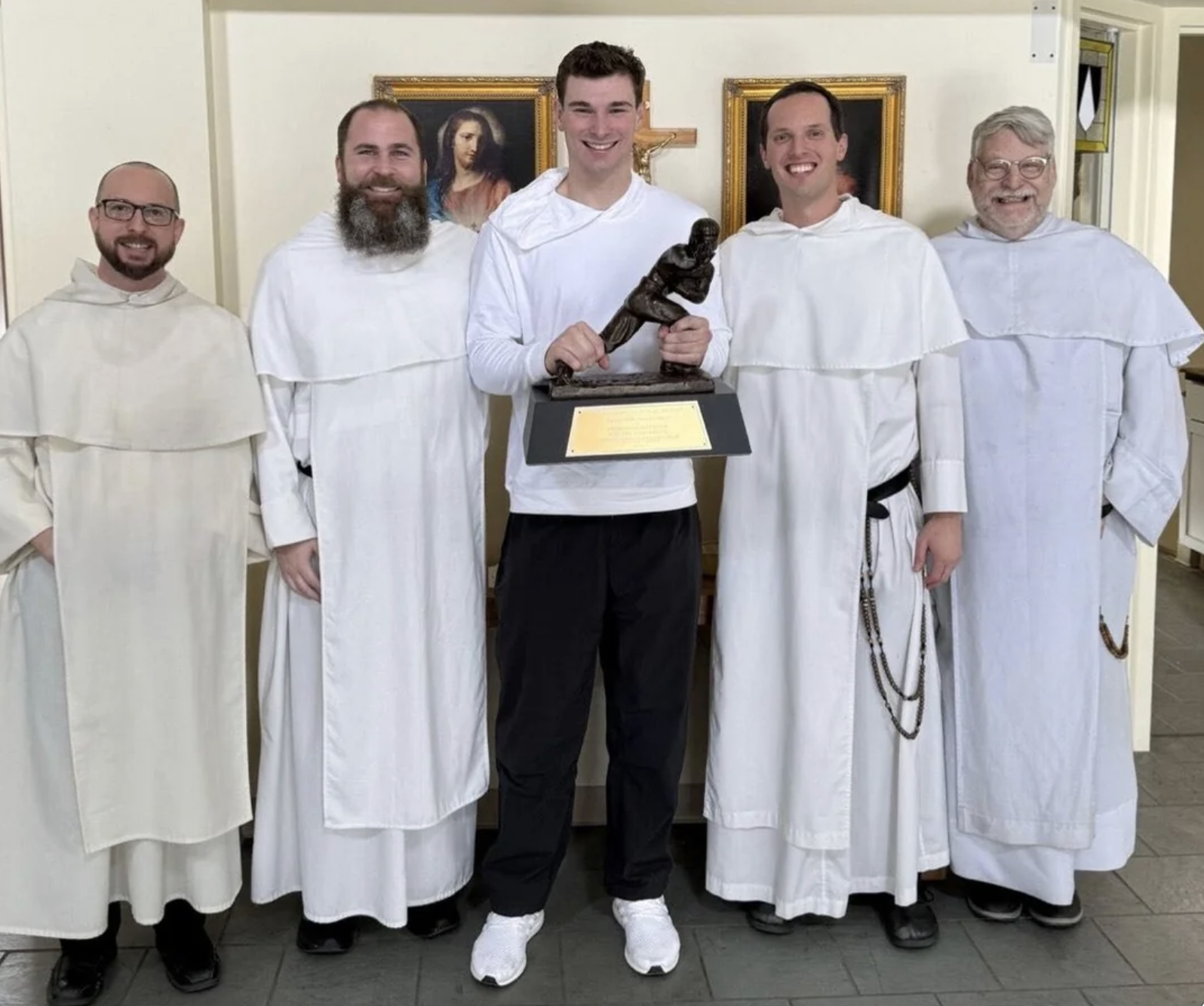
Fernando Mendoza (center) brought the Heisman Trophy by St. Paul’s Catholic Center (Photo courtesy of X /Father Patrick Hyde)
The question at the heart of this week’s podcast was a familiar one for readers who wonder why elite newsrooms all but ignoring the role that religion plays in many crucial parts of American life (other than partisan politics).
Why not ask questions about the role this young man’s faith plays in his extraordinary life, including his accomplishments in sports and academia? Why not talk to his priests? Why not probe the role of faith in his close-knit Catholic family?
Read the Times lede again, including the final cadences about the Heisman speech in which “the Indiana quarterback delivered another of his patented, impassioned speeches filled with authenticity, love and, above all else, humility.”
Did editors consider whether faith played a strong role in making this rather out-of-nowhere quarterback the humble player of the year?
At one point in the feature, an observer suggests that Mendoza’s greatness is simply “in his DNA.”
Why not consider that it is also linked to his head, his heart and his soul? Why not cover that angle of the story, as well?
In the podcast, I argued that the rise of Indiana’s team is the most powerful college football story of the year. However, there is another story of equal importance and, because of Mendoza, these stories are connected.
The bottom line: The development of “Name, Image, Likeness (NIL)” policies have poured millions and millions of dollars into the recruiting process for top college football players. In a few cases, with quarterbacks, it has given college stars stacks of money as high as young NFL quarterbacks.
Players with the highest salaries have, so far, been young men who were already national stars and used the doors opened by NIL to jump from one elite school to another — such as Carson Beck accepting between $3-4 million to move from the University of Georgia to Miami University.
In the national championship match, Beck will face Mendoza. Oh, Beck is also an outspoken Christian, as well.
The University of Miami reached the final game despite the heroics of a quarterback who, with Mendoza, symbolizes the other side of the NIL story. In this case, we are talking about quarterbacks who were promoted from schools with less gridiron clout (Mendoza planned to go to Yale, before heading to the University of California, Berkeley) to players from schools that were completely off the major-college sports map.
In this case, we are talking about Trinidad Chambliss, who led the University of Mississippi to within a few plays of the final game. Chambliss came to Oxford, Mississippi, from Ferris State University (in Big Rapids, Michigan), where he led a small-college, Division II team. He was supposed to be a back-up at Ole Miss, but injuries shoved him into the spotlight.
Simply stated, Chambliss shocked the nation. Is there a religion angle here?
Well, if reporters wanted to write about this remarkable young man they needed to talk to his mother. On game days, she was the woman meeting with her son for their traditional moment of devotions and prayers. What about this quarterback’s unusual name? A Yahoo!Sports report noted:
Trinidad Chambliss’ parents are Trent and Cheryl Chambliss. His father, Trent, is an assistant principal at Wyoming High School, who also coached Trinidad in youth football. When Chreyl became pregnant with Trinidad, her second child, she and Trent agreed that if it was a girl she would pick the name, and Trent if it was a boy. Although Trinidad was named after Puerto Rican boxer Felix Trinidad, Cheryl liked the name because of its roots in faith.
Roots in faith? An ESPN story from October, 2025, noted:
Cheryl Chambliss, whose late father, Donald Griffioen, was a longtime pastor and helped open churches around the country, agreed to her husband’s idea with one condition: She would name a baby girl Trinity, after the Christian doctrine that says God exists as three separate persons -- the Father, Son and Holy Spirit.
“We are a faith-based family,” Cheryl Chambliss said. “Trinidad was just fine with me because it translates to Trinity, and so that’s very important. When people ask me, he is named after the Trinity.”
In the end, there was really no way for journalists to avoid the role of faith in some of this year’s most amazing college football stories, especially in the playoffs.
Yet, mainstream journalists — as opposed to those in religious and conservative media — looked the other way, more often than not.
Why do that?
Enjoy the podcast and, please, pass it along to others.