
Crossroads Podcast: Apparently, More Americans Are Attending Church
When it comes to Big Questions in life and death, the sprawling Religious Landscape Study from the Pew Research Center continues to yield glimpses inside complicated faith issues.
For example, 55% of U.S. adults said that when trying to determine if something is right or wrong they believe that the answer may depends on the situation. Meanwhile, only 44% (keep that number in mind) said they believe there are absolute, unchanging and transcendent standards for truth and error.
In a flashback to the early 1990s bestseller “Culture Wars: The Struggle to Define America,” this leads me to ask: “What would James Davison Hunter say?”
This culture wars theme surfaced during the new “Crossroads” podcast, as host Todd Wilken and I discussed a must-read Religion News Service report: “What church do you attend? Maybe more than one, survey finds.”
Apparently, in the post-pandemic era, more and more Americans are conducting their spiritual searches in multiple sets of pews or, perhaps, attending one church in person and another via digital streaming. It’s a seeker-friendly, mix-and-match approach.
Here is some crucial background from veteran religion-beat scribe Adelle M. Banks.
Researchers for the multiyear Hartford Institute for Religion Research study found that 46% of some 24,000 churchgoers responding to their survey reported active engagement with more than one church.
Engaging in other congregations did not prevent these churchgoers from giving and volunteering at the primary church in their lives, said Scott Thumma, principal investigator of the Exploring the Pandemic Impact on Congregations study. …
Of the tens of thousands surveyed, half were evangelical Protestant (50%), one-third were Catholic or Orthodox (32%), and 18% were mainline Protestant. About 7 in 10 worship at churches with 250 or more attendees (71%), the majority attend churches that offer online services (85%), and one-fifth are part of multiracial congregations (19%).
Project researchers, who have previously surveyed congregational leaders, said the most recent research, released Monday (June 16), looks at the behaviors and attitudes of those most likely to be attending church.
In previous generations, researchers would have assumed that many of these multi-church believers are “church shopping” as they considered leaving one congregation, or even a denomination, to join another.
However, Thumma said participating in “multiple services regularly did not detract from one’s commitment to one’s home church.” Instead, it “was as if these highly committed religious persons wanted/needed more spiritual sustenance than their one church provided and sought out this nourishment elsewhere while remaining as involved in their home church.”
Banks noted that the introduction to the 36-page report, “This Place Means Everything to Me,” claimed that: “From the perspective of the 24,000 church attenders we surveyed, the picture that emerges is largely positive.”
For decades, researchers have assumed that the most active members of religious congregations are the most dedicated, fitting the familiar “80-20” equation that says 20% of the people in an organization do 80% of the giving and volunteer work.
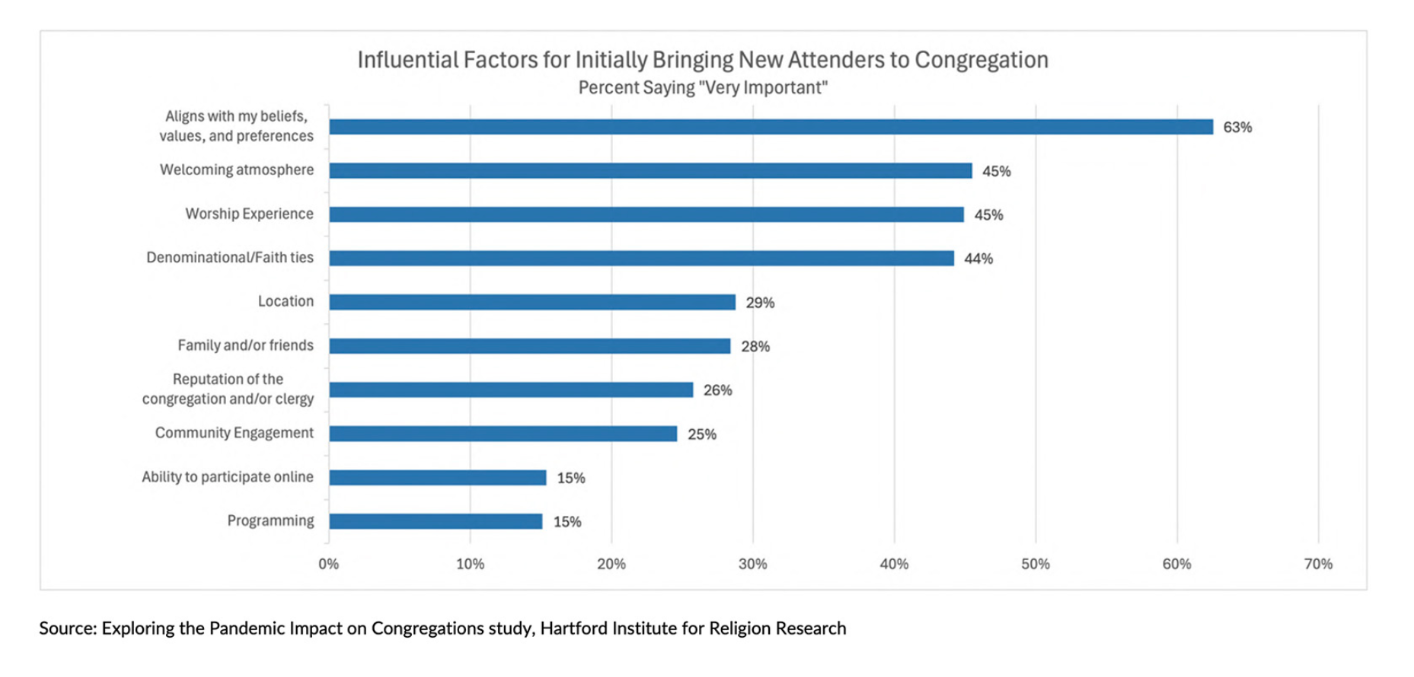
Meanwhile, what were the factors that steered people in this survey to consider attending — to one degree or another — a congregation?
The most popular response given, at 63%, was that the congregation: “Aligns with my beliefs, values and preferences.”
Journalists, I noted, will need to ask researchers if “beliefs” are the same thing as “doctrines,” as in clear statements of beliefs and practices what a faith insists are absolutely true. Then again, some researchers now argue that when people say they want churches that align with their “beliefs, values and preferences,” they are talking about matters of politics and public life.
In that same chart, 45% percent of the survey participants stressed that they were seeking a “welcoming atmosphere” or what they considered an excellent “worship experience.”
What about people who said they were seeking a congregation because of their own “denominational” or “faith” ties that bind?
This is crucial. Only 44% choose that answer — another sign of America’s move into an age in which the fastest growing form of Protestantism is nondenominational. For more information, see this essay from chartmaster Ryan Burge: “The rise of nondenominational churches, a big news trend that's really hard to cover.” And see this GetReligion post from religion-beat legend Richard Ostling: “Nondenominational era 2.0 — What are America's biggest local Protestant churches?”
In the podcast, I noted that these number, if anything, show the puzzle-like nature of many trends that fascinate reporters and readers interested in religion news.
My biggest question remains: Why are some churches growing, while others are declining, often in the same denominations or traditions? For example: Why would one Catholic parish thrive, while another — in the same city — is in rapid decline?
Is that a “political” issue, with Republicans in one kind of pew and Democrats in another? Or, is it true — as some claim — that most growing congregations offer worship services and programs that affirm specific, traditional approaches to doctrine, faith and morality? In other words, the belief in absolute truths.
Then again, church-shoppers may be looking for the best “products” available in their ZIP codes. What if parents are seeking spectacular preaching, exciting music and strong programs for young people? If “denominational” ties are secondary, it’s possible that they could switch between several congregations while seeking what they want. Would it matter if these congregations affirmed slightly different, or even clashing, approaches to doctrine?
Thinking through these issues reminded me of an anecdote about a clash between leaders of progressive Anglican flocks in Europe and North America and their counterparts in the doctrinally conservative churches in Africa, Asia and elsewhere.
This encounter was described by the Rt. Rev. C. FitzSimons Allison, a retired Episcopal Church bishop who is now part of the Anglican Church in North America — a body recognized as valid by many Global South bishops, but not by Canterbury or leaders in the U.S. Episcopal Church.
Needless to say, [Allison] has witnessed more than his share of Anglican debates about the future of the Anglican Communion, a communion in which national churches are in rapid decline in rich, powerful lands like the United States, Canada and England, but exploding with growth in the Global South.
During one global meeting, Allison watched a symbolic collision between these two worlds. Bishops from North America and their allies were talking about moving forward, making doctrinal changes in order to embrace the cultural revolutions in their lands. They were sure that Anglicans needed to evolve, or die.
Finally, a frustrated African bishop asked three questions: “Where are your children? Where are your converts? Where are your priests?”
What can journalists do to study and describe these crucial facts of life in growing churches, as opposed to those that are in decline? Does doctrine play a role, or are people looking for the right brand of politics?
Clearly, many Americans who are seeking churches — multiple churches, even — have different goals, needs and motivations.
Is this complicated? Very much so. Are there important news stories inside this maze? Yes, there are.
Enjoy the podcast and, please, pass it along to others.