
‘We Don’t Feel Safe’: West Bank Christian Village Faces Escalating Attacks
TAYBEH, West Bank — On hills just east of Ramallah is the village of Taybeh. Its population has fallen to 1,200 today, while more than 80% of the town's sons and daughters now live abroad.
What sets Taybeh apart from every other village in the West Bank is that all of its residents remain Christian — Greek Orthodox, Greek Catholic and Latin — making it a symbol of a presence that is fading but refusing to disappear.
Taybeh is not simply one small Palestinian village among hundreds. It is the last living witness to a Christian civilization rooted in this land since the dawn of Christianity itself. Its Canaanite origins stretch back thousands of years. Through every era that has passed over this land: Roman, Byzantine, Islamic, Crusader and Ottoman, the town has kept a Christian pulse that has never broken.

Real People. Real Reporting. Donate to Religion Unplugged now through August 17, and your gift will be doubled.
The Gospel of John mentions a village called "Ephraim" as the refuge Jesus withdrew to before entering Jerusalem. Many researchers and church historians have concluded this village is Taybeh itself, a claim affirmed by Father Bashar Fawadleh, pastor of the Church of Christ the Redeemer in the town.
“Jesus fled to Ephraim to escape threats to his life, but today we don’t feel this town is a safe refuge because of the ongoing attacks,” he said.
In the fifth century, the Church of St. George was built on the town’s eastern edge and remains one of the oldest and richest churches in Palestine’s history. In 1596, the town appeared in Ottoman tax records under the name “Taybat al-Asem,” home to twenty-three Christian families at the time.
A joint Palestinian-French archaeological mission in 2009 uncovered a tomb in the church courtyard containing hundreds of artifacts from the Byzantine and medieval periods, confirming the site's continuous use across centuries.
Crusaders added a second church beside it in the twelfth century and fortified the town with a castle known as St. Elias. But it fell to Saladin following the Battle of Hattin in 1187, after which it took the name “Taybeh,” from the Arabic word for “good” or “kind,” in reference to the goodness of its people.
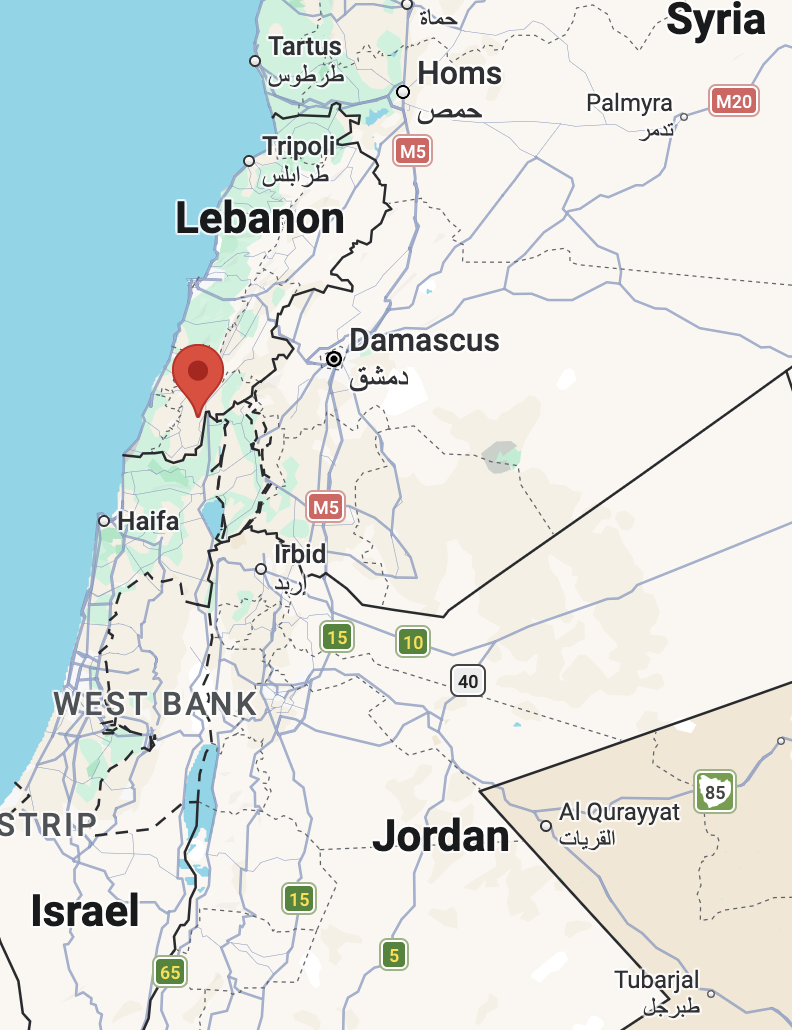
Taybeh is indicated with red marker. (Google Maps)
Christians made up nearly 20% of Palestine's population in 1948; today that figure has fallen below 2%, the result of years of displacement, pressure and forced migration. In the West Bank alone, the Christian population numbers no more than 50,000 to 75,000.
Against this backdrop, Taybeh carries an exceptional weight: It is the only village where every resident remains Christian, a mirror reflecting Palestine's historical image before it began to be erased.
‘Almost daily’ attacks
The attacks on Taybeh did not emerge from nothing. Since Oct. 7, 2023, the town has seen a sharp escalation in violence, which Mayor Suleiman Khoury describes as having become “almost daily.”
Between July of last year and early this year, more than eight vehicles were burned, according to Fawadleh, who said “the attacks are carried out by extremist settler groups — including those known as “hilltop youth” under the protection and support of official Israeli bodies.”
Agricultural land has been vandalized and seized, vineyards damaged, beehives stolen or destroyed, and farmers denied access to their fields during olive harvest season. Over the years, occupation authorities have confiscated 173 hectares of the town’s land.
In early July 2025, the attacks reached a peak when a fire was set at the archaeological site attached to the 15th-century Byzantine Church of St. George. Residents described it as among the most serious attacks the town has witnessed.
The American ambassador visited afterward and called for accountability, while U.S. Secretary of State Huckabee said following his own visit: “Desecrating a church, mosque or synagogue is a crime against humanity and against God.”
Racist graffiti and inciting slogans explicitly targeting Christians have also been documented on the town's walls.
“The repeated attacks are carried out by extremist settler groups under the protection and support of official Israeli bodies,” Fawadleh said. “Attacks in Taybeh have become almost daily since new settlement outposts were established around the town.”
Khoury described a town under siege: “Since Oct. 7 until today, the attacks haven’t stopped. Just last night, attacks hit a wood company and other buildings inside the town. Farmers can no longer reach their land.”
Civil defense teams, he added, struggle to reach fire sites, forcing residents to extinguish blazes with whatever simple means they have.
A farmer’s severed bond with his land
The toll extends well beyond visible material losses. When a farmer is denied access to his land, it is not only ownership that is violated; he is stripped of a livelihood passed down through generations.
The attacks have also reached economic institutions: a concrete factory was targeted and its workers barred from operating. A climate of insecurity has kept Christian tourists and pilgrims away, damaging a commercial sector that once thrived during holiday seasons.
Hanna Dahleh, a 68-year-old farmer, recalled a land that once fed his household and preserved its dignity.
“In my youth, the path to the land was as clear as the palm of my hand. You'd go in the morning, plant, watch and count the days with a farmer's patience,” Dahleh said.
Repeated attacks turned the field from a season of labor into a site of confrontation.
“The settlers didn't come once and leave. They entered our lives the way dust settles on a shoe — you don't notice it at first, but it accumulates until you feel it with every step,” Dahleh added.
Today, he summed up a generation's loss in two words: “My land went silent. Not because the land died, but because reaching it became forbidden. The field is close in distance but as far as the end of the earth.”
“A farmer doesn't just live off the land, he lives with it,” Dahleh added. “When you deny him access, you're not confiscating a harvest. You're confiscating an entire relationship between a person and their land.”
The social fabric has frayed as well. Religious feast days once marked by joy are now met with uneasy anxiety.
Reham Fawadleh, 38, who gave birth to her three children here, described leaving her home in search of safety for her family. Sudden checkpoints have trapped her children, students at a Catholic school in Ramallah have been unable to reach their classrooms. One night, settlers stoned the family’s home, planting a fear in the children that Reham says will never leave them.
She now lives in Ramallah out of necessity, but returns to Taybeh once a month to check on the house and keep it from appearing abandoned, fearing settler militias would seize it otherwise.
“I don’t hide my fear from my children because they see it in my eyes,” the mother said. “But I teach them one thing: Fear is one thing, and surrender is another. We are afraid — and we are staying.”
An accelerating exodus
The migration figures need little elaboration. Fawadleh said Taybeh has lost roughly fifteen families who left the town since 2023 alone, in addition to dozens of young people who have emigrated abroad, particularly to the United States and Spain.
Khoury laid out the pattern plainly: “There’s internal migration and external migration. The worker who lost his job, the farmer who can no longer reach his land, the employee facing difficult living conditions — all of them are now thinking about leaving.”
He estimated that roughly 80% of the town's sons and daughters now live outside Palestine, with the current resident population just over 2,000 according to the last local election data, down from roughly 3,000 in earlier periods.
Set against the broader picture, Christians have fallen from over 20% of the area’s population in 1948 to below 2% today.
“Christians aren’t a minority, but they've become few in number. The Christian presence is at risk, as is the Palestinian presence more broadly,” Fawadleh said. “But because we are so few, we sometimes feel more exposed to being targeted, and that there are those who want to silence the Palestinian Christian voice capable of telling the truth to the world.”
‘We will remain’
In this context, Taybeh becomes more than a village; it becomes a final line. If it succumbed to this pressure and began losing its residents one by one, the cohesive Christian presence in the West Bank will be irreversible.
The church has taken on this responsibility, supporting residents through employment opportunities and assistance with education and health care, while maintaining contact with the Latin Patriarchate in Jerusalem and foreign consulates in search of real protection.
Still, Fawadleh insisted: “What is happening remains insufficient. There is a need for more effective political and diplomatic action.”
“We live in a state of fear, panic, sleeplessness and an inability to live a normal life,” he added. “Although international pressure has succeeded in curbing some attacks, what's happening still isn't enough”.
In Taybeh, the ringing of church bells mixes with the scent of olives and a quiet fear that goes unspoken. The town holds fast to its old alleys and Canaanite stones, to a Byzantine church more than 15 centuries old, and to farmers who have refused to hand over the keys to their land.
“As Christ taught us, we are the salt of the earth and the light of the world, and we must preserve that salt and keep that light burning,” Fawadleh said. “We must endure, because our existence is a living testimony to the history of this land and its message.”
This story was produced in collaboration with Egab.
Aseel Mafarjeh is a West Bank-focused journalist, focusing on stories that speak of the challenges and creativity of youth in Palestine.